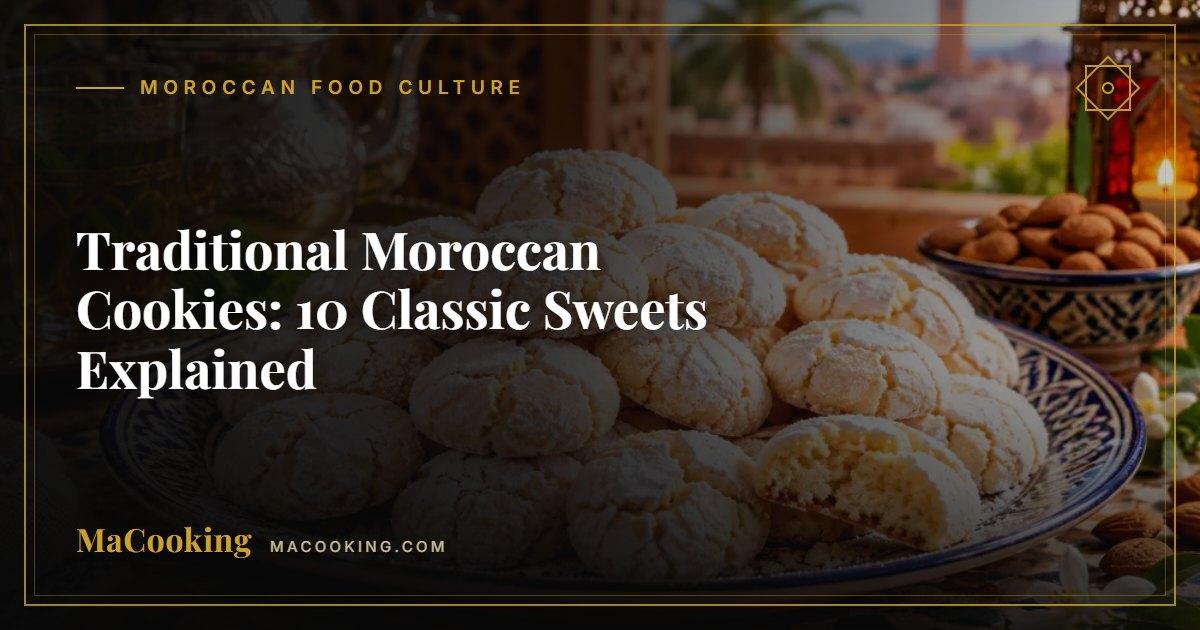
Traditional Moroccan cookies are small, fragrant sweets built on almonds, semolina, sesame, honey, orange blossom water and warm spices. They range from crumbly ghriba and twice-baked fekkas to honey-soaked chebakia and date-filled makrout, and they are served with mint tea for celebrations, holidays and everyday hospitality.
Key Takeaways
- Moroccan cookies fall into three families: dry and crumbly (ghriba, fekkas), fried and honeyed (chebakia, sweet briouats), and filled or shaped (makrout, kaab el ghazal).
- Almonds, sesame, semolina, honey, orange blossom water, anise and cinnamon appear again and again.
- Most are made for tea time, religious holidays, weddings and welcoming guests.
- Western pantries can reproduce them well with a few smart substitutions and some attention to texture.
- Dry cookies keep longer than honey-soaked ones, so choose what to bake based on when you will serve them.
What Counts as Traditional Moroccan Cookies?
"Cookie" is a loose translation. In Morocco, sweets of this kind are often grouped under the word halwa or halwiyat, and many bakeries sell them by weight in mixed boxes. Some are true biscuits. Others sit between pastry and confection, like honey-dipped fried dough or almond paste wrapped in thin pastry.
What unites them is how they are used. They are offered with tea when someone visits, arranged on a platter for religious holidays, and baked in large batches before weddings and family gatherings. If you want to see how generosity shapes the sweet table, The Psychology of Moroccan Hospitality explains why food is never just food in a Moroccan home.
Regional habits matter too. Fez is known for refined, delicate pastry work, and the north and the Mediterranean coast share some traditions with neighbouring countries, while home bakers everywhere have their own family version of ghriba. For a broader view of the cuisine, the Moroccan cuisine overview on Wikipedia is a useful starting point.
What Are the 10 Classic Moroccan Cookies and Sweets?
These are the sweets you will meet most often, whether in a Moroccan bakery, at a family table or on a holiday platter. Spellings vary (ghriba, ghribia, gharaiba), so the list below also doubles as a guide to Moroccan cookies names.
1. Ghriba bahla (plain ghriba)
The name ghriba is often translated as something close to "unusual" or "strange", and bahla means "simple". Plain ghriba is the cracked-top cookie most people picture: pale, domed, crumbly outside and soft within. Recipes differ from family to family. Some use flour with a little semolina, others use mostly semolina. Fat can be butter, oil or a mix, and flavour comes from vanilla, orange blossom water or lemon zest.
The cracks are the signature. They appear when the dough is rolled into balls, often dipped in icing sugar, and baked until just set. Overbaking turns them dry and brown instead of tender.
2. Almond ghriba
This is the richer, nuttier version, made with ground almonds and often a touch of orange blossom water. The texture is denser and chewier than plain ghriba, with a gently golden edge. It is also naturally suited to anyone who prefers flour-light baking. To bake your own, follow the Almond Ghriba Cookies recipe, which gives quantities and timings.
3. Coconut ghriba
Another popular variation uses desiccated coconut in place of, or alongside, almonds. The cookies are lighter, slightly chewy and very easy for beginners. Many home bakers treat the coconut version as an everyday cookie and keep the almond version for guests.
4. Chebakia
Chebakia is a flower-shaped pastry made from a dough scented with sesame, anise, cinnamon and spices. It is folded into a rosette, fried, dipped in hot honey and finished with sesame seeds. It is closely associated with Ramadan, when it is commonly served alongside soup and dates at the evening meal. The shaping takes practice, but the aroma alone is worth the effort. Our chebakia recipe walks through the folding step by step.
5. Makrout
Makrout (also spelled makroud) is a diamond-shaped semolina pastry stuffed with a date paste. It can be fried and soaked in honey, or baked in some versions. The semolina dough gives a tender, slightly grainy bite, and the date filling brings a deep caramel sweetness. It is shared across North Africa, with local variations in the dough and syrup. Try the Makrout (Moroccan Semolina Date Cookies) recipe.
6. Kaab el ghazal (gazelle horns)
These crescents have a thin, delicate pastry around a filling of almond paste scented with orange blossom water and sometimes cinnamon. The name means "gazelle's ankles" or "gazelle horns", depending on the translation. They are among the most elegant sweets on the platter and traditionally appear at weddings and holidays. The shaping is the hard part, because the dough must be rolled thin without tearing.
7. Fekkas
Fekkas is Morocco's answer to biscotti: a log of dough with almonds, raisins, sometimes anise or sesame, baked, sliced and baked again until crisp. It is firmer than ghriba and made for dunking in tea or coffee. It also keeps well, which makes it one of the most practical cookies for gifting. Bake it with the Moroccan Fekkas with Almonds and Raisins recipe.
8. Sellou (sfouf)
Sellou is not baked into a shape. It is a crumbly, energy-rich mixture of toasted flour, ground almonds, sesame, honey or sugar, butter or oil and warming spices. It is often pressed into mounds or eaten by the spoonful, and is closely connected with Ramadan and celebrations. It is a good reminder that Moroccan "cookies" include sweets that do not fit the Western definition at all.
9. Sweet briouats
Briouats are small triangles or cylinders of thin warqa pastry, filled with almond paste, fried or baked, and dipped in honey. Savoury briouats exist too, but the sweet version is a staple of festive platters. The crisp shell and the sticky almond centre make it a favourite for people who find other cookies too dry.
10. Lemon-scented shortbread-style cookies
Many Moroccan bakeries and home cooks make buttery, shortbread-style cookies (often called sablés, borrowing from French) flavoured with lemon zest, orange blossom water or vanilla. They are often decorated with jam, almonds or a dusting of sugar. This is where Moroccan lemon cookies belong: not a single fixed recipe, but a popular family of tender, zesty tea biscuits.
How Do the Main Moroccan Cookies Compare?
This table summarises the texture, method and typical use of each type, so you can pick the right one for your table.
| Cookie | Key ingredients | Texture | Method | Typical occasion |
|---|---|---|---|---|
| Ghriba (plain, almond, coconut) | Flour or semolina, sugar, fat, eggs; almonds or coconut | Crumbly, soft centre | Baked | Tea time, holidays, gifts |
| Chebakia | Flour, sesame, anise, cinnamon, honey | Crisp outside, sticky and chewy | Fried, soaked in honey | Ramadan, celebrations |
| Makrout | Semolina, date paste, honey | Tender, grainy dough, soft filling | Fried or baked, then syrup | Holidays, gatherings |
| Kaab el ghazal | Almond paste, thin dough, orange blossom water | Delicate shell, soft filling | Baked | Weddings, holidays |
| Fekkas | Flour, almonds, raisins, anise or sesame | Dry, crunchy | Baked twice | Tea and coffee, gifting |
| Sellou (sfouf) | Toasted flour, almonds, sesame, honey, spices | Fine, crumbly, rich | Toasted and mixed, no baking of shapes | Ramadan, celebrations |
| Sweet briouats | Warqa pastry, almond paste, honey | Crisp shell, sticky centre | Fried or baked, dipped in honey | Festive platters |
| Lemon shortbread-style cookies | Butter, flour, sugar, lemon zest | Buttery, tender | Baked | Everyday tea |
Which Moroccan Tea Cookies Go Best With Mint Tea?
Moroccan mint tea is sweet, so the best Moroccan tea cookies are the ones that are not overly sugary themselves. Dry, crumbly textures balance a hot, sugary glass. Fekkas can be dunked without falling apart, and ghriba dissolves slowly alongside each sip. Lemon-scented shortbreads add a bright note that cuts through the mint.
Honey-soaked sweets such as chebakia and makrout are richer. They are usually served in small portions with tea, and are often paired with plain tea or unsweetened coffee by people who find the combination too sweet. For more pairing ideas, read the Moroccan Food Pairing Guide.
If you want the ritual behind the glass, the free chapter "The Moroccan Tea Ceremony — The Complete Guide" is free to read online. Inside the full ebook The Royal Moroccan Table — Part 5: Sweet Morocco, you will also find chapters titled "Chebakia & Sellou — Ramadan Sweets" and "Briouats — The Art of the Sweet Parcel".
Are There Moroccan Lemon Cookies?
Yes, though not as one defined classic. Lemon zest is a popular way to brighten Moroccan dough, particularly ghriba and shortbread-style biscuits. Moroccan cooks often pair citrus with orange blossom water, vanilla or a small amount of anise.
Preserved lemon is a different matter. It is a salty, fermented ingredient used mostly in savoury dishes such as the Chicken Tagine with Preserved Lemons, and is not normally used in cookies. For cookies, use fresh lemon zest and a small amount of juice.
A simple way to make a lemon version of ghriba:
- Rub the zest of one unwaxed lemon into the sugar with your fingertips to release the oils.
- Mix with the dry ingredients and fat as your base recipe directs.
- Add only a teaspoon or two of juice if the dough needs moisture, since too much will make it spread.
- Roll into balls, coat in icing sugar and bake at about 170°C (340°F) until just set, which is often around 12 to 15 minutes depending on size.
How Can You Make Moroccan Cookies With a Western Pantry?
Most ingredients are easy to find now, and more supermarkets stock them each year; The Moroccan Pantry Revolution covers the trend in detail. If something is missing, these substitutions work reasonably well.
| Traditional ingredient | Substitute | Note |
|---|---|---|
| Orange blossom water | Vanilla extract plus fresh orange zest | Use less than the water measure and adjust to taste |
| Fine semolina | Fine cream of wheat or plain flour | Texture will be softer and less grainy |
| Ground almonds | Almond flour (blanched, finely ground) | Avoid very coarse meal for ghriba |
| Smen (aged butter) | Good-quality butter | Flavour will be milder and less tangy |
| Date paste | Pitted Medjool dates blended with a little butter | Process until completely smooth |
| Warqa pastry | Filo pastry (thin layers, brushed with butter) | Similar crispness, slightly different chew |
What Mistakes Should You Avoid, and How Do You Store Moroccan Cookies?
Common mistakes
- Overbaking ghriba. Take them out when the surface is set and the base is pale gold, not brown.
- Overworking the dough. Mix until it just comes together to keep crumbly cookies tender.
- Using cold honey for chebakia. The honey should be warm and fluid so it coats without clumping.
- Adding too much orange blossom water. It is potent, and a heavy hand makes cookies taste like soap.
- Skipping the rest. Resting dough for makrout and kaab el ghazal makes rolling and shaping easier.
Storage
Store dry cookies such as ghriba and fekkas in an airtight tin, with parchment between layers, at room temperature. They generally keep for a week or two, sometimes longer. Honey-soaked sweets are best within about a week, and should be kept somewhere cool and dry; humid weather softens them quickly. Never refrigerate fried honeyed pastries unless your kitchen is very warm, since condensation can make them sticky.
For more ideas on what to bake next, browse our Desserts & Sweets recipes, or see Moroccan Sweets for Special Occasions for guidance on building a holiday platter.
Frequently Asked Questions
What are the most famous traditional Moroccan cookies?
Ghriba, chebakia, makrout, kaab el ghazal (gazelle horns) and fekkas are the best known. Ghriba is a crumbly, cracked-top cookie, chebakia is a honey-soaked fried sesame pastry, makrout is a date-filled semolina diamond, kaab el ghazal holds almond paste, and fekkas is a twice-baked biscotti-style biscuit.
What is Moroccan ghriba made of?
Ghriba is usually built on flour or semolina, sugar, fat (butter or oil), eggs and a flavouring such as almonds, coconut, sesame or lemon zest. The best versions bake just long enough to set, giving a cracked surface, a pale colour and a soft, crumbly centre rather than a crisp snap.
Which Moroccan cookies are best with mint tea?
Dry, crumbly cookies work best with sweet mint tea. Fekkas, plain or almond ghriba and lemon-scented shortbread-style biscuits all hold up well. Fekkas is made for dunking, while ghriba melts in the mouth between sips. Honey-soaked sweets like chebakia are richer and are usually served in smaller portions.
Are there Moroccan lemon cookies?
Lemon zest is a common flavouring in Moroccan home baking, especially in ghriba and shortbread-style cookies, often alongside orange blossom water or vanilla. There is no single fixed recipe called Moroccan lemon cookies, so it is best seen as a variation on the classic crumbly cookie.
How long do Moroccan cookies keep?
Dry cookies such as ghriba and fekkas keep well in an airtight tin for about one to two weeks at room temperature, and often longer. Honey-soaked sweets like chebakia and makrout are best within a week or so. Keep all of them away from humidity so they stay crisp or crumbly.
Can I make traditional Moroccan cookies without orange blossom water?
Yes. Orange blossom water gives a floral aroma, but you can use a little vanilla extract with fresh orange or lemon zest instead. Use a smaller amount than the recipe's water measure and taste as you go. The cookie will taste slightly different but still be delicious.
Conclusion
Traditional Moroccan cookies are less a single category than a whole sweet vocabulary: crumbly ghriba, crisp fekkas, honeyed chebakia, date-filled makrout and delicate kaab el ghazal. Start with the easiest, a batch of almond ghriba, and a glass of mint tea. Once you have mastered that rhythm, the rest of the platter becomes much easier to approach.