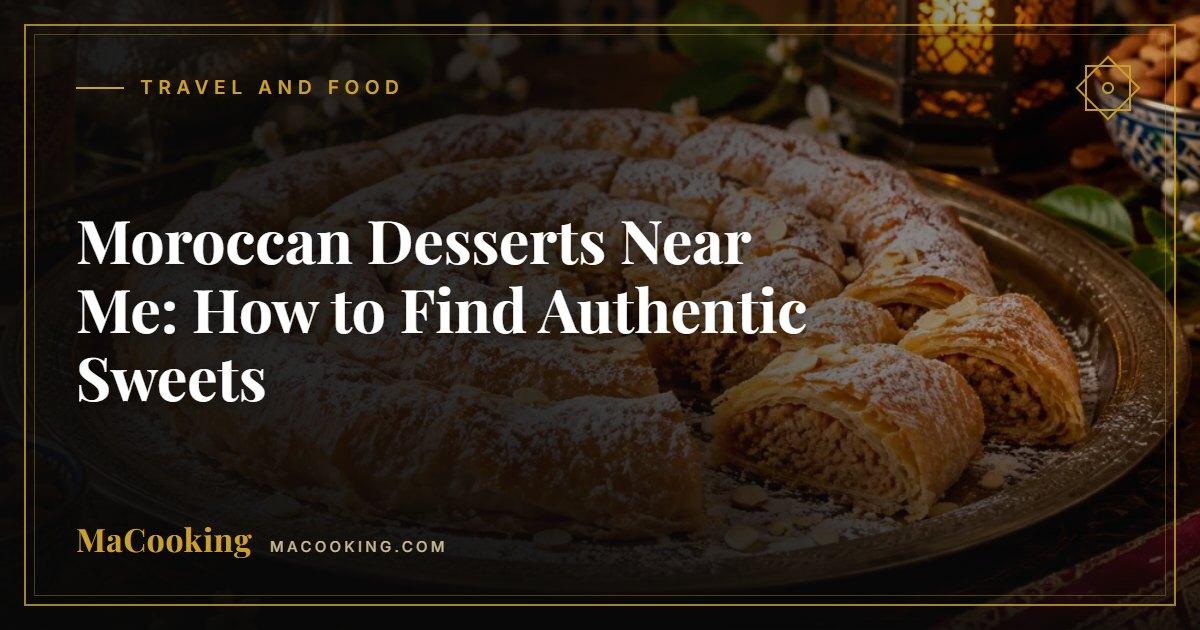
To find authentic Moroccan desserts near you, search maps for "Moroccan bakery," "pâtisserie marocaine" and "halal Maghrebi pastry," then check the display case. Real shops sell almond cookies such as ghriba, fekkas and gazelle horns, scented with orange blossom water and sold by weight in mixed boxes.
Key Takeaways
- Search with several terms (Moroccan, Maghrebi, halal, French "pâtisserie marocaine"), because many shops do not label themselves simply as "Moroccan."
- Look for almond, semolina, sesame, honey and orange blossom water; be wary of neon colours and artificial almond flavouring.
- Start with a mixed box of popular Moroccan desserts so you can compare textures: crumbly, crunchy, soft and honeyed.
- When ordering Moroccan cookies online, check ingredients, packing date, packaging and delivery time before paying.
- If nothing good is nearby, many classic cookies are very achievable at home with the right recipe.
What Makes a Moroccan Dessert "Authentic"?
Morocco's sweet repertoire is shaped by a handful of ingredients used with great restraint: almonds (ground, whole or made into paste), fine semolina, sesame seeds, honey, dates, butter or smen, and fragrant waters, especially orange blossom. Spices such as cinnamon, anise and sometimes mastic or gum arabic appear in small amounts. If you want the wider cultural background, Wikipedia's overview of Moroccan cuisine is a reasonable starting point.
"Authentic" does not mean one single recipe. A ghriba in Fez can differ from one in Marrakech or Tetouan, and families have their own proportions. What you can reasonably look for is a recognisable flavour profile and a texture that matches the sweet:
- Almond-forward, not sugar-forward. Almond cookies should taste of toasted nuts first and sweetness second.
- Aromatic, not perfumed. Orange blossom water should smell floral and gentle. If it smells like soap, it has been overdone.
- Correct texture. Ghriba is crumbly and tender inside, fekkas is dry and crisp, makrout is soft and moist, and chebakia is crisp-chewy with a honey gloss.
- Simple colouring. Moroccan bakers do decorate (some pastries are dusted or iced), but the base should look golden, brown or natural, not bright artificial colours.
Where Can I Find Moroccan Desserts Near Me?
The answer depends on where you live, but the same types of places tend to work in most Western cities.
Moroccan and Maghrebi bakeries
These are the best option. They are most common in cities with long-established North African communities, such as Paris, Brussels, Amsterdam, Montreal and parts of London, but smaller towns often have at least one. In many shops the cookies are baked in the morning and sold by weight. Ask what was baked that day.
Halal bakeries and Arabic sweet shops
Not every Arabic or halal bakery stocks Moroccan sweets, but many carry a few: almond cookies, date pastries, sesame items or baklava-style rolls. Staff can often tell you whether an item is Moroccan or comes from another cuisine, and sometimes whether they can make a Moroccan assortment to order.
Moroccan restaurants and tea rooms
Restaurants may serve a plate of cookies with mint tea, or sell boxes at the counter. During Ramadan and around Eid, restaurants and home bakers often take orders for larger trays. A friendly question at the end of a meal can lead you to the best source in town.
Specialty grocers and markets
North African and Middle Eastern grocers frequently stock packaged cookies, plus the ingredients for baking your own: fine semolina, orange blossom water, whole almonds, sesame, dates and anise. Farmers' markets and community food fairs sometimes have home bakers selling Moroccan cookies. Look for hand-written ingredient lists, and check local regulations or labelling if you have allergies.
Home bakers and community groups
A lot of excellent Moroccan baking is done at home and sold by word of mouth. Local Facebook groups, neighbourhood forums and community centres can be worth a search, especially before Eid or Ramadan. Treat these like any small food business: ask about ingredients, allergens and how they are packed.
How Do I Search for Moroccan Cookies Near Me?
When you type "moroccan cookies near me" into a map app, results often skew towards cafés or generic bakeries. These adjustments usually help:
- Try the French and Arabic spellings. "Gâteaux marocains," "pâtisserie marocaine," "halwiyat" and "hlou" can surface shops that English searches miss.
- Search by item. Try "ghriba," "chebakia," "kaab el ghzal," "cornes de gazelle" or "makrout." A bakery that lists these names almost certainly knows what it is selling.
- Read photos, not just stars. Customer photos of the counter will show whether you see crescent-shaped almond cookies, cracked-top ghriba, and trays of honeyed chebakia, or just generic cakes.
- Scan reviews for specifics. Comments that mention "tasted like my grandmother's" are less useful than ones that mention almond paste, freshness or orange blossom.
- Check seasonal timing. Chebakia and sellou are strongly associated with Ramadan, so they may be hard to find outside that season. Call ahead.
Which Popular Moroccan Desserts Should You Look For?
If you are unsure what to order, use this table as a shopping cheat sheet. It describes what each sweet generally is and what a good example tends to look like.
| Sweet | What it is | What good looks like | Possible red flag |
|---|---|---|---|
| Ghriba | Crumbly cookie, often with almond, semolina, coconut or walnut | Cracked top, tender and crumbly inside, pale gold | Hard, dry and heavily browned |
| Fekkas | Twice-baked, biscotti-like cookie with nuts, often anise and raisins | Crisp, even slices, fragrant spice | Stale, chewy or soft in the middle |
| Kaab el ghzal (gazelle horns) | Crescent of thin dough filled with almond paste and orange blossom water | Thin, delicate shell, plump filling, floral aroma | Thick doughy shell, pasty or artificial filling |
| Chebakia | Fried, flower-shaped sesame dough dipped in honey | Glossy but not drippy, crisp-chewy, sesame and spice aroma | Greasy, soggy or sticky to the touch |
| Makrout | Semolina dough with a date filling, soaked or glazed with honey | Soft, moist, rich date flavour | Dry crumbling dough, little filling |
| Briouats | Small sweet parcels, often almond-filled, fried or baked and honeyed | Crisp pastry, well-sealed, almond paste not oily | Soggy wrapper, rancid-smelling oil |
| Sellou (sfouf) | Toasted flour, almond, sesame and spice mix, often eaten by the spoonful | Fine, fragrant and nutty, not pasty | Bitter or burnt flavour |
| Baghrir | Spongy "thousand-hole" semolina pancake, served with honey and butter | Fresh, light, with a bubbled surface on one side | Dense and rubbery |
Some of these are easier to find in a shop than others. Ghriba, fekkas, almond crescents and honeyed pastries are common in bakery cases, while baghrir is typically made fresh at home or in cafés. For a closer look at the almond-based end of the spectrum, the guide to Moroccan almond pastries will help you recognise what you are looking at. For the pastries sold from stalls and carts rather than shops, read about Moroccan street food desserts.
How Can You Tell Good Moroccan Cookies From Mass-Produced Ones?
You do not need to be an expert to judge quality. Use your eyes, nose and a single bite.
- Smell first. Fresh almonds, toasted sesame and a light floral note are what you want. A sharp chemical or "marzipan-flavouring" smell often means artificial almond essence.
- Check for oil. A bit of oil on paper after wrapping is normal for fried or almond-rich items. Pooling oil, or a rancid, paint-like smell, means old nuts or reused oil.
- Look at consistency. Handmade cookies are never perfectly identical. A tray of perfectly uniform, shiny cookies in synthetic colours is more likely industrial.
- Ask what is in it. A reputable baker can usually tell you whether the filling is real almond paste, whether butter, smen or oil is used, and what is in the glaze.
- Taste one. Many Moroccan bakers are happy to let a first-time customer try a piece, especially if you are buying a mixed box.
If you want to know what "right" tastes like, baking a batch yourself is the fastest education. Try almond ghriba cookies to learn the crumbly, cracked-top texture, or the makrout recipe to understand how a semolina and date pastry should feel. Once you have made them, you will know instantly when a shop's version is good.
Can You Buy Moroccan Cookies Online?
Yes. If there is no Moroccan bakery within reach, ordering Moroccan cookies online is a practical alternative. Searches like "moroccan cookies for sale" return everything from small bakeries to marketplace resellers, so it is worth being selective.
What to check before you order
- Ingredients and allergens. These should be listed clearly: nuts, sesame, gluten, egg, dairy.
- Baking or packing date. Freshness matters more for almond cookies than for most biscuits.
- Packaging. Crumbly cookies such as ghriba need rigid boxes with padding; honeyed pastries need tight, leak-proof packaging.
- Shipping time and climate. Honeyed and filled pastries do not do well sitting in a hot depot. Choose faster shipping in summer.
- Return or replacement policy. Perishable goods are often excluded, but a good seller will still say what happens if the box arrives damaged.
- Cross-border rules. If you are importing from Morocco or another country, check your own customs and food import regulations first, because they differ between the US, UK, EU, Canada and Australia.
Which sweets travel best?
| Sweet | Shipping suitability | Why |
|---|---|---|
| Fekkas | Very good | Twice-baked and dry, so it is sturdy |
| Ghriba | Good with careful packing | Crumbly, so it needs rigid boxes |
| Makrout | Moderate | Honey and date filling can stick or soften in heat |
| Chebakia | Moderate | Honey coating can soften in humid conditions |
| Filled almond pastries | Depends on the seller | Delicate shells; quality of the box matters |
| Anything with cream | Poor | Needs refrigeration |
How Should You Order and Store Moroccan Sweets?
Once you find a good source, a few habits will help you get the best from it.
- Buy a small mixed box first. A handful of four to six types lets you compare without committing to a kilo of something you might not love.
- Order close to when you need them. Almond cookies are at their best in the first days after baking.
- Store dry cookies in an airtight tin at cool room temperature, away from sun and the stove. Separate honeyed pieces from dry ones, or the dry cookies will soften.
- Refrigerate anything with fresh filling or cream, and eat it promptly.
- Freshen up crisp cookies by warming them briefly in a low oven, then letting them cool completely.
- Serve them the Moroccan way: a small plate of mixed cookies alongside mint tea or coffee, offered to guests as a sign of welcome.
If the tea side of the experience interests you, you can read the free chapter "The Moroccan Tea Ceremony — The Complete Guide", which is free to read online. The full ebook, The Royal Moroccan Table — Part 5: Sweet Morocco, also includes chapters such as "Briouats — The Art of the Sweet Parcel" and "Chebakia & Sellou — Ramadan Sweets."
What If There Is No Moroccan Bakery Near Me?
Many people live nowhere near a Moroccan bakery, and that is where home baking comes in. Moroccan cookies are, for the most part, made from pantry ingredients: almonds, semolina or flour, sugar, eggs, butter or oil, and orange blossom water. Good starting points include:
- Crumbly and easy: the ghriba linked above is a forgiving first bake.
- Festive and fried: the chebakia recipe for Moroccan sesame cookies walks you through shaping and frying the honeyed flower cookies that are especially popular during Ramadan.
- Show-stopper: the m'hancha almond snake pastry is for when you want to make something that looks as impressive as it tastes.
- More to explore: browse the full Desserts & Sweets recipes collection for puddings, pancakes and more.
Substitutions are straightforward. If you cannot find orange blossom water at your local supermarket, check the international aisle or a Middle Eastern grocer. For almonds, buy whole blanched almonds and grind them yourself for a fresher flavour than most pre-ground almond meal. A small amount of fine semolina (not coarse) is key for makrout and some ghriba, so check the label.
Frequently Asked Questions
What is the best search term for finding a Moroccan bakery?
Try several: "Moroccan bakery," "pâtisserie marocaine," "Moroccan pastries," "Maghrebi bakery" and "halal bakery." Many Moroccan shops list themselves under French or broader Arabic-sweets labels, so one search term alone can miss them. Check recent photos of the display case for ghriba, chebakia and almond crescents.
Are Moroccan desserts the same as Turkish or Lebanese sweets?
They overlap but are not the same. Moroccan sweets lean on almond paste, orange blossom water, sesame, semolina and honey, and are often dry cookies served with mint tea. Syrup-soaked baklava-style pastries are common across the region, but Moroccan bakeries typically have a much larger range of almond cookies.
How long do Moroccan cookies stay fresh?
Dry, baked cookies such as fekkas and ghriba generally keep well for a week or more in an airtight tin at cool room temperature. Honey-soaked pieces like chebakia keep for a while too but soften with humidity. Anything with cream or fresh fillings should be refrigerated and eaten quickly. Always follow the seller's advice.
Can I buy Moroccan cookies online?
Yes, many Moroccan and North African bakeries and specialty grocers ship cookies. Check the ingredient list, the baking or packing date, how the box is cushioned, and delivery time. If you are ordering across borders, check your country's rules on importing food, as these vary.
Which Moroccan dessert should a first-timer order?
Start with a mixed box: one almond ghriba, a fekkas, a makrout and a chebakia. This gives you crumbly, crunchy, soft and honeyed textures in one go. Pair them with mint tea or black coffee, and note which you like before buying a larger quantity.
Are Moroccan sweets vegan or nut-free?
Usually not. Many contain almonds, eggs, butter or honey, and nut-free options are rare because almonds and sesame are central to the cuisine. Cross-contact is also likely in a Moroccan bakery. If you have an allergy, speak to the baker directly and consider baking at home instead.
Conclusion
Finding good Moroccan desserts near you is mostly a matter of searching with the right words, looking closely at what is in the display case, and asking a few simple questions. Start with a mixed box of popular Moroccan desserts, learn which textures and flavours you love, and then build from there, whether that means a regular bakery run, an online order, or your own batch of cookies at home.