
Introduction
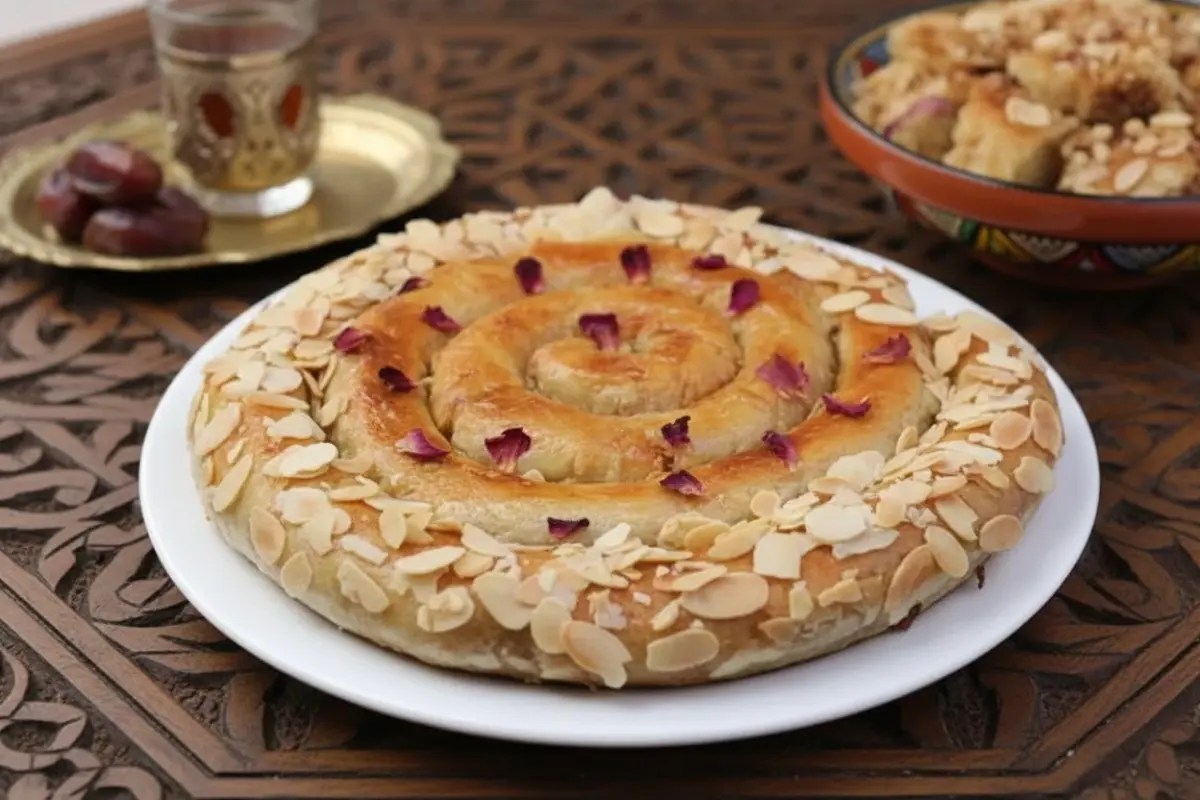
M'hancha, whose name translates to 'the snake' in Arabic, is one of Morocco's most spectacular and beloved pastries - a coiled serpent of crispy, flaky warqa pastry wrapped around a fragrant filling of ground almonds sweetened with sugar, perfumed with orange blossom water, and warmly spiced with cinnamon. When baked to golden perfection, brushed with melted butter, and generously dusted with powdered sugar, this dramatic pastry becomes the centerpiece of celebrations, weddings, holidays, and special family gatherings. The name comes from its distinctive coiled presentation - the long cylinder of filled pastry is carefully spiraled into a tight coil resembling a coiled snake, creating both visual drama and practical portions when sliced into wedges. Each slice reveals beautiful layers of paper-thin pastry encasing the rich, aromatic almond filling.
The magic of m'hancha lies in the marriage of textures and flavors: the shattering crispness of buttery warqa pastry (similar to phyllo but traditionally hand-stretched even thinner) contrasts beautifully with the soft, moist almond paste filling. The almonds provide rich, nutty flavor and satisfying substance, while orange blossom water adds haunting floral notes that are quintessentially Moroccan. Cinnamon provides warm spice, and the generous coating of powdered sugar adds sweetness and creates the pastry's signature snowy appearance. The combination is simultaneously rich and delicate, sweet but not cloying, complex yet harmonious - everything a celebration dessert should be.
In Moroccan culture, m'hancha holds special status as luxury pastry reserved for important occasions. It appears at weddings as part of the elaborate sweet tables, at religious celebrations during Eid, at engagement parties, and whenever families want to show hospitality and celebration. Making m'hancha is considered a skilled art - the traditional warqa pastry requires expertise to make from scratch (though most modern cooks use phyllo dough as a convenient substitute), the almond filling must be perfectly textured and flavored, and the coiling technique requires practice to achieve the tight, neat spiral. When a beautiful m'hancha appears on the table, it signals both celebration and the cook's skill and care.
About This Recipe
M'hancha, the spectacular coiled serpent pastry, holds prestigious status in Moroccan culinary tradition as one of the country's most celebrated and recognizable desserts. The name 'm'hancha' literally means 'the snake' in Moroccan Arabic, directly referencing the pastry's distinctive coiled presentation that resembles a coiled serpent. This dramatic appearance is no accident - in Moroccan culture, the serpent coil represents eternity, continuity, and the cyclical nature of life, making m'hancha symbolically appropriate for celebrations marking important life transitions like weddings, engagements, and births. The pastry's origins trace back to the refined court cuisine of Morocco's imperial cities - Fez, Marrakech, Meknes, and Rabat - where skilled palace cooks developed elaborate pastries to showcase their artistry and honor royal occasions. The technique of wrapping almond paste in paper-thin pastry reflects Moorish and Andalusian influences, particularly from the sophisticated medieval courts of Al-Andalus (Islamic Spain) where almond-based sweets and delicate pastries reached high art. When the Moors were expelled from Spain, many brought their culinary expertise to Morocco, enriching local traditions. The use of almonds in Moroccan pastries reflects both the nut's abundance in Morocco (particularly in the Souss region and around Tafraout) and its prestigious status as a luxury ingredient associated with wealth and celebration. Orange blossom water, another signature ingredient, comes from the bitter orange trees (bigaradiers) that perfume Moroccan gardens and courtyards, with the distillation of orange blossoms into fragrant water being an ancient Moroccan craft. The traditional pastry wrapper, warqa, represents one of Morocco's most impressive culinary techniques - creating impossibly thin, translucent sheets of dough through a specialized dabbing technique on a hot griddle. Making warqa requires years of practice and is considered a specialized skill, with expert warqa makers being highly valued. Today, most Moroccan cooks use phyllo dough as a practical substitute that creates nearly identical results with far less difficulty. M'hancha's role in Moroccan celebrations is deeply embedded in cultural tradition. At weddings, m'hancha appears as the centerpiece of elaborate sweet tables, often surrounded by other traditional pastries like chebakia, ghoriba, briwats, and kaab el ghazal. The act of serving m'hancha to guests demonstrates hospitality, generosity, and respect for the occasion's importance. During religious celebrations like Eid al-Fitr and Eid al-Adha, families make m'hancha as part of the festive sweets prepared to mark the holy days. The pastry also appears at engagement parties, birth celebrations, and any gathering marking significant family milestones. In modern Morocco, m'hancha bridges tradition and contemporary life. Traditional pastry shops (pâtisseries) display beautiful m'hanchas in their windows, often creating elaborate versions with multiple coils or decorative patterns. Home cooks make simplified versions for family celebrations. Cooking classes teach tourists the art of m'hancha making as a window into Moroccan culture. The pastry has also gained international recognition as Moroccan cuisine receives global attention, appearing in cookbooks, food shows, and restaurants worldwide. Beyond Morocco's borders, m'hancha has become an ambassador of Moroccan pastry arts, introducing international audiences to the sophistication, artistry, and distinctive flavors of Moroccan sweets. More than just a dessert, m'hancha embodies Moroccan values of hospitality, celebration, skill, beauty, and the importance of marking life's special moments with special foods.
Nutritional Info (per serving)
Recipe Tags
Understanding the Ingredients
Almonds
The heart of m'hancha is the almond filling - you need about one pound (roughly three and a half cups) of blanched almonds. Blanched almonds (with skins removed) create a smoother, more refined filling and lighter color. You can buy pre-blanched almonds or blanch them yourself by briefly boiling raw almonds and slipping off the skins. The almonds are ground into a fine meal or paste - traditionally done in a mortar and pestle, though modern cooks use food processors. The texture should be fine but still slightly grainy, not completely smooth like almond butter. The almonds provide the filling's substance, rich nutty flavor, and characteristic texture. Quality matters - fresh, sweet almonds create superior filling.
Sugar for Filling
The almond filling requires substantial sugar - about one to one and a quarter cups - to sweeten the almonds and help bind the filling. Granulated white sugar is traditional and most common. Some cooks use a combination of granulated and powdered sugar for finer texture. The amount can be adjusted based on preference for sweetness, but the filling should be quite sweet as it's balanced by the neutral pastry and the lightly sweet powdered sugar coating. The sugar also helps create the filling's characteristic paste-like consistency.
Orange Blossom Water
Orange blossom water is absolutely essential for authentic m'hancha - it provides the distinctive floral, perfumed aroma that makes Moroccan pastries so recognizable. You need about three to four tablespoons for the filling. Orange blossom water is distilled from bitter orange blossoms and has an intensely floral, slightly bitter-sweet aroma. The amount is important - too little and the filling lacks characteristic flavor; too much and it becomes soapy and overpowering. Available in Middle Eastern or Mediterranean grocery stores, or online. Do not substitute orange extract - the flavor is completely different.
Ground Cinnamon
Cinnamon provides warm, sweet spice that complements the almonds and orange blossom beautifully. You need about two teaspoons for the filling. Use good quality ground cinnamon for best flavor - fresh, aromatic cinnamon makes a noticeable difference. The cinnamon should be present but balanced - it enhances rather than dominates. Some families use more cinnamon for spicier filling, others less for more delicate flavor. This is adjustable to taste.
Butter and Eggs for Filling
The almond filling requires melted butter (about four tablespoons or one-quarter cup) for richness and to help bind the mixture, and eggs (one or two large eggs) to create cohesive paste that holds together and doesn't crumble. The butter adds flavor and moisture, while the eggs act as binder, transforming loose almond meal into workable paste. Some recipes use only egg yolks for richer filling; others use whole eggs. The filling should be moist enough to hold together when squeezed but not wet or sticky.
Warqa or Phyllo Pastry
Traditional m'hancha uses warqa - Morocco's paper-thin pastry made by hand-dabbing dough onto a hot griddle to create impossibly delicate sheets. Making warqa from scratch requires significant skill and practice, so most modern cooks (even in Morocco) use phyllo dough as a convenient, reliable substitute that creates nearly identical results. You need about one pound (one box) of phyllo dough. Phyllo must be thawed properly (overnight in refrigerator, then one hour at room temperature) and kept covered with a damp towel while working to prevent drying and cracking. Each m'hancha typically uses four to six sheets of phyllo layered together for strength.
Melted Butter for Brushing
Generous amounts of melted butter - about one-half to three-quarters cup total - are essential for creating flaky, crispy layers and golden color. The butter is brushed between phyllo layers before filling, brushed on the assembled pastry before baking, and brushed again after baking for shine and richness. Use unsalted butter for best control over flavor. The butter should be melted but not too hot, which could tear delicate phyllo.
Powdered Sugar and Cinnamon for Topping
The finished m'hancha is generously dusted with powdered sugar (also called confectioners' sugar or icing sugar) - about one cup or more - creating the pastry's signature snowy appearance. Some cooks mix the powdered sugar with a bit of ground cinnamon (one teaspoon) for additional flavor and subtle color. The powdered sugar coating is not just decoration - it adds sweetness and creates beautiful contrast against the golden pastry. Be generous - a proper m'hancha should look abundantly dusted.
Step-by-Step Cooking Guide
Prepare the Almond Filling
Begin by making the almond filling, which can be done ahead. Place one pound (three and a half cups) of blanched almonds in a food processor. Pulse until finely ground - the texture should be like fine meal or sand, not powder and not chunky. You want some texture remaining. Transfer the ground almonds to a large mixing bowl. Add one to one and a quarter cups of granulated sugar, two teaspoons of ground cinnamon, and a pinch of salt. Mix thoroughly. Add one or two eggs (start with one), four tablespoons of melted butter, and three to four tablespoons of orange blossom water. Mix with your hands or a wooden spoon until everything comes together into a cohesive, moist paste. The mixture should hold together when squeezed but not be wet or sticky. If too dry and crumbly, add the second egg or more orange blossom water one tablespoon at a time. If too wet, add more ground almonds or powdered sugar. Taste and adjust sweetness or orange blossom water as desired. Set aside or refrigerate until ready to use.
Tip: Don't over-process almonds into paste - leave some texture. Mixture should hold together when squeezed. Adjust moisture with egg or orange blossom water. Can be made a day ahead and refrigerated. Taste and adjust sweetness and flavoring.
Prepare the Phyllo and Workspace
Thaw phyllo dough properly: overnight in refrigerator, then one hour at room temperature before using. Set up your workspace with a large, clean work surface. Have ready: thawed phyllo dough, melted butter (about half to three-quarters cup) in a bowl with a pastry brush, the almond filling, and a damp kitchen towel. Carefully unroll the phyllo sheets and immediately cover with the damp towel to prevent drying - phyllo dries out and becomes brittle very quickly when exposed to air. Work with one sheet at a time, keeping the rest covered. Have a large baking sheet (at least twelve inches in diameter, or rectangular) ready, lined with parchment paper. Preheat your oven to 350°F (175°C).
Tip: Proper phyllo thawing is crucial - don't rush it. Keep phyllo covered at all times - it dries in minutes. Work on a large, clear surface. Have everything ready before starting. Preheat oven while assembling.
Layer the Phyllo Sheets
Place one sheet of phyllo on your work surface horizontally (long edge toward you). Brush it generously but gently with melted butter, covering the entire surface. Lay a second sheet directly on top and brush with butter again. Repeat for a total of four to six phyllo sheets, layering and buttering each one. The number of sheets depends on the phyllo thickness and your preference - more sheets create sturdier pastry, fewer create more delicate, flaky texture. Four sheets is minimum, six is maximum. Work relatively quickly but carefully - handle the delicate phyllo gently to avoid tearing. Small tears are fine and won't show in the final product, but try to keep sheets mostly intact.
Tip: Brush butter edge to edge - don't leave dry spots. Work quickly but gently. Four to six sheets creates proper structure. Small tears are okay. Keep unused phyllo covered while working.
Add the Almond Filling
Take the almond filling and form it into a long, thick log the length of the phyllo's long edge (about sixteen to eighteen inches long and about one to one and a half inches in diameter). Place this log along the long edge of the phyllo nearest to you, leaving about one inch of phyllo edge empty. The log should be thick and substantial - you want generous filling in each slice. Press and shape the filling firmly into an even cylinder. Make sure the filling log is uniform in thickness from end to end for even rolling and consistent slices. If the filling feels too soft to hold its shape, refrigerate it briefly to firm up before continuing.
Tip: Make filling log thick and substantial - 1 to 1.5 inches diameter. Shape it uniformly for even rolling. Press firmly so it holds together. Leave 1 inch phyllo edge for sealing. Chill filling briefly if too soft.
Roll the Pastry
Starting from the edge with the filling, carefully begin rolling the phyllo around the almond filling, rolling away from you. Roll tightly and evenly, keeping the filling log centered and maintaining even tension. The phyllo should wrap snugly around the filling with no air pockets. Continue rolling until you have a long, filled cylinder. When you reach the far edge, brush it with butter and press gently to seal. The cylinder should be about one and a half to two inches in diameter and sixteen to eighteen inches long. Brush the entire outside of the cylinder with melted butter. Handle gently as the phyllo is delicate.
Tip: Roll tightly with no air pockets - this ensures neat slices. Keep filling centered. Maintain even tension. Seal edge with butter. Brush outside generously. Handle gently but confidently.
Coil into Snake Shape
This is the signature step. Carefully transfer the filled cylinder to your prepared baking sheet. Starting from one end, begin coiling the cylinder into a tight spiral, like a coiled snake. Work slowly and carefully, creating a neat spiral that becomes progressively larger as you work from the center outward. The coils should be touching each other but not overlapping. Continue until the entire cylinder is coiled. Tuck the final end neatly underneath or against the coil. Adjust the spiral as needed to make it as round and neat as possible - this is what will be presented, so take time to make it beautiful. The final coil should be about ten to twelve inches in diameter. Brush the entire surface generously with melted butter.
Tip: Coil tightly and neatly for beautiful presentation. Keep coils touching but not overlapping. Work carefully to avoid tearing. Make it as round and even as possible. Brush generously with butter before baking.
Bake the M'hancha
Place the coiled m'hancha in the preheated 350°F (175°C) oven. Bake for thirty to forty minutes, until the pastry is golden brown and crispy. The phyllo should be deeply golden (not pale) with some darker golden spots. After about twenty minutes, check and rotate the pan if needed for even browning. If the top is browning too quickly but the pastry isn't fully crispy, reduce temperature to 325°F (165°C) and continue baking. The m'hancha is done when it's uniformly golden, crispy to the touch, and you can hear slight crackling sounds. As soon as it comes out of the oven, immediately brush it generously with more melted butter while still hot - the hot pastry will absorb the butter, creating extra richness and shine.
Tip: Bake until deeply golden and crispy - pale pastry isn't done. Rotate for even browning. Reduce heat if browning too fast. Brush with butter immediately after baking while hot. Listen for crackling - sign of crispiness.
Finish and Serve
Let the m'hancha cool for about ten to fifteen minutes - it should be warm but no longer piping hot. While still warm, generously dust the entire surface with powdered sugar, using a fine-mesh sieve to create an even coating. Be very generous - the m'hancha should look abundantly covered in white, like it's been snowed on. Some cooks mix a teaspoon of cinnamon into the powdered sugar for subtle spice and color. You can add decorative touches: create patterns by placing a stencil on top before dusting, add a few whole toasted almonds for decoration, or use additional cinnamon lines for visual interest. Let cool to room temperature before slicing. To serve, cut into wedges like a cake, each slice revealing the beautiful spiral layers. Serve with Moroccan mint tea. M'hancha can be made several hours ahead and keeps well covered at room temperature for one to two days.
Tip: Dust generously while warm for best appearance. Use sieve for even coating. Let cool before cutting for clean slices. Cut into wedges. Serves beautifully with mint tea. Best day of baking but keeps 1-2 days.
Common Mistakes to Avoid
❌ Letting Phyllo Dry Out
Solution: Phyllo dries out within minutes when exposed to air, becoming brittle and impossible to work with. Always keep unused phyllo covered with a damp (not wet) kitchen towel. Work with one sheet at a time. Thaw properly and don't leave package open.
❌ Underfilling or Overfilling
Solution: Too little filling creates disappointing slices with mostly pastry; too much filling makes rolling difficult and can burst during baking. Use one to one and a half inch diameter filling log - substantial enough for good filling-to-pastry ratio but manageable to roll.
❌ Rolling Too Loosely
Solution: Loose rolling creates air pockets and gaps that make slicing messy and presentation poor. Roll tightly and evenly, maintaining consistent tension throughout. The cylinder should be compact and neat with filling fully enclosed and no gaps.
❌ Not Using Enough Butter
Solution: Skimping on butter results in dry, tough pastry instead of flaky, crispy layers. Brush generously between phyllo sheets, on the rolled cylinder, and again after baking. The pastry should glisten with butter - don't be shy.
❌ Underbaking
Solution: Pale, underbaked m'hancha is soft and doughy instead of crispy and flaky. Bake until deeply golden brown with some darker spots. The pastry should be crispy to the touch and make slight crackling sounds. Proper baking is crucial for texture.
❌ Cutting While Hot
Solution: Cutting m'hancha while piping hot creates messy slices as the filling hasn't set and the pastry is still soft. Let cool to warm or room temperature for clean, beautiful slices that reveal the spiral pattern perfectly.
Ingredient Substitutions
Instead of: Warqa Pastry
Use: Phyllo dough (also called filo) is the standard modern substitute and works beautifully - available frozen in most grocery stores. Spring roll wrappers can work in a pinch but create different texture. No good substitute exists for the ultra-thin quality.
Instead of: Blanched Almonds
Use: Almonds with skins can be used but will create darker filling with slightly bitter notes - blanch them yourself if possible. Almond flour/meal can substitute ground almonds. Other nuts (walnuts, pistachios) create different but interesting variations.
Instead of: Orange Blossom Water
Use: Rose water creates different but equally traditional Moroccan flavor - use same amount. Almond extract (one to two teaspoons) works but lacks floral notes. Vanilla isn't traditional but acceptable. Orange blossom water is ideal and worth seeking out.
Instead of: Butter
Use: Ghee adds rich, nutty flavor and works beautifully. For dairy-free version, use neutral vegetable oil for brushing phyllo, though flavor and crispiness won't be quite the same. Butter is strongly preferred for authentic results.
Serving Suggestions
Serve as the centerpiece of celebration dessert tables at weddings, Eid, or special family gatherings.
Present whole on a beautiful platter, dusted abundantly with powdered sugar, for dramatic presentation before cutting.
Cut into wedges and serve with small glasses of Moroccan mint tea - the classic pairing.
Accompany with additional Moroccan sweets like chebakia, ghoriba, or briwats for elaborate sweet spread.
Serve slightly warm for maximum flakiness, or at room temperature for neater slicing.
Garnish the serving platter with fresh mint leaves, orange blossom flowers, or whole toasted almonds for beauty.
Pair with strong coffee or tea - the sweetness benefits from bitter, aromatic beverages.
Present individual slices on small plates with a dusting of additional powdered sugar and cinnamon.
Storage & Reheating Guide
Storage
M'hancha keeps reasonably well and can be made ahead for convenience, though it's best the day it's made. Store completely cooled m'hancha covered loosely with aluminum foil or in an airtight container at room temperature for up to two days. The pastry will gradually lose some crispiness as it sits, becoming softer and more tender - still delicious but different from fresh. Do not refrigerate as this makes the pastry soggy and tough. The powdered sugar coating may dissolve somewhat - you can refresh it before serving. For longer storage, m'hancha can be frozen: wrap very well in plastic wrap then foil, freeze for up to one month. Thaw at room temperature before serving.
Reheating
To restore crispiness to day-old m'hancha, reheat in a 325°F (165°C) oven for eight to ten minutes until warmed through and the pastry crisps up again. Do not microwave - this makes the pastry soggy and tough. If the powdered sugar has dissolved or looks patchy, dust with fresh powdered sugar after reheating and cooling slightly. The filling can be made several days ahead and refrigerated, and the entire m'hancha can be assembled and baked on the day you plan to serve it for freshest results.
Tips: Best the day it's made for maximum crispiness. Store at room temperature, never refrigerate. Reheat in oven to restore crispness. Can freeze for longer storage. Refresh powdered sugar before serving if needed. Make filling ahead but bake day-of for best results.
Frequently Asked Questions
Recipe by

Similar Recipes


Our Recipe Ebooks
Discover our collection of authentic Moroccan recipe ebooks. Learn traditional cooking methods and create delicious meals at home.
The Moroccan Vegen
The Royal Moroccan Table -Part1
The Royal Moroccan Table -Part2
YouTube Channel
Watch step-by-step cooking videos, learn professional techniques, and get inspired by traditional and modern recipes from around the world.
Latest Video
"Traditional Moroccan Tagine Masterclass"