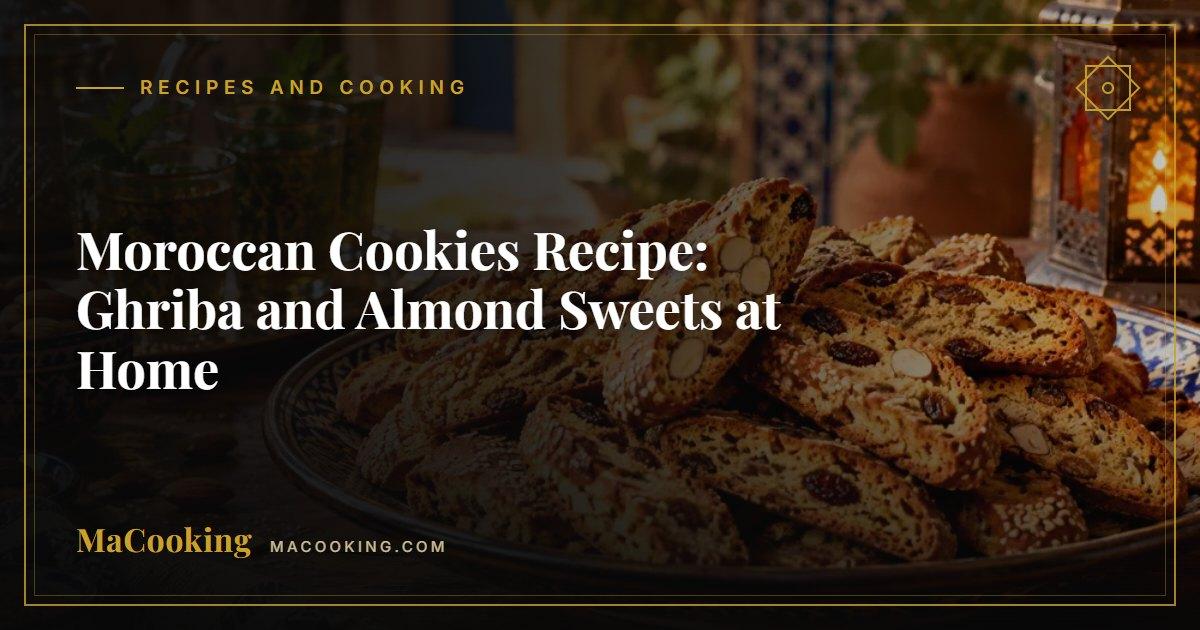
This moroccan cookies recipe makes almond ghriba: crackle-topped cookies with a crisp shell and chewy, fragrant centre. Mix ground almonds, sugar, eggs, lemon zest and orange blossom water, chill the dough, roll balls in icing sugar and bake at 180°C (350°F) for 12–14 minutes. They keep for about a week.
Key Takeaways
- Almond ghriba needs only a handful of ingredients and no special equipment, just a bowl, a spoon and an oven.
- Chilling the dough and coating the balls thickly in icing sugar is what gives the signature cracked top.
- Orange blossom water and lemon zest provide the Moroccan perfume. Easy substitutions are listed below.
- Date-filled and semolina-based cookies, such as makrout, are close relatives you can bake next.
- Pull ghriba from the oven while the tops are still pale. They firm up as they cool.
What Makes Traditional Moroccan Cookies Different?
Traditional Moroccan cookies are built on a short list of pantry staples: almonds, semolina, flour, honey, sesame, dates, eggs and fragrant waters. Butter and sugar play a supporting role rather than the lead. The result is a cookie that tastes of nuts, citrus zest and blossom water, and is meant for sipping with sweet mint tea rather than eating by the handful on its own.
Moroccan cuisine has a tradition of small, elegant sweets served on a tray in the middle of the table, usually when guests arrive. A few cookies come out beside the teapot, and each has its own character: crumbly, chewy, crisp or syrup-soaked. If you want to see how these sit among the wider repertoire, our Desserts & Sweets recipes collection is a good place to browse. For a broader look at Morocco's cuisine, Wikipedia's overview of Moroccan cuisine gives useful background.
Ghriba (sometimes spelled ghoriba or ghribia) is made across North Africa, and every household has its own version. Some cooks make it with semolina or flour and oil or butter, while others use ground almonds, coconut, walnuts or chickpea flour. This article focuses on the almond version, which is naturally rich and works well with Western pantries.
What Ingredients Do You Need for Moroccan Almond Cookies?
This recipe makes about 22 cookies, each around 25 g (a heaped tablespoon of dough). Almond flour does most of the work, so buy blanched, finely ground almonds. Almond meal with skins will give a darker, coarser cookie.
- 300 g (3 cups) blanched almond flour
- 150 g (¾ cup) caster (superfine) sugar
- 20 g (2 tablespoons) fine semolina or plain flour (optional, for structure)
- 1 teaspoon baking powder
- ¼ teaspoon fine salt
- Zest of 1 lemon
- ½ teaspoon ground cinnamon (optional)
- 2 large eggs
- 30 g (2 tablespoons) butter, melted and cooled, or a neutral oil
- 1 teaspoon orange blossom water
- ½ teaspoon vanilla extract
- About 100 g (¾ cup) icing (powdered) sugar, for rolling
Substitutions for Western pantries
| Ingredient | Substitute | What changes |
|---|---|---|
| Blanched almond flour | Whole blanched almonds, ground in a food processor with 2 tablespoons of the sugar | Slightly coarser texture. Pulse in short bursts so the almonds do not turn oily. |
| Orange blossom water | Rose water (½ teaspoon) or a few drops of almond extract plus extra zest | Different floral note, still pleasant. Taste the dough before adding more. |
| Fine semolina | Plain flour, rice flour or omit | Without it the cookies are softer and more fragile. |
| Butter | Neutral oil or mild olive oil | Slightly less rich, but equally tender. |
| Lemon zest | Orange or mandarin zest | Sweeter, softer citrus aroma. |
Moroccan Cookies Recipe: Almond Ghriba Step by Step
This is how to make Moroccan cookies of the ghriba type, with a soft, sticky dough and no rolling pin. Allow about 20 minutes of active time, plus 30 minutes of chilling.
- Heat the oven. Preheat to 180°C (350°F), or 160°C fan. Line two baking trays with baking paper.
- Combine the dry ingredients. In a large bowl, whisk the almond flour, sugar, semolina, baking powder, salt, cinnamon and lemon zest. Rub the zest through the sugar with your fingertips to release its oils.
- Mix the wet ingredients. In a small bowl, beat the eggs with the melted butter, orange blossom water and vanilla.
- Form the dough. Pour the wet mixture into the dry and stir until it comes together into a soft, thick, slightly sticky dough. It should hold its shape when scooped but not feel dry.
- Chill. Cover and refrigerate for at least 30 minutes, or up to 24 hours. This firms the dough so the balls stay tall rather than spreading.
- Shape. Put the icing sugar in a shallow bowl. With slightly damp hands, roll about 25 g of dough into a ball. Drop it into the icing sugar and roll until completely and thickly coated. For a very pronounced crackle, coat a second time.
- Arrange. Place the balls on the trays about 4 cm (1½ inches) apart. Do not flatten them.
- Bake. Bake for 12–14 minutes, one tray at a time, until the cookies have puffed, cracked and the bases are lightly golden. The tops should still look pale.
- Cool. Leave them on the tray for 10 minutes. The centres will feel soft at first and then set to a chewy texture.
If you would like another take on the same cookie, our Almond Ghriba Cookies recipe and the shorter Ghriba with Almonds post show variations on the technique and are good to compare with your first batch.
Why Did My Ghriba Spread, Stick or Not Crack?
Almond-based doughs are sensitive to moisture and heat. Most problems come from the dough being too warm or too wet, or from an oven that is not fully up to temperature. Use an oven thermometer if you suspect yours runs cool.
| Problem | Likely cause | Fix |
|---|---|---|
| Cookies spread flat | Dough too warm or wet; eggs larger than expected | Chill longer; add a tablespoon of almond flour or semolina to the dough. |
| No cracks on top | Icing sugar coating too thin; stale baking powder | Roll twice in icing sugar; replace baking powder. |
| Hard and dry | Overbaked | Pull them when the tops are pale and let them finish setting on the tray. |
| Dark bottoms | Thin or dark tray; oven too hot | Use a light-coloured tray or double-tray; lower the oven by 10°C. |
| Dough sticks to hands | Dough not chilled enough | Dampen your hands lightly with water and chill the dough for another 15 minutes. |
Can You Make Moroccan Date Cookies at Home?
Yes, and there are two good routes. The first is the classic one, which is makrout. These are diamond-shaped semolina cookies filled with spiced date paste, cooked and often finished in honey. They take more time but are very rewarding. Our Makrout (Moroccan Semolina Date Cookies) recipe walks you through the dough, the filling and the shaping.
The second route is quicker. You can turn the almond ghriba above into a date-filled cookie:
- Use about 100 g (3½ oz) of soft date paste, or pitted dates mashed with a teaspoon of warm water. Add a pinch of cinnamon if you like.
- Divide the date paste into 22 small pieces of roughly 4–5 g each and roll them into little balls.
- Flatten a ball of chilled almond dough in your palm, set a date ball in the centre and fold the dough around it, sealing it well.
- Roll in icing sugar and bake as above, adding 1–2 minutes if the cookies feel soft at the edges.
Medjool dates are soft enough to use straight from the packet. If your dates are firm, soak them in hot water for 10 minutes, drain and pat dry before mashing. A very wet filling can leak out during baking.
Which Moroccan Cookie Should You Bake Next?
Once you have the ghriba rhythm, the wider Moroccan cookie tray is easy to explore. Some of these are one-bowl bakes, while others need frying or syrup. This table helps you choose based on effort and mood.
| Cookie | Main ingredients | Texture | Effort |
|---|---|---|---|
| Almond ghriba | Ground almonds, sugar, eggs, orange blossom water | Crisp shell, chewy centre | Easy |
| Fekkas | Flour, almonds, raisins, aniseed or sesame | Dry and crunchy, twice-baked like biscotti | Easy to moderate |
| Makrout | Semolina, date paste, honey | Tender and sticky, rich with dates | Moderate |
| Chebakia | Flour, sesame, spices, honey | Crisp and honeyed, flower-shaped | Advanced (shaping and frying) |
| M'hancha | Almond paste, thin pastry | Crisp coil with a soft, nutty filling | Advanced |
If you prefer a crunchier cookie, start with Moroccan Fekkas with Almonds and Raisins. For the honeyed, sesame-covered classic that appears on many Ramadan tables, try our Chebakia Recipe (Moroccan Sesame Cookies). And if you enjoy shaping pastry, M'hancha (Moroccan Almond Snake Pastry) is a showpiece worth the effort.
How Do You Serve and Store Moroccan Cookies?
In Moroccan homes, cookies are usually served on a platter with mint tea or coffee, often in small portions and with a few kinds side by side. Ghriba pairs well with the sweetness and freshness of mint tea. For the full ritual behind the pour, you can read the free chapter, "The Moroccan Tea Ceremony — The Complete Guide", online.
Storage
- Room temperature: store cooled ghriba in an airtight container for about a week. They get chewier each day, which many people like.
- Freezer: freeze baked cookies in a single layer, then transfer to a container for up to two months. Thaw at room temperature. Alternatively, freeze the uncoated dough balls and roll them in icing sugar just before baking, adding a minute or two to the time.
- Layering: place baking paper between layers so the icing sugar coating does not stick.
- Honey-soaked cookies: makrout and chebakia are best kept in a cool place and eaten within a couple of weeks. Do not freeze them if you want the syrup texture to stay perfect.
Gifting and presentation
Ghriba are fragile when freshly baked but sturdy after a day. Pack them snugly in a tin with paper cases so they do not move. If you want the full spread, add a few traditional Moroccan almond pastries to the same box for variety.
Tips for Better Moroccan Almond Cookies
- Use fresh almond flour. Old almond flour can taste flat or slightly bitter. Smell it before baking.
- Grate the zest finely. Large pieces of zest make the dough bumpy and can crack the cookie in odd places.
- Do not skip the chill. Even 30 minutes makes shaping far easier.
- Weigh the dough balls. Equal sizes bake evenly. A kitchen scale helps, but a heaped tablespoon scoop also works.
- Bake one tray at a time. Ghriba needs steady, even heat to crack neatly. Rotate the tray halfway if your oven has hot spots.
- Adjust the sweetness. The icing sugar coating adds sweetness. If you want less, reduce the sugar in the dough by 20 g, but keep the coating for the cracked look.
Frequently Asked Questions
What is the most popular Moroccan cookie?
Ghriba is one of the most widely made Moroccan cookies, along with chebakia, makrout and fekkas. It appears at celebrations, Eid and everyday tea time. Ghriba comes in many versions, from plain flour and semolina to almond, coconut or walnut, but all share a crackled top and tender crumb.
Why are my ghriba cookies flat and not cracked?
Flat ghriba usually means the dough was too wet, the oven too cool, or the icing sugar coating too thin. Chill the dough, coat each ball generously in icing sugar, bake at 180°C (350°F) and do not flatten the balls. Fresh baking powder also helps the cracks form.
Can I make Moroccan almond cookies without flour?
Yes. The almond ghriba here works with only ground almonds, sugar, eggs and flavourings. The optional 20 g of semolina or flour just adds a little structure. Leave it out for a more fragile, chewier cookie, and check your baking powder label if you need them strictly gluten-free.
What are Moroccan date cookies called?
The best-known Moroccan date cookie is makrout: a semolina dough filled with spiced date paste, cut into diamonds, then fried or baked and often soaked in honey. For a quicker version, tuck a small piece of date paste inside an almond ghriba dough ball before baking.
How long do Moroccan cookies keep?
Almond ghriba keeps in an airtight container at room temperature for about a week, and the texture gets chewier each day. Drier cookies like fekkas last longer. Honey-soaked cookies such as makrout and chebakia should be kept cool and are best within a couple of weeks.
Can I use almond extract instead of orange blossom water?
You can, but the flavour will be different. Orange blossom water gives ghriba its floral, distinctly Moroccan fragrance. If you cannot find it, use a few drops of almond extract plus extra lemon zest, or a small amount of rose water. Start with half the quantity and taste the dough.
Conclusion
Almond ghriba is one of the friendliest ways into Moroccan baking: a few ingredients, one bowl and a pretty crackled finish. Master the chill, the thick coat of icing sugar and the pale-top bake, and you can move on to date-filled versions, fekkas and makrout. Put the kettle on, make the mint tea and share the tray. For more ideas, browse all Moroccan recipes on MaCooking.