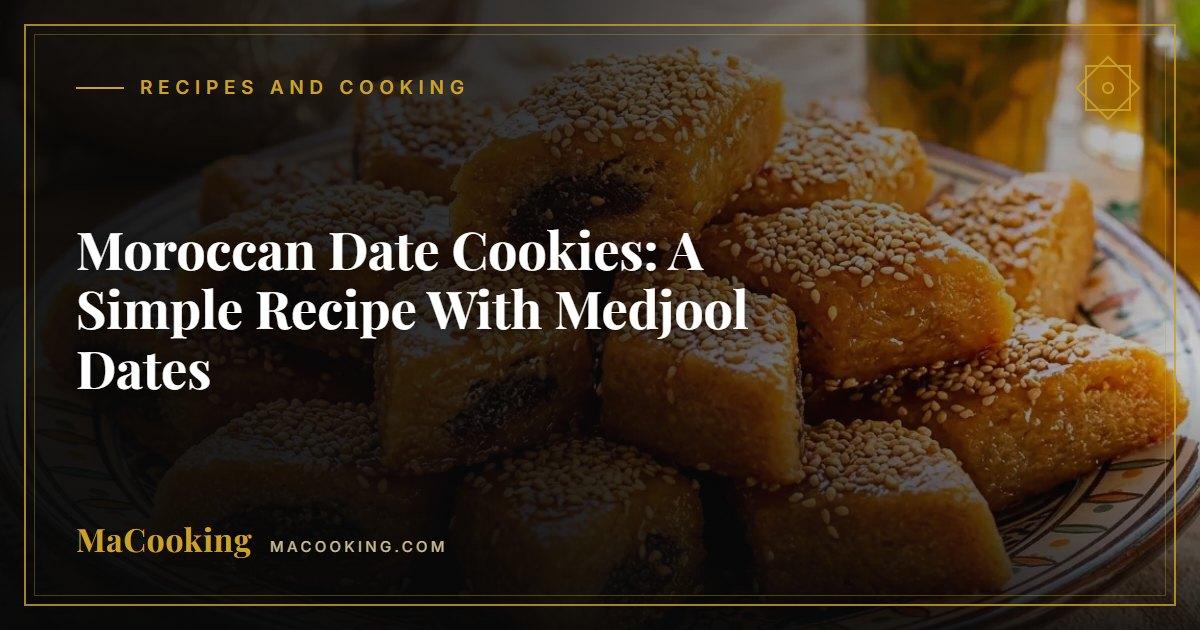
Moroccan date cookies are tender semolina-and-butter cookies wrapped around a spiced Medjool date paste, baked until pale gold and brushed with honey. This version uses pantry staples, takes about 90 minutes including resting time, and makes roughly 30 diamond-shaped cookies that stay soft for days.
Key Takeaways
- Medjool dates blend into a smooth, caramel-rich filling with no cooking, which makes this one of the easiest Moroccan cookies to start with.
- Fine semolina plus a little flour gives the dough its sandy, tender crumb. Resting the dough for 30 minutes is essential.
- Orange blossom water, cinnamon and a pinch of salt are what make the flavor taste unmistakably Moroccan.
- Bake at 180°C / 350°F for 18 to 22 minutes, then brush with warm honey while the cookies are still hot.
- They keep for about a week in a tin and freeze well, so they are ideal for tea gatherings and holiday platters.
What Are Moroccan Date Cookies?
Dates are central to Moroccan sweet-making. They show up stuffed with almond paste, folded into pastries, simmered into tagines and pressed inside cookies. Among moroccan desserts with dates, the filled semolina cookie is probably the most recognizable: a crumbly, buttery shell around a dense, sticky center that tastes of caramel, cinnamon and flower water.
The best-known traditional form is makrout, a diamond-shaped semolina cookie stuffed with date paste that is found across North Africa, with regional variations in the dough, the flavorings and whether the cookies are fried or baked. The recipe below is a streamlined, baked, home-friendly take on that idea. If you want to try the fully traditional version afterward, our makrout recipe with semolina and dates is the natural next step.
This cookie belongs to the wider family of sweets covered in our guide to Moroccan desserts and sweets, where you can explore everything from almond pastries to rice pudding.
Why Medjool Dates for Moroccan Date Cookies?
Morocco grows many date varieties, especially in the oases of the south and southeast, and the Medjool is among the most prized. Its flesh is thick, soft and honeyed, with a deep caramel flavor. Medjool palms in other countries are widely reported to descend from offshoots taken from Morocco in the early twentieth century; you can read an overview on Wikipedia's Medjool page.
For baking, the practical advantages are what matter:
- Moisture: Medjools are soft enough to mash into a paste with just a fork or a food processor, no extra syrup needed.
- Sweetness: They are sweet enough that the filling needs no added sugar, so the cookie does not become cloying.
- Size: Fewer dates are needed per batch, so pitting is quick.
If you can only find drier dates such as Deglet Noor, you can still make the recipe. See the substitution table below.
What Ingredients Do You Need?
This recipe makes about 30 cookies. All the ingredients are easy to find in supermarkets, Middle Eastern shops or online.
For the dough
- 250 g (1½ cups) fine semolina
- 125 g (1 cup) all-purpose (plain) flour
- 1 tbsp granulated sugar
- ¼ tsp fine salt
- 150 g (⅔ cup) unsalted butter, melted and slightly cooled
- 1 tsp orange blossom water
- About 100 ml (⅓ cup + 2 tbsp) cool water, added gradually
For the filling
- 300 g (about 12 to 14) pitted Medjool dates
- 1 tbsp softened unsalted butter
- ½ tsp ground cinnamon
- Pinch of ground cloves (optional)
- 1 tsp orange blossom water
- 1 tbsp toasted sesame seeds (optional, for texture)
For the finish
- 3 tbsp honey
- 1 tsp orange blossom water
- 1 to 2 tbsp toasted sesame seeds, for sprinkling (optional)
Substitutions for Western pantries
| Ingredient | Substitute | What changes |
|---|---|---|
| Fine semolina | Fine-ground semolina or "semolina flour" (not coarse); or extra all-purpose flour | Coarse semolina feels gritty. All flour gives a softer, shortbread-like cookie. |
| Medjool dates | Deglet Noor dates soaked 10 minutes in hot water, drained well | Filling is a little less sweet and needs an extra teaspoon of butter. |
| Orange blossom water | ½ tsp finely grated orange zest plus 1 tsp water | Less floral, but still fragrant. |
| Butter | Sunflower or light olive oil (same weight, slightly less: 130 ml) | Dairy-free, a touch less rich, slightly sandier crumb. |
| Honey | Maple syrup or agave | Milder flavor; glaze is thinner. |
How Do You Make Moroccan Date Cookies Step by Step?
If you have wondered how to make Moroccan cookies without special equipment, this is a good place to start. You need a bowl, a baking sheet and your hands.
1. Make the dough
- In a large bowl, whisk together the semolina, flour, sugar and salt.
- Pour in the melted butter and rub it through the dry ingredients with your fingertips for 2 to 3 minutes, until the mixture looks like damp sand and holds together when squeezed.
- Let it rest for 10 minutes. This allows the semolina to absorb the fat.
- Add the orange blossom water, then sprinkle in the water a few tablespoons at a time, gathering the dough as you go. Stop when it forms a smooth, soft ball that is not sticky. You may not need all the water.
- Knead gently for about 1 minute, just until smooth. Cover and rest for 30 minutes at room temperature.
2. Prepare the date filling
- Pit the dates and tear them into pieces. Remove any tough skin fragments.
- Pulse in a food processor with the butter, cinnamon, cloves and orange blossom water until a thick, sticky paste forms. Without a processor, mash with a fork and then knead in your hands, dampened with a little water so the paste does not stick.
- Stir in the sesame seeds if using. Divide the paste into 2 equal portions and roll each into a log about 30 cm (12 in) long and 1.5 cm (½ in) thick. Chill the logs for 10 minutes if they feel too soft.
3. Shape the cookies
- Preheat the oven to 180°C / 350°F (160°C fan) and line a baking sheet with parchment paper.
- Divide the dough into 2 equal portions. Roll one portion into a rope about 30 cm (12 in) long, then flatten it slightly with your palm into a long strip about 5 cm (2 in) wide.
- Press a shallow trench lengthwise down the center with your finger or the handle of a wooden spoon. Lay a date log in the trench.
- Bring the long edges of the dough up and over the filling and pinch them closed along the seam. Roll the log gently so the seam faces down and the dough surrounds the dates evenly.
- Flatten the log lightly with the palm of your hand to a thickness of about 2 cm (¾ in). Smooth any cracks with a damp fingertip.
- With a sharp knife, cut on the diagonal into diamonds about 3 cm (1¼ in) wide. Place on the baking sheet about 2 cm apart. Repeat with the second portion.
4. Bake and glaze
- Bake for 18 to 22 minutes, until the cookies are set and the bottoms and edges are pale golden. The tops should stay light. Browning them too far dries out the crumb.
- While the cookies bake, warm the honey with the orange blossom water over low heat for about 1 minute until fluid. Do not boil.
- Brush the warm cookies lightly with the honey mixture as soon as they come out of the oven. Sprinkle with sesame seeds while the glaze is tacky.
- Cool on the tray for 10 minutes before moving them. They firm up as they cool.
How Long Does Each Step Take?
| Stage | Time | Notes |
|---|---|---|
| Mix and rest dough | 10 min + 30 min rest | Resting is not optional; it prevents cracking. |
| Prepare date filling | 10 min | Can be done during the dough rest. |
| Shape and cut | 15 to 20 min | Faster once you have done one log. |
| Bake | 18 to 22 min | Rotate the tray halfway if your oven has hot spots. |
| Glaze and cool | 10 to 15 min | Glaze while hot for the best absorption. |
| Total | About 1 hour 45 min | About 50 minutes of active work. |
Why Did My Date Cookies Crack, Crumble or Turn Dry?
Semolina doughs are forgiving once you know their habits. These are the most common problems and how to fix them.
- The dough cracks when you shape it. It is too dry or has not rested. Knead in a teaspoon of water at a time, and always give it the full 30 minutes so the semolina can hydrate.
- The filling leaks out. The dough strip was too thin or the seam was not pinched. Make sure the dough covers the date log with a little overlap, and place the seam on the underside.
- The cookies are hard rather than tender. The dough was overworked or baked too long. Knead only until smooth, and pull the cookies out when the edges are just golden.
- The cookies fall apart when cut. The knife needs to be sharp, and you should cut with a firm downward press rather than sawing. Chill the shaped log for 10 minutes if it feels soft.
- The date paste is too sticky to roll. Dampen your hands lightly with water or oil, or chill the paste for 15 minutes.
- The flavor is flat. Do not skip the salt or the orange blossom water. A small pinch of salt lifts the sweetness of the dates.
Which Other Traditional Moroccan Cookies Should You Try?
If these cookies make you curious about traditional Moroccan cookies, the table below is a quick guide to some of the best-known Moroccan cookies names and what to expect from each.
| Cookie | Main flavors | Texture | Where to start |
|---|---|---|---|
| Makrout | Semolina, date paste, honey | Crumbly outside, sticky inside | Makrout recipe |
| Ghriba | Almond, orange blossom, sometimes coconut or walnut | Crackled top, soft and chewy center | Almond ghriba |
| Fekkas | Almonds, raisins, aniseed | Twice-baked, crunchy, like biscotti | Moroccan fekkas |
| Chebakia | Sesame, honey, orange blossom, spices | Fried, honey-soaked, crisp-chewy | Chebakia guide |
| Kaab el ghazal (gazelle horns) | Almond paste, orange blossom | Thin, delicate crescent with a soft filling | Almond pastries guide |
Many of these sweets are made in large batches ahead of Eid, weddings and other celebrations, and served with mint tea. Our guide to Moroccan almond pastries and traditional sweets goes deeper into the almond-based family if you want to build a full tray.
How Do You Serve and Store Moroccan Date Cookies?
Serve them at room temperature on a platter with a pot of fresh mint tea, or alongside strong coffee. A small stack on a plate also makes a good gift when wrapped in parchment and tied with string.
Storage
- Room temperature: Layer the cookies between sheets of parchment in an airtight tin for 5 to 7 days. The date filling keeps them moist.
- Freezer: Freeze the baked, glazed cookies in a single layer on a tray, then transfer them to a freezer container for up to 2 months. Thaw at room temperature for about 1 hour.
- Make-ahead: Keep the filling in the fridge for up to a week and the rested dough for up to 2 days. Bring both to cool room temperature before shaping.
Variations to Try
- Sesame-coated: Press the cut cookies into raw sesame seeds before baking for a nuttier crust. For a fuller version of this idea, see our makrout with dates and sesame.
- Almond-date filling: Mix 40 g (⅓ cup) of finely ground almonds into the date paste for a richer, slightly less sticky center.
- Spiced: Add a pinch of ground aniseed or ginger to the dough, which is a common pairing with sweets in Moroccan kitchens.
- Orange zest: Add the zest of half an orange to the dough for brightness.
- Round cookies: If you prefer, cut the filled log into small rounds and flatten slightly. The flavor is identical.
Dates are just as versatile in savory cooking. For ideas beyond cookies, read our collection of Moroccan date recipes, from stuffed dates to date-infused tagines.
Why Do Dates Matter So Much in Moroccan Cooking?
Dates have long been a staple food in the oasis regions of Morocco, and they are widely eaten to break the fast during Ramadan and offered to guests as a gesture of welcome. This is why date sweets feel so at home in Moroccan hospitality: a plate of cookies and tea is rarely absent when visitors arrive.
To understand how ingredients like dates, almonds and orange blossom became part of the Moroccan table, you can read the free chapter "A History of the Moroccan Table" online. It is part of the ebook The Royal Moroccan Table: The Soul of Morocco, whose full edition also includes a chapter titled "How to Read a Moroccan Recipe", useful if you enjoy cooking from traditional sources.
Frequently Asked Questions
What kind of dates are best for Moroccan date cookies?
Medjool dates are the easiest choice because they are large, soft and caramel-like, so they blend into a smooth paste with little effort. Deglet Noor dates also work, but they are firmer and drier, so soak them in hot water for 10 minutes and add a little extra butter to the filling.
Can I make Moroccan date cookies without semolina?
You can, but the texture changes. Semolina gives the dough its fine, sandy crumb. If you only have all-purpose flour, use about 400 g (3 cups) in total and reduce the water slightly. The cookies will be softer and less crumbly, closer to a shortbread than a traditional semolina cookie.
How long do Moroccan date cookies keep?
Stored in an airtight tin at room temperature, they stay good for about 5 to 7 days. The date filling keeps them moist. For longer storage, freeze the baked and glazed cookies in a single layer, then transfer to a container for up to 2 months, and thaw at room temperature.
Are Moroccan date cookies the same as makrout?
They are close relatives. Makrout is the classic semolina cookie stuffed with date paste, often fried and soaked in honey. This recipe uses the same flavors and shape but bakes the cookies and finishes them with a light honey glaze, which makes it simpler for a home kitchen.
Can I make the dough or filling ahead?
Yes. The date filling keeps in the fridge for up to a week, and the rested dough can be refrigerated for up to 2 days. Bring both to cool room temperature before shaping so the dough is pliable and the paste is easy to roll.
Are these cookies vegan or dairy-free?
Not as written, because they use butter. To make them dairy-free, replace the butter in both the dough and filling with a neutral oil such as sunflower, or with a good vegan block butter. Use maple syrup or agave instead of honey for the glaze if you want them fully vegan.
Conclusion
Moroccan date cookies prove that a great sweet does not need a long ingredient list: fine semolina, butter, ripe Medjool dates and a spoonful of orange blossom water are enough. Once you have mastered the basic shape, you can explore fried makrout, almond-filled ghriba or honey-soaked chebakia. For a complete tour of the category, browse our Desserts and Sweets collection and bake a tray to share with tea.