A History of the Moroccan Table
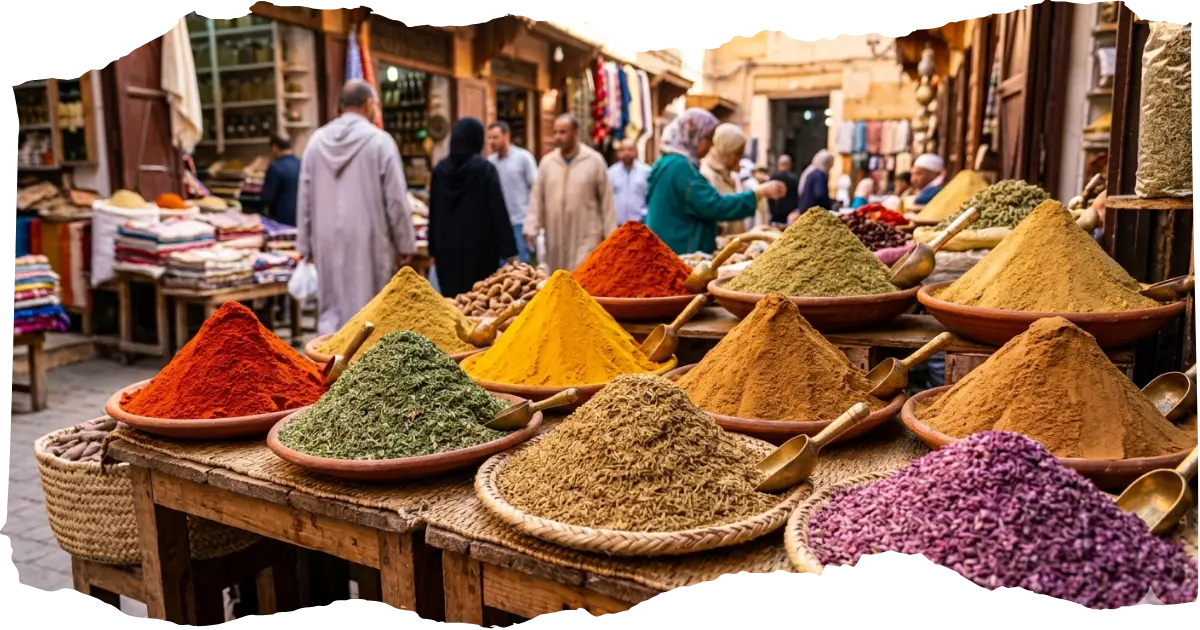
Five thousand years of invasion, trade, exile, and migration — all of it recorded not in stone, but in the pot. To eat Moroccan food is to taste every civilisation that has ever passed through this country at the edge of the world.
Most people know Moroccan food through a handful of images: the conical tagine, the mountain of couscous, the silver teapot pouring mint tea from a great height. These images are real and beautiful — but they are the surface of something far more layered. To understand why Moroccan food tastes the way it does, you need to understand the people who built it across fifty centuries of continuous culinary history.
The Amazigh Foundation — 3000 BCE to Present
The Imazighen — known to the outside world as the Berbers, though they have never called themselves that — are the original inhabitants of North Africa. They were present in the Atlas Mountains and the Saharan plains long before any empire arrived, and they are present still. Their cuisine is the bedrock on which everything else was built.
The Amazigh contribution to Moroccan cuisine is fundamental and irreducible. They gave Morocco argan oil — pressed from the fruit of a tree that grows nowhere else on earth, in a process so labour-intensive that for centuries only Moroccan women performed it. They gave Morocco couscous — the word itself is Amazigh, from the verb seksu, meaning to make well-formed, to round. They developed the couscoussier, the double-boiler steaming vessel that remains the most important piece of kitchen equipment in the Moroccan home.
The Arab-Islamic Transformation — 7th Century CE
When Arab armies reached North Africa in the seventh century, they brought with them not just a new religion but a new culinary vocabulary. Dates, almonds, honey, dried figs, rose water, and the concept of cooking as an art form connected to beauty, generosity, and the divine entered the Moroccan kitchen simultaneously.
Most significantly, they brought saffron — and with it, the idea that food should engage all five senses simultaneously. The colour of the saffron in the broth, the perfume rising from the pot, the warmth on the tongue, the delicate flavour, the golden sheen on the meat: these were considered aspects of a single unified sensory experience, not separate qualities to be evaluated individually. This holistic approach to flavour remains one of the defining characteristics of Moroccan cooking.
The Islamic concept of barakah — divine blessing — also transformed the Moroccan table. Food prepared with proper intention and consumed in gratitude was believed to carry spiritual nourishment as well as physical. This is why Moroccan cooks still say 'Bismillah' — in the name of God — before they begin cooking, and why 'Hamdullah' — thanks be to God — is the correct response when asked how a meal was.

The Andalusian Refinement — 15th Century
In 1492, the same year Columbus sailed to the Americas, the last Muslim kingdom in Spain fell to the Catholic monarchs Ferdinand and Isabella. In the years that followed, hundreds of thousands of Muslims and Jews — the Moriscos and the Sephardim — were expelled from Al-Andalus, the Islamic civilisation that had flourished on the Iberian Peninsula for nearly eight centuries.
Most of them crossed the Strait of Gibraltar and settled in the northern cities of Morocco — Fes, Tétouan, Chefchaouen. They arrived carrying the most sophisticated urban cuisine in the medieval world. Pastilla — the extraordinary sweet-savoury pastry made with warqa dough, pigeon or chicken, almonds, eggs, and cinnamon — is their single most enduring gift to Moroccan cooking. So is orange blossom water, which perfumes the pastries and sweet drinks of northern Morocco to this day.
When you taste the bittersweet contrast in a lamb bastilla dusted with cinnamon and powdered sugar, you are tasting the memory of a paradise lost — the gardens of Al-Andalus, preserved for five centuries in pastry and spice.
The Andalusian influence is most visible in the cuisine of Fes — historically the city where the most cultivated Andalusian families settled, and where the most refined Moroccan cooking tradition developed. Fassi cuisine is characterised by its complexity, its use of sweet elements in savoury dishes, its elaborate presentations, and its profound nostalgia for a lost civilisation expressed through food.
The Sub-Saharan Influence — The Great Trade Routes
For centuries, Morocco was the northern terminus of the trans-Saharan trade routes. Gold, salt, ivory, and textiles moved northward through the Sahara; finished goods and spices moved south. Along with the commodities came flavours and techniques from the Sahel and beyond: black pepper in quantities that permanently changed the spice profile of Moroccan cooking, dried fruits and dates that gave new depth to meat dishes, and cooking traditions from sub-Saharan Africa that added warmth, earthiness, and a particular relationship with fire to the Moroccan kitchen.
The Mediterranean Coast — Ancient and Continuous
Morocco's long Atlantic and Mediterranean coastlines have always kept it connected to the wider world. The Romans grew grain here; the Phoenicians established trading posts; the Portuguese built fortified cities on the Atlantic coast. All of them left traces. The love of fresh fish simply prepared, the use of olive oil as a finishing flavour rather than a cooking medium, the clean acidity of fresh lemon juice — these Mediterranean elements form a constant counterpoint to the richer, more complex interior dishes of the mountains and desert cities.