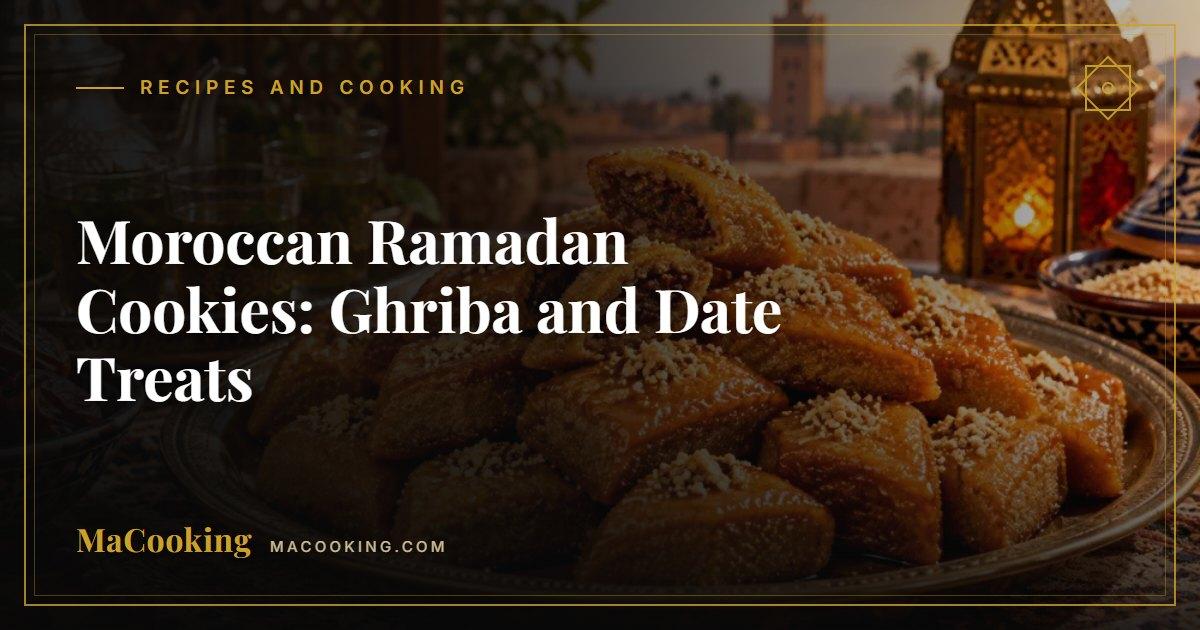
A classic moroccan cookies recipe for Ramadan starts with ghriba: almonds or semolina, sugar, eggs and orange blossom water, baked until the top cracks and the centre stays tender. Pair it with honey-dipped date cookies, and you have two traditional sweets for tea after iftar that can both be made days ahead.
Key Takeaways
- Almond ghriba needs only a handful of ingredients. The cracked, pale top comes from a thick coating of icing sugar and a moderate oven.
- Moroccan date cookies are semolina dough wrapped around a spiced date paste, then glazed with warm honey. They can be baked instead of fried.
- Sesame seeds are toasted before use in many Moroccan sweets, which gives a nutty depth that raw seeds lack.
- Most Ramadan cookies keep well, so you can bake them over the weekend and serve them all week with mint tea.
- Orange blossom water is the signature scent. Orange zest with a drop of vanilla is a reasonable substitute.
What Makes Traditional Moroccan Cookies Different?
Traditional Moroccan cookies are built on a few pantry staples: almonds, semolina, sesame, dates, honey and floral waters. Butter and sugar are present, but they are rarely the headline. You will find far less of the creaming-and-whisking technique that defines Western biscuits. Instead, the dough is often mixed by hand, rested, shaped into small portions and finished with a coating (icing sugar, sesame or honey) that gives each cookie its identity.
During Ramadan these sweets sit beside the evening tea, after the fast is broken with dates, soup and other savoury dishes. They are small and rich, meant to be eaten one or two at a time with a glass of sweet mint tea. If you want to see how the sweets fit into the whole evening, our guide to Moroccan Ramadan food and the daily menu walks through the order of the table. Moroccan baking draws on a long mix of Arab, Amazigh (Berber) and Andalusian influences, a history summarised in the Wikipedia overview of Moroccan cuisine.
Which Moroccan Cookies Are Served During Ramadan?
Four or five cookies appear again and again on Ramadan trays, and each has a different texture. Most households make a few of them rather than all. The table below compares them so you can choose what suits your time and equipment.
| Cookie | Main ingredients | Method | Texture |
|---|---|---|---|
| Ghriba (almond or semolina) | Ground almonds or semolina/flour, sugar, egg, orange blossom water | Shaped by hand, rolled in icing sugar, baked | Crackled outside, soft and chewy or crumbly inside |
| Makrout | Semolina, butter or oil, date paste, honey | Filled dough cut into diamonds, baked or fried, honey-dipped | Tender, sticky, deeply sweet |
| Chebakia | Flour, sesame, spices, honey | Folded into flower shapes, fried, soaked in honey | Crisp shell, sticky exterior |
| Fekkas | Flour, almonds, raisins, anise or sesame | Baked as a loaf, sliced, baked again | Dry and crunchy, like biscotti |
| Sellou (sfouf) | Toasted flour, sesame, almonds, honey or sugar | No baking after the flour is toasted | Crumbly, fine and rich |
We have separate recipes for several of these. See our chebakia recipe, the sellou preparation guide and the Moroccan fekkas with almonds and raisins. Here we focus on two you can bake in a standard home oven: almond ghriba and date cookies.
Moroccan Cookies Recipe: Almond Ghriba Step by Step
This is the answer to how to make Moroccan almond cookies without any flour. The cookies are naturally gluten-free as long as your baking powder is, and they bake into pale, cracked domes with a chewy centre. Our own almond ghriba cookies recipe has a slightly different method, so compare both and keep the one you prefer.
Ingredients (makes about 20 cookies)
- 250 g (2½ cups) finely ground blanched almonds
- 150 g (¾ cup) caster sugar
- 1 tsp baking powder
- Pinch of fine salt
- Zest of 1 lemon
- 1 large egg plus 1 egg yolk
- 1 tsp orange blossom water
- ½ tsp ground cinnamon (optional)
- About 100 g (¾ cup) icing sugar, for rolling
Method
- Mix the dry ingredients. In a large bowl, combine the ground almonds, sugar, baking powder, salt, cinnamon and lemon zest. Rub the zest through with your fingertips to release its oils.
- Add the wet ingredients. Whisk the egg, yolk and orange blossom water lightly, then pour into the bowl. Mix with a spatula, then your hands, until a thick, sticky dough forms. If it feels unmanageable, add one tablespoon of extra ground almonds, but keep it soft.
- Chill. Cover and refrigerate for 30 minutes. This makes the dough easier to shape and helps the cookies keep their height.
- Heat the oven. Set it to 170°C (340°F), or 150°C fan. Line two trays with baking paper.
- Shape. Put the icing sugar in a wide bowl. With damp hands, roll walnut-sized portions (about 25 g each) into balls. Drop each into the icing sugar and roll until it is completely and thickly coated.
- Bake. Place the balls 4 cm (1½ in) apart. Do not flatten them. Bake for 14 to 16 minutes, until the surface is cracked and the base is just beginning to colour. The tops should stay white.
- Cool. Leave on the tray for 10 minutes. They firm up as they cool, so lifting them too soon can break them.
Why ghriba cracks, and what stops it
The cracks come from the sugar crust setting while the dough inside expands from the baking powder. A thin sugar coat, a very cool oven or old baking powder will give smooth tops. An oven that is too hot will brown the surface before it splits. Use an oven thermometer if your cookies are inconsistent. Note that ghriba comes in several families: some are made with semolina or flour and oil or butter, giving a crumblier bite, while the almond version is denser and chewier.
How Do You Make Moroccan Date Cookies?
Moroccan date cookies, usually called makrout, are semolina logs filled with a spiced date paste, cut into diamonds and finished with honey. The version below is baked, which is easier and less greasy for a first attempt. Our full makrout recipe covers the traditional approach in more depth.
Ingredients (makes about 30 pieces)
Dough
- 300 g (about 1¾ cups) fine semolina
- 100 g (¾ cup) plain flour
- 150 g (⅔ cup) butter or ghee, melted
- Pinch of salt
- 1 tsp orange blossom water
- About 100 ml (⅓ cup plus 1 tbsp) warm water, added gradually
Filling and glaze
- 250 g pitted soft dates (Medjool or deglet noor)
- 1 tbsp softened butter
- ½ tsp ground cinnamon
- 1 tsp orange blossom water
- About 150 g (½ cup) runny honey, warmed
- Sesame seeds, lightly toasted, for sprinkling (optional)
Method
- Make the dough. Mix the semolina, flour and salt. Pour in the melted butter and rub it between your palms until the mixture looks like damp sand and holds when squeezed.
- Add liquid. Sprinkle in the orange blossom water and warm water, a little at a time, until a smooth, pliable dough forms. It should not be sticky. Cover and rest for 20 minutes so the semolina hydrates.
- Prepare the filling. Knead the dates with the butter, cinnamon and orange blossom water until you have a smooth, pliable paste. If the dates are dry, soften them for 5 minutes in hot water, then drain and pat them dry before kneading.
- Shape. Divide both the dough and the date paste into two equal parts. Roll the date paste into a log about 2 cm thick. Flatten a piece of dough into a long strip, lay the log on top and wrap the dough around it, pinching the seam closed. Roll gently until smooth, then flatten the log slightly with your palm.
- Cut. Using a sharp knife, cut the log into diamonds about 4 cm wide. Press a light pattern into the top with a fork if you like.
- Bake. Arrange on a lined tray and bake at 180°C (350°F) for 20 to 25 minutes, until pale golden at the edges.
- Glaze. While the cookies are still hot, dip each one into the warm honey for a few seconds, turning once. Drain on a rack and sprinkle with sesame seeds if using.
Tip: the diamonds cut cleanly if you chill the filled log for 15 minutes before slicing.
Where Do Sesame Seeds Fit in Moroccan Cookies?
Sesame is one of the signature flavours in Moroccan sweets, and moroccan cookies with sesame seeds range from the crunchy fekkas to chebakia and sellou. Our guide to Moroccan almond pastries shows how nuts and sesame share the stage across the repertoire.
Sesame is used in three main ways:
- As a coating: pressed onto cookies or sprinkled over honey glazes, as in the date cookies above.
- In the dough: mixed into fekkas, or ground into the base of sellou.
- In the frying and honey step: chebakia is traditionally scattered with seeds after its honey bath.
How to toast sesame seeds
Toast raw white sesame seeds in a dry pan over medium-low heat for 3 to 5 minutes, stirring constantly, until they turn light golden and smell nutty. Tip them onto a plate immediately, because they continue to darken in the hot pan. Untoasted seeds taste flat and slightly bitter in comparison.
To end the evening properly, serve the cookies with mint tea. Our free chapter, The Moroccan Tea Ceremony: The Complete Guide, is free to read online and explains the pour, the sweetness and the serving order.
What Can I Substitute in Moroccan Cookies?
Some Moroccan ingredients are harder to find outside North Africa and the Middle East. These swaps work reasonably well, though the flavour will shift slightly.
| Ingredient | Substitute | Notes |
|---|---|---|
| Orange blossom water | Orange zest plus a drop of vanilla | Less floral but still fragrant. Rose water works, but use about half as much. |
| Fine semolina | Fine cornmeal or semolina flour | Cornmeal makes a grainier, more crumbly texture. Avoid coarse semolina. |
| Ghee or smen | Unsalted butter | Smen has a strong, cheesy fermented note that butter will not replicate. |
| Ground blanched almonds | Almond flour | Use finely ground, not almond meal with skins, for a paler cookie. |
| Medjool dates | Deglet noor or other soft dates | Soak dry dates briefly in hot water, then drain well. |
| Honey glaze | Light agave or golden syrup | Warm gently and keep the dip short, since these are thinner. |
What Are the Most Common Mistakes?
- Overbaking ghriba. The tops should stay pale. Browned ghriba turns dry and hard once it cools.
- Using a thin sugar coat. Be generous. A thick coat gives the signature cracked look.
- Skipping the semolina rest. The dough cracks and crumbles if the grains have not absorbed the liquid.
- Dipping in cold honey. Warm honey, and cookies that are still hot, give the best absorption. Cold honey just sits on the surface.
- Over-wetting the dates. If the filling is sloppy, it leaks during baking. Pat softened dates dry first.
How Should You Store and Plan Ahead for Ramadan?
Because Ramadan evenings are busy, plan the baking over a weekend. Here is a practical schedule for the two cookies in this article.
| Cookie | Prep time | Keeps (airtight, cool) | Freezer |
|---|---|---|---|
| Almond ghriba | 20 min plus 30 min chilling, 15 min baking | About 1 week | Up to 2 months, unbaked balls or baked cookies |
| Date cookies | 45 min plus 20 min resting, 25 min baking | About 2 weeks | Up to 2 months, before the honey dip |
Store ghriba in a tin with baking paper between layers so the sugar crust stays intact. If it softens, warm it at 120°C (250°F) for 5 minutes and cool it again. Keep honey-glazed cookies in a single layer or with paper between them, or they will stick together.
If you are planning more than sweets, our guide to preparing for Ramadan the Moroccan way covers rituals and recipes together. Browse all our Moroccan recipes for savoury dishes to serve before the cookies.
Frequently Asked Questions
How do I make Moroccan almond cookies?
Mix 250 g ground almonds with 150 g caster sugar, 1 tsp baking powder, lemon zest, orange blossom water, 1 egg and 1 yolk. Chill the sticky dough, roll walnut-sized balls in icing sugar, and bake at 170°C (340°F) for 14-16 minutes until cracked and still pale.
Why didn't my ghriba crack on top?
Cracks need a generous coat of icing sugar, fresh baking powder and a properly heated oven. If the dough is too wet or the cookies are flattened, they spread instead of splitting. Roll the balls thickly in sugar, do not press them down, and check your oven temperature with a thermometer.
Can I make Moroccan date cookies without frying?
Yes. Baking the semolina and date cookies at 180°C (350°F) for 20-25 minutes works well and is simpler than deep-frying. Dip them in warm honey while they are still hot so the syrup soaks in. They will be slightly drier than fried versions, but they keep well.
How long do Moroccan Ramadan cookies keep?
Almond ghriba keeps about a week in an airtight tin, and date cookies keep about two weeks if kept cool and dry. Both can be frozen, uncoated or undipped, for up to two months. Re-crisp ghriba in a low oven for a few minutes if they soften.
What can I use instead of orange blossom water?
Use a little finely grated orange zest plus a drop of vanilla extract, which gives a similar citrusy fragrance. Rose water is a floral alternative, but use less because it is stronger. Add either gradually and taste the dough, since brands vary in strength.
Conclusion
A good moroccan cookies recipe does not need many ingredients, just attention to texture: a thick sugar crust on ghriba, a rested semolina dough and a warm honey dip for the date cookies. Bake them ahead, keep them in tins, and bring them out with mint tea after iftar. Once these feel comfortable, move on to chebakia and fekkas for a fuller Ramadan tray.