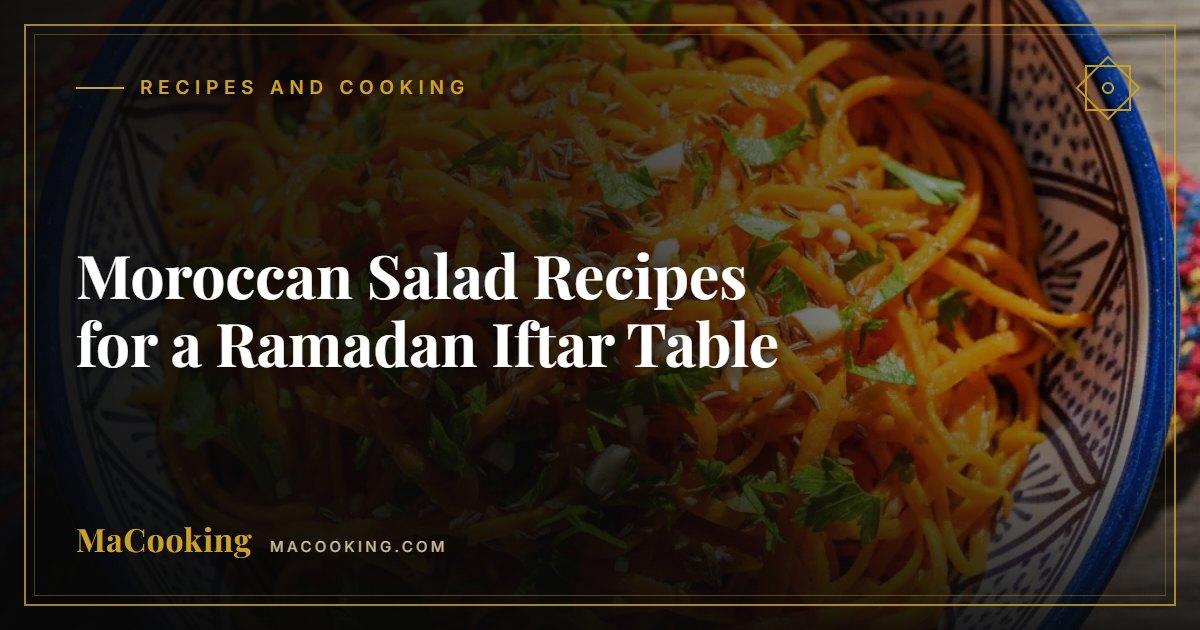
The best Moroccan salad recipes for dinner at iftar are cooked, well-seasoned and made ahead: spiced carrot salad, lemony chickpea salad, smoky zaalouk and a fresh couscous salad. Most take under 40 minutes, improve after a few hours in the fridge, and sit comfortably beside harira, dates and bread on a Ramadan table.
Key Takeaways
- Moroccan salads are often cooked or marinated, not just raw leaves, which makes them ideal for preparing before sunset.
- Four dishes cover a whole spread: carrot salad, chickpea salad, zaalouk and a cold couscous salad.
- Cumin, paprika, garlic, lemon, olive oil and fresh herbs form the flavour base of nearly every one.
- Cooked salads keep 3-4 days in the fridge; add herbs and lemon at the end for brightness.
- Serve three or four small bowls rather than one large salad, so the table has contrast in colour, temperature and texture.
Why Do Salads Matter on the Iftar Table?
In a Moroccan home, the fast is usually broken gently: dates, water or milk, then a bowl of harira, often with eggs, bread and sweets. Salads fill the space between that first light meal and the heavier dish that may follow. They bring acidity, freshness and vegetables to a table that can otherwise lean rich and fried.
Moroccan "salads" are also broader than the Western idea. Many are slow-cooked vegetable dishes served cool or at room temperature, scooped up with bread. That is exactly why they suit Ramadan: you cook once in the afternoon, and everything is ready the moment the call to prayer sounds. If you want to understand the nutritional and cultural logic behind this style of eating, our piece on the benefits of Moroccan salads goes deeper.
If you are looking for Moroccan salad recipes for dinner outside Ramadan, the same dishes work year-round as a starter spread or a light main with bread and olives.
Which Moroccan Salad Recipes for Dinner Work Best at Iftar?
Choose dishes that can be made ahead, that contrast with each other, and that don't compete for stove or oven space at the last minute. This table compares the salads in this guide and a few classics worth adding.
| Salad | Main ingredients | Active + cooking time | Served | Fridge life |
|---|---|---|---|---|
| Cooked carrot salad | Carrots, cumin, garlic, lemon, parsley | 10 + 10 min | Cold or room temp | 4 days |
| Chickpea salad | Chickpeas, tomato, onion, cilantro, lemon | 15 min | Cold | 3 days |
| Zaalouk | Eggplant, tomato, garlic, paprika, cumin | 15 + 35 min | Warm or room temp | 4 days |
| Couscous salad | Couscous, cucumber, tomato, mint, lemon | 20 min | Cold | 2 days |
| Taktouka (optional) | Roasted peppers, tomato, garlic | 20 + 30 min | Warm or cold | 4 days |
| Beetroot salad (optional) | Cooked beets, cumin, orange blossom or lemon | 10 min (pre-cooked beets) | Cold | 4 days |
For an everyday iftar, three bowls are plenty: one orange or red (carrot or taktouka), one green or fresh (chickpea or couscous), and one deep and savoury (zaalouk).
What Are the Core Moroccan Salad Ingredients?
Once your pantry is stocked, most of these salads come together with very little shopping. Here are the main Moroccan salad ingredients, what they do, and what to use if you cannot find them.
| Ingredient | Role in the dish | Substitute if needed |
|---|---|---|
| Ground cumin | Earthy backbone of carrot, chickpea and zaalouk | Toasted, ground cumin seed is best; no real substitute |
| Sweet paprika | Colour and mild sweetness | Mild smoked paprika (use slightly less) |
| Fresh cilantro and flat-leaf parsley | Freshness; often used together | All parsley, with a little mint |
| Preserved lemon | Salty, floral depth | Fresh lemon zest plus a pinch of extra salt |
| Olive oil | Body and richness | Mild extra-virgin; avoid very peppery oils |
| Fresh garlic | Sharp, savoury note | Lightly cooked garlic if serving to guests who dislike raw bite |
| Orange blossom water | Floral lift in sweeter carrot or orange salads | A little orange zest and juice |
| Ripe tomatoes | Sweetness and sauce for cooked salads | Good canned whole tomatoes in winter |
Preserved lemons are worth making if you cook Moroccan food regularly. Our step-by-step guide to preserved lemons explains the salting and the wait. They need about four weeks, so start well before Ramadan.
How Do You Make Moroccan Carrot Salad?
If you have wondered how to make Moroccan carrot salad, the cooked version is the one you will meet most often on a family table. The carrots are simmered until just tender, then dressed while warm so they soak up the lemon, garlic and cumin.
Ingredients (serves 4-6)
- 500 g (1 lb) carrots, peeled and sliced into 5 mm (¼ inch) rounds
- 2 garlic cloves, finely grated
- 3 tbsp olive oil
- 2 tbsp lemon juice (about 1 lemon)
- 1 tsp ground cumin
- ½ tsp sweet paprika
- ½ tsp fine salt, plus more to taste
- 1 tsp sugar or honey (optional)
- 3 tbsp chopped parsley or cilantro
Method
- Bring a pot of salted water to a boil. Add the carrots and cook for 8-10 minutes, until a knife slides in easily but the slices still hold their shape.
- Drain well and let them steam dry for 2 minutes. Wet carrots dilute the dressing.
- While still warm, toss with garlic, cumin, paprika, salt, sugar, olive oil and lemon juice.
- Rest for at least 30 minutes, then stir in the herbs. Taste and add more lemon or salt if needed.
Prefer something raw and crunchy? Our Moroccan shredded carrot salad (shlada zrodiya) uses grated carrots and a lighter dressing, and is a lovely contrast to a cooked spread.
Common mistake: overcooking the carrots into mush. Test one at 8 minutes. They should have a gentle bite, since they will soften slightly as they marinate.
What Is the Best Moroccan Salad With Chickpeas?
A Moroccan salad with chickpeas is the most useful one to know because it doubles as a light main. The chickpeas bring protein and staying power after a long day of fasting, and the herb-heavy dressing keeps it from tasting heavy.
Ingredients (serves 4)
- 2 cans (400 g each) chickpeas, drained and rinsed, or about 300 g (1¾ cups) cooked from dried
- 1 small red onion, finely diced
- 1 ripe tomato, seeded and diced
- 3 tbsp chopped cilantro
- 3 tbsp chopped flat-leaf parsley
- 3 tbsp olive oil
- 2 tbsp lemon juice
- ½ tsp ground cumin
- ¼ tsp paprika
- ½ tsp salt
- 1-2 tbsp finely diced preserved lemon rind (optional; reduce the salt if using)
Method
- Soak the diced onion in cold water for 5 minutes, then drain. This softens the sharpness.
- Warm the chickpeas briefly in a pan or microwave, about 1-2 minutes. Warm chickpeas absorb the dressing better.
- Whisk the oil, lemon juice, cumin, paprika and salt in a large bowl. Add the chickpeas and toss.
- Fold in the onion, tomato, herbs and preserved lemon. Let it sit for 15 minutes before serving.
You can find a fuller version with extra variations in our chickpea salad with cilantro and lemon. If you cook dried chickpeas, soak them overnight and simmer 60-90 minutes until creamy, then salt near the end.
How Do You Make Zaalouk, the Smoky Eggplant Salad?
Zaalouk is a cooked eggplant and tomato salad, mashed lightly and seasoned with garlic, paprika and cumin. It is one of the most loved dishes on a Moroccan salad table and deserves a place at iftar because it tastes even better the next day.
Ingredients (serves 4-6)
- 2 medium eggplants (about 700 g / 1½ lb), peeled in stripes and cut into 2 cm cubes
- 4 ripe tomatoes (about 600 g), grated, skins discarded, or one 400 g can whole tomatoes, crushed
- 3 garlic cloves, minced
- 3 tbsp olive oil
- 1 tsp sweet paprika
- 1 tsp ground cumin
- Pinch of chilli flakes or cayenne (optional)
- 3 tbsp chopped cilantro
- Salt, and a squeeze of lemon to finish
Method
- Steam or boil the eggplant cubes for 10 minutes until soft. Drain in a colander and press gently to remove excess water.
- In a wide pan, warm the oil over medium heat. Add the garlic, paprika, cumin and chilli for 30 seconds, until fragrant.
- Add the tomatoes and a pinch of salt. Cook for 12-15 minutes, stirring, until thick and jammy.
- Add the eggplant. Mash with a wooden spoon and cook for 15-20 minutes over low heat, until the mixture is dense and glossy with oil at the edges.
- Stir in cilantro and lemon. Taste for salt.
Tip: don't blend it. A rough, spoonable texture is what you want. Serve warm or at room temperature with crusty bread for scooping.
Is There a Good Moroccan Couscous Salad for Dinner?
Yes, with one caveat. A Moroccan couscous salad is a modern, cold adaptation, not the steamed Friday dish. If you want the classic, read how to make authentic Moroccan couscous. This cold version borrows the flavours (cumin, mint, lemon, chickpeas) and is a good way to add a filling element to an iftar spread without turning on the stove for long.
Ingredients (serves 4-6)
- 200 g (1 cup) medium couscous
- 240 ml (1 cup) boiling water or vegetable stock
- 4 tbsp olive oil, divided
- ½ tsp salt
- ½ English cucumber, diced
- 2 tomatoes, seeded and diced
- ½ red onion, finely diced
- 100 g (⅔ cup) cooked chickpeas
- 3 tbsp chopped mint and 3 tbsp parsley
- 3 tbsp lemon juice
- ½ tsp ground cumin
- 40 g (¼ cup) raisins or chopped dried apricots (optional)
Method
- Put the couscous in a heatproof bowl with 1 tbsp oil and the salt. Pour over the boiling water, cover tightly and leave for 5 minutes.
- Fluff with a fork, rubbing gently to separate the grains. Cool completely, about 15 minutes.
- Whisk the remaining 3 tbsp oil with lemon juice and cumin.
- Combine couscous with vegetables, chickpeas, herbs and dried fruit. Add the dressing and toss.
Use fine or medium grains. Avoid pearl (Israeli) couscous, which is a different product and needs boiling. If your cooks lean towards the traditional, our couscous recipes collection has the steamed classics.
How Should You Plan and Serve a Moroccan Salad Spread?
Aim for balance rather than quantity. A good spread has something cooked, something fresh, something sweet-sour, and something creamy or hearty. Use small bowls, so people can sample.
A sample timeline for the afternoon
- Day before: cook zaalouk and carrot salad; cook dried chickpeas if using; refrigerate.
- 2-3 hours before iftar: remove salads from the fridge so they come to cool room temperature. Cold mutes the spices.
- 1 hour before: make the couscous salad and chickpea salad; chop herbs.
- 15 minutes before: add herbs and lemon to each bowl, drizzle olive oil, and set out bread and olives.
Hosting guests who are new to Ramadan? Our guide to hosting a Moroccan iftar covers timing, etiquette and what to put out first. For a broader selection of quick dishes, see top 10 easy Moroccan recipes for Ramadan iftar.
If you want to go deeper into the cold-dish tradition, the full ebook The Royal Moroccan Table, Part 4: The Royal Banquet includes the chapters "The Moroccan Mezze — Salads & Starters" and "The Complete Ramadan Table". Those are premium chapters that sit inside the paid book.
Storage and food-safety notes
- Cool cooked salads quickly and refrigerate within 2 hours of cooking.
- Keep dishes with raw onion, herbs and tomato for up to 2-3 days; the texture softens after that.
- Don't freeze carrot, chickpea or couscous salads. Zaalouk freezes reasonably well for 1-2 months, though the texture is slightly looser on thawing.
Common Mistakes When Making Moroccan Salads
- Under-seasoning. Cooked salads need more salt and acid than you expect, especially once chilled.
- Serving ice-cold. Cold dulls cumin and garlic. Rest at room temperature for 20-30 minutes.
- Skipping the drain. Watery eggplant or carrots dilute the dressing and make a limp salad.
- Adding herbs too early. They darken in acid. Fold them in at the end.
- Using one flavour profile throughout. Vary your bowls: a sweeter carrot, a tangy chickpea, a smoky zaalouk.
For background on how salads sit within the wider cuisine, the Moroccan cuisine overview on Wikipedia is a useful starting point.
Frequently Asked Questions
What salads are served at a Moroccan iftar?
Common choices include cooked carrot salad, chickpea salad, zaalouk (eggplant and tomato), taktouka (peppers and tomato), beetroot salad and a simple tomato-cucumber salad. They are usually served in small bowls alongside harira, dates, bread and eggs, so everyone can build a plate to their taste.
Can I make Moroccan salads ahead for Ramadan?
Yes. Cooked salads such as carrot, zaalouk and taktouka actually taste better after a few hours or the next day. Keep them covered in the fridge for up to four days. Add fresh herbs, lemon juice and any crisp vegetables just before serving.
What dressing is used in Moroccan salads?
Most use olive oil, lemon juice, garlic, cumin, paprika and fresh parsley or cilantro. Some add a little sugar or honey for balance, orange blossom water for sweeter carrot salads, or finely chopped preserved lemon rind for a salty, fragrant edge.
Is Moroccan couscous salad traditional?
Couscous salad is a modern, lighter adaptation rather than a classic dish. Traditional couscous is steamed and served hot with stew, usually on Fridays. The cold version borrows Moroccan flavours such as cumin, mint, lemon and chickpeas, and suits warm-weather dinners and buffets.
Are Moroccan salads vegan?
Most are naturally vegan, since they rely on vegetables, legumes, olive oil, herbs and spices. Check the garnish and serving spread, as hard-boiled eggs, or honey in the dressing, can appear. Swap honey for sugar or agave to keep everything plant-based.
Conclusion: Start With Three Bowls
You don't need a dozen dishes to set a convincing Moroccan table. Begin with carrot salad, chickpea salad and zaalouk, add couscous salad if you need something more filling, and let the spices and lemon do the work. Make the cooked dishes the day before, finish the fresh ones just ahead of sunset, and you will have a relaxed, generous iftar spread. For more ideas, browse our full collection of Moroccan salads and appetizers.