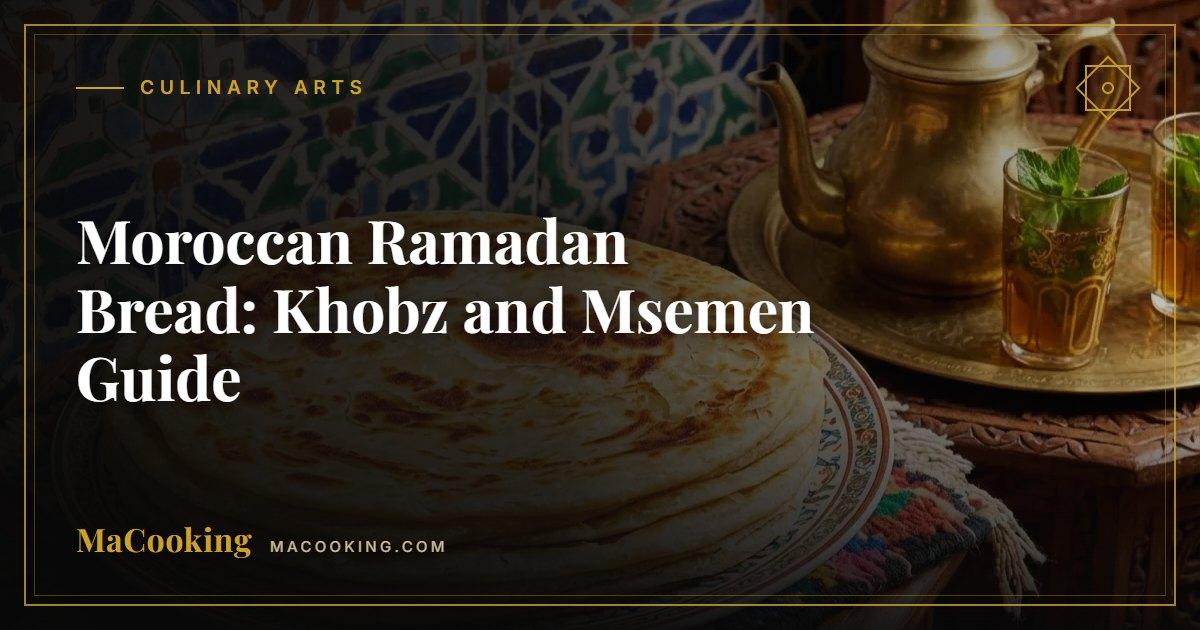
Moroccan breakfast bread is usually msemen, a flaky, layered, square pan-fried flatbread, served with honey, butter or olive oil and mint tea. Khobz, the round everyday loaf, appears at nearly every meal, including Ramadan iftar and suhoor, where it scoops up harira, eggs and tagine sauces.
Key Takeaways
- Khobz (round loaf) and msemen (layered pan-fried flatbread) are the two breads that anchor the Moroccan table, including during Ramadan.
- Both are achievable at home with pantry staples: bread flour, a little semolina or whole wheat, yeast for khobz, and oil or butter for msemen.
- Khobz is the classic bread for tagine because it works as an edible spoon; batbout is a good softer alternative.
- Msemen freezes beautifully, which makes it a smart make-ahead option for pre-dawn suhoor meals.
- Resting the dough properly matters more than any special equipment, for both breads.
What Are the Main Moroccan Bread Types?
Bread in Morocco is not one thing. It is a small family of breads, each with a job to do. Some are baked, some are cooked on a griddle, and some are almost a cross between bread and pancake. If you are new to the topic, the table below sorts the most common Moroccan bread types by texture and typical moment of the day.
| Bread | Texture | Cooked how | Typical use |
|---|---|---|---|
| Khobz | Firm crust, soft crumb; round and fairly thick | Baked (traditionally in a neighbourhood oven) | Every meal; scooping up tagine, salads and soups |
| Msemen | Flaky, layered, chewy-crisp | Pan-fried on a griddle | Breakfast, tea time, Ramadan suhoor |
| Harcha | Crumbly, semolina-rich, slightly sweet | Pan-cooked | Breakfast with butter, jam or cheese |
| Baghrir | Spongy, with a honeycomb of tiny holes | Cooked on one side only | Breakfast and Ramadan tables, with honey-butter |
| Batbout | Soft, pocket-style, similar to a small pita | Griddle-cooked | Sandwiches, kefta, dipping into sauces |
For a deeper look at the history and social role of loaves in Morocco, including the tradition of taking dough to the communal oven, read Moroccan Bread Culture: From Clay Ovens to Modern Tables.
How Do You Make Khobz at Home?
Khobz is the easiest place to start if you want a reliable, everyday loaf. The method is straightforward, and it needs no kneading machine, no steam injection and no sourdough starter. The dough is slightly soft, which gives the characteristic tender crumb under a crust that holds up to sauce.
A quick khobz formula
This is a simple framework to get you oriented. For full instructions and shaping photos' worth of detail, use our Homemade Moroccan Khobz recipe.
- Flour: 500 g total. A common blend is 350 g bread flour plus 150 g fine semolina or whole wheat flour.
- Yeast: 7 g (one standard sachet) instant or active dry yeast.
- Salt and sugar: 1½ teaspoons fine salt and 1 teaspoon sugar.
- Water: about 340 ml lukewarm water, added gradually.
- Oil: 1 tablespoon olive or neutral oil (optional but helpful for tenderness).
- Mix the dry ingredients, then add water and oil. Knead for about 10 minutes by hand until smooth, elastic and just tacky.
- Cover and let rise for about 1 hour, until roughly doubled.
- Divide into two pieces. Shape each into a tight ball, then flatten gently into a disc about 4 cm thick.
- Place on a tray dusted with semolina or flour, cover loosely, and rest 30 to 45 minutes.
- Prick lightly with a fork if you like (some cooks do, to limit large air pockets). Bake at 220°C (425°F) for 20 to 25 minutes, until golden and hollow-sounding underneath.
- Cool on a rack for at least 15 minutes before tearing in.
Pantry substitutions for Western kitchens
| If you cannot find... | Use this instead | What changes |
|---|---|---|
| Fine semolina | Cream of wheat (plain, not instant flavoured) or a bit more bread flour | Slightly less of the characteristic nutty bite |
| Bread flour | All-purpose (plain) flour | Slightly softer, less chewy crumb |
| Smen (aged preserved butter) | Regular butter, with a tiny pinch of blue cheese stirred in if you want funk | Milder aroma; use sparingly |
| Traditional clay or communal oven | Baking stone, steel or heavy preheated tray | Less smoky character, but good crust |
How Do You Make Msemen, the Easy Moroccan Breakfast Bread?
If you want an easy Moroccan breakfast bread that feels special, msemen is the one. The dough is only flour, water, salt and a little sugar. The magic is in the folding: you stretch each ball paper-thin, brush it with fat, fold it into a square, and cook it on a hot griddle. The result is a stack of flaky, buttery layers with a satisfying chew.
Msemen at a glance
- Dough: 300 g all-purpose flour, 100 g fine semolina, 1 teaspoon salt, 1 teaspoon sugar, and about 220 to 250 ml warm water.
- Folding fat: about 100 g softened butter mixed with a few tablespoons of neutral oil, plus extra semolina for dusting.
- Yield: roughly 8 to 9 pancakes.
- Knead the dough for 10 minutes until smooth and quite elastic. It should be softer than bread dough.
- Divide into 8 or 9 balls, coat each in oil, and rest, covered, for at least 20 minutes.
- On an oiled surface, flatten one ball with oiled fingertips into a very thin, almost translucent round or rectangle.
- Brush with the butter-oil mix, sprinkle with a little semolina, then fold into thirds both ways to make a square.
- Rest the folded squares for 10 to 15 minutes, then gently flatten each to about 12 to 14 cm across.
- Cook in a lightly oiled skillet over medium heat for 2 to 3 minutes per side, until golden with darker flecks.
- Crush gently between your hands as soon as it comes off the heat to open up the layers.
Step-by-step technique, including how to stretch the dough without tearing it, is covered in How to Make Moroccan Msemen. The full recipe, with quantities for a larger batch, is in Msemen (Moroccan Pancakes).
How should you serve msemen?
The simplest serving is the best. Drizzle with honey, add a little butter, or pair with olive oil and soft cheese. For something a touch more luxurious, try Msemen with Honey and Argan Oil, where the nutty oil balances the sweetness. The same dough can also be folded around a filling of spiced onions and herbs to make msemen mahshi, a savoury version that suits lunch or a light iftar course.
Common mistakes with msemen
- Dough too stiff: it will tear instead of stretching. Add a spoonful of water and rest longer.
- Skipping the rest: unrested dough springs back and refuses to thin out.
- Heat too high: the outside browns before the inner layers cook. Medium heat is enough.
- Too little fat between layers: the layers fuse into a single dense pancake.
Which Moroccan Bread Goes With Tagine?
For Moroccan bread for tagine, khobz is the default. In a traditional Moroccan meal, bread is both food and utensil: you tear off a piece with your right hand, pinch up a bite of meat or vegetable from the section of the dish in front of you, and use the bread to catch sauce. A good loaf needs a crust sturdy enough not to collapse and a crumb soft enough to soak up the juices.
| Tagine style | Best bread | Why it works |
|---|---|---|
| Sweet-savoury meat tagines (prunes, apricots, almonds) | Khobz | Neutral, sturdy; soaks up rich, syrupy sauce |
| Kefta and egg tagines | Khobz or batbout | Soft bread wraps tender meatballs and runny yolk easily |
| Fish tagines with chermoula | Khobz | Mops up herb-and-lemon sauce |
| Vegetable tagines | Khobz or whole wheat khobz | Hearty crumb balances lighter dishes |
Try pairing a fresh loaf with the Beef Tagine with Prunes, where the sticky, sweet sauce is exactly what a crusty khobz is for.
What Bread Do Moroccans Eat at Iftar and Suhoor?
Ramadan eating in Morocco usually follows a pattern, though every household has its own habits. At iftar, the fast is traditionally broken with dates and something to drink, followed by harira soup, often with hard-boiled eggs, and sweets such as chebakia. Bread, most commonly khobz, sits on the table alongside. Later in the evening, richer dishes like tagine or rfissa may appear. Rfissa is a dish that puts msemen at its centre, shredded and layered under chicken and lentils; see Rfissa (Chicken with Lentils and Msemen).
Suhoor, the pre-dawn meal, tends toward breads that are filling and easy to eat when you are not fully awake. Msemen, baghrir, harcha and khobz are all common choices, served with olive oil, honey, cheese, eggs, amlou (almond, argan oil and honey paste), tea or milk. You can read more about the morning table in Moroccan Breakfast Traditions. For general background on the month itself, Wikipedia's overview of Ramadan is a reliable starting point.
A make-ahead plan for busy Ramadan days
- Weekend: make and fold a double batch of msemen. Cook half, or freeze the uncooked folded squares separated by parchment.
- Midweek: bake khobz in the afternoon so it is fresh for iftar. Wrap the leftover loaf in a clean tea towel for suhoor.
- Suhoor: reheat frozen msemen straight from the freezer on a dry skillet over medium-low heat, about 3 minutes per side.
How Do You Store and Reheat Moroccan Bread?
- Khobz: keep at room temperature in a bread bag or wrapped in a cloth for up to 2 days. Slice and freeze for up to 2 months. Refresh in a 180°C (350°F) oven for 5 to 8 minutes.
- Msemen: refrigerate cooked pieces for up to 3 days, or freeze for up to 2 months with parchment between each. Reheat on a dry skillet.
- Harcha: best the day it is made, but it toasts nicely the next morning.
- Baghrir: eat fresh. It dries out quickly, and the texture is the whole point.
For more flatbreads and pastries in the same family, browse our Breads & Pastries recipes.
Frequently Asked Questions
What is the most popular Moroccan breakfast bread?
Msemen is the best-known Moroccan breakfast bread, a layered, pan-fried square flatbread eaten with honey, butter, jam or olive oil. Khobz, the round everyday loaf, is just as common at the morning table, usually served with olive oil, soft cheese or amlou alongside mint tea or coffee.
Can I make Moroccan bread without a special oven?
Yes. Khobz bakes well on a preheated baking sheet, pizza stone or baking steel in a standard home oven. Msemen, harcha, baghrir and batbout are all cooked in a skillet or on a flat griddle, so they need no oven at all.
What bread do you eat with Moroccan tagine?
Khobz is the traditional choice. Its sturdy crust and soft crumb let you tear off pieces and scoop up meat, vegetables and sauce by hand. Batbout, a soft griddle-cooked pocket bread, also works well, especially for kefta or fish tagines with plenty of sauce.
What do Moroccans eat for suhoor during Ramadan?
Suhoor varies by household, but many families eat msemen, baghrir, harcha or khobz with eggs, olive oil, honey, cheese or amlou, plus tea, milk, yogurt or dates. The aim is a filling meal that is gentle enough to eat before dawn.
How do I store and reheat msemen?
Cool msemen completely, stack with parchment between layers, and refrigerate for up to three days or freeze for up to two months. Reheat on a dry skillet over medium heat for a minute or two per side until soft and crisp at the edges.
Is khobz the same as pita bread?
No. Both are round wheat breads, but khobz is a thicker, denser loaf with a firm crust and soft interior, often made with some semolina or whole wheat. Pita is thinner and puffs into a pocket. Batbout is closer to pita in texture.
Conclusion
If you only learn two breads from the Moroccan kitchen, make them khobz and msemen. One gives you the loaf that anchors lunch, dinner and every tagine; the other gives you a flaky, golden breakfast that makes early Ramadan mornings easier. Start with khobz for confidence, move on to msemen once you are comfortable with soft dough, and freeze extras so the work pays off all month long.