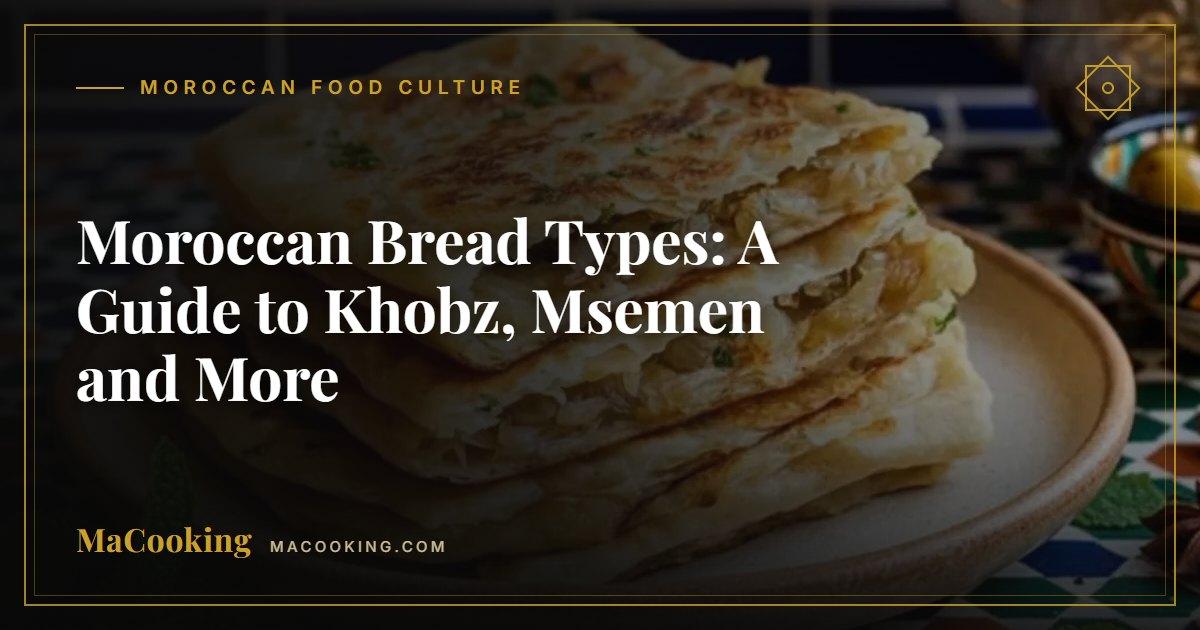
Moroccan bread types fall into two broad camps: round, yeasted loaves like khobz that are used to scoop and mop up tagines, and griddled, layered or pancake-style breads like msemen, harcha, baghrir and batbout that suit breakfast, tea time and stuffing. Most start with wheat flour or semolina, water, salt and, often, yeast.
Key Takeaways
- Khobz is the daily loaf. It is eaten with nearly every savory meal and doubles as an eating utensil.
- Msemen, rghaif and meloui are laminated, pan-cooked flatbreads for breakfast, tea or stuffing.
- Harcha, baghrir and batbout are semolina cakes, spongy pancakes and pocket breads. Each has its own natural partners.
- Moroccan bread ingredients are simple: wheat flour and/or semolina, water, salt, yeast, and oil or butter in the layered styles. Texture comes from technique.
- Bread is torn and used by hand, never cut at the table, and rarely wasted.
What are the main Moroccan bread types?
Moroccan bread is less a single thing than a family. There are loaves baked in ovens, flatbreads cooked on a flat pan, griddle cakes made with semolina, and fried dough. Names and spellings shift between Arabic, Amazigh and French transliterations, so you will see msemen and msemmen, baghrir and beghrir, and khobz and khubz used interchangeably. The table below sets out the most common Moroccan bread names and what separates them.
| Bread | Style | Texture | Typically eaten |
|---|---|---|---|
| Khobz | Round yeasted loaf, oven-baked | Soft crumb, firm crust | Lunch and dinner, with tagines and salads |
| Khobz dyal chaair | Barley loaf | Denser, earthier | With soups and rustic dishes |
| Msemen | Folded, layered square, pan-cooked | Flaky outside, chewy within | Breakfast, tea, stuffed or with honey |
| Rghaif | Thinner, stretched, folded flatbread | Papery layers, soft centre | Breakfast, street-food style fillings |
| Meloui | Round laminated flatbread | Soft and buttery layers | Breakfast, with honey or cheese |
| Harcha | Semolina griddle cake | Crumbly, golden crust | Breakfast and tea, with butter, jam or cheese |
| Baghrir | Yeasted semolina pancake, one side cooked | Spongy, riddled with holes | Breakfast and Ramadan, with honey butter |
| Batbout | Small griddled pocket bread | Soft, slightly chewy, splits open | Sandwiches, stuffed with kefta or chicken |
| Sfenj | Fried ring of wet dough | Airy inside, crisp outside | Morning, with tea or coffee |
Regional habits colour all of these. Home cooks in different cities may knead, rest and shape the same dough differently, and bakers add their own touches such as sesame, anise or nigella seeds. Treat the descriptions here as the common versions rather than the only ones.
What is khobz, and why is it on every Moroccan table?
Khobz (the Arabic word for bread) is the daily loaf: round, flattish, with a golden crust and a soft, slightly springy crumb. It is placed on the table before the food arrives and stays until the last sauce has been wiped up. In practical terms, it is how most Moroccan meals are eaten: tagines, salads, dips and egg dishes are all picked up with a piece of torn bread rather than a fork.
Everyday khobz: the basics
The dough is usually wheat flour, often mixed with some fine semolina for a more tender, slightly sweet crumb, plus yeast, salt, a little sugar and warm water. It is kneaded until supple, shaped into rounds, rested, and often dusted with semolina or bran on the base. Some bakers prick the top or add seeds. The loaves are baked at high heat until the crust sounds hollow when tapped.
In many Moroccan towns and cities, families have traditionally shaped dough at home and carried it to a neighbourhood oven, the ferran, to be baked. That communal habit is part of why bread feels like a shared, public good rather than just a food. To explore that tradition further, read Moroccan bread culture, from clay ovens to modern tables.
Whole wheat and barley variations
Khobz made with whole wheat flour (khobz bel kemh) is common, and barley bread (khobz dyal chaair) has deep rural roots. Barley loaves are denser and more earthy, and they pair well with hearty soups and simple vegetable dishes. If you want to bake the classic at home, our recipe for homemade Moroccan khobz walks you through the dough, shaping and baking step by step.
What are the layered and griddled Moroccan flatbreads?
This is the family that most visitors fall for first. These breads share one idea: stretch a soft dough thin, add fat, fold it, and cook it on a hot, lightly oiled surface until the layers separate.
Msemen
Msemen is the best known. Balls of rested dough, made from flour, a little fine semolina, salt and water, are oiled, flattened, brushed with fat and sprinkled with semolina, then folded into a square. Each square is pressed flat again and cooked on a griddle until it is browned in spots, crisp at the edges and chewy and layered inside. It is served warm with honey, butter or jam, or alongside coffee and mint tea.
Msemen is also versatile. The folded layers can hold a filling of onions and herbs, as in stuffed msemen with onions and herbs, and torn pieces form the base of the festive chicken-and-lentil dish rfissa. If you want a hands-on lesson in stretching and folding, the full msemen recipe is a good place to begin. For the technique in more depth, see how to make Moroccan msemen.
Rghaif and meloui
Rghaif is a close cousin of msemen. The dough is typically stretched even thinner and folded into a more delicate, papery packet, often cooked until the outside crisps. Meloui is usually round, with softer, buttery layers, and is common at breakfast with honey or cheese. The names are used loosely from region to region, and one cook's meloui can be another's rghaif. What matters is the technique: thin dough, fat between layers and a hot pan.
Harcha
Harcha is a different animal: a thick semolina cake made with fine or medium semolina, butter or oil, a little sugar, baking powder and milk or buttermilk. It is cooked in a dry pan or lightly oiled skillet until it develops a crisp golden crust with a tender, crumbly interior. Split it and serve it warm with butter, jam, honey or soft cheese.
What are baghrir and batbout?
Baghrir, the thousand-hole pancake
Baghrir is a yeasted semolina batter poured onto a hot, ungreased pan and cooked on one side only. As it cooks, bubbles rise and burst, leaving the surface covered with tiny holes that act like a sponge for melted butter and honey. The finished pancake is pale and soft, not browned. It is a staple at breakfast and a familiar sight on Ramadan tables. Our baghrir recipe covers batter consistency and the pan temperature that gives you those holes.
Batbout, the Moroccan pita
Batbout is a small round bread, usually made from wheat flour (sometimes with semolina), yeast, salt and water, cooked on a griddle or in a pan rather than baked. It puffs slightly and can be split open to form a pocket. It is often used for sandwiches filled with kefta, chicken or vegetables, or served with dips and salads. Try the batbout recipe if you want a pan-cooked bread that is easier than layered flatbreads.
Sfenj, the fried morning bread
Sfenj is not baked or griddled but fried: a wet, elastic dough is shaped into rings and dropped into hot oil, where it puffs. The result is crisp outside and airy within. It is usually eaten warm in the morning, plain or lightly sugared, with tea or coffee.
What are the main Moroccan bread ingredients?
A pantry tour shows how much variety comes from very little. Moroccan bread ingredients are mostly the same handful of items, and their ratios and handling make the difference. The table below also lists common substitutions for cooks outside Morocco.
| Ingredient | Role | Used in | Western-pantry substitute |
|---|---|---|---|
| Wheat flour (plain or bread flour) | Structure and chew | Khobz, msemen, batbout | Unbleached all-purpose or bread flour |
| Fine semolina | Tenderness, crunch, non-stick dusting | Msemen, harcha, baghrir, khobz | Fine durum semolina; avoid coarse grits or instant cereal |
| Whole wheat or barley flour | Earthy flavour, density | Rustic khobz | Whole wheat flour, with barley flour if available |
| Yeast | Lift | Khobz, batbout, baghrir, sfenj | Instant or active dry yeast |
| Salt and sugar | Flavour and browning | Nearly all | Fine sea salt, granulated sugar |
| Oil, butter or smen | Layers, richness | Msemen, rghaif, meloui, harcha | Neutral oil or butter; smen is an aged, funky butter, so use butter plus a pinch of salt |
| Milk or buttermilk | Tenderness, flavour | Harcha | Milk with a splash of lemon juice or plain yoghurt |
| Sesame, anise, nigella | Aroma and topping | Some khobz and batbout | Sesame seeds, caraway or fennel in small amounts |
Fine durum semolina is the one ingredient worth seeking out. Many international supermarkets now stock it alongside other North African staples, a shift explored in our look at Moroccan ingredients in global supermarkets.
How do you eat Moroccan bread?
Knowing how to eat Moroccan bread is partly a matter of etiquette and partly just habit, and the habits are easy to pick up.
- Tear, do not slice. Khobz is broken by hand into pieces the size of a scoop. In many homes the host breaks the loaf and passes it around.
- Use your right hand. Traditionally bread and food are handled with the right hand, with bread pinching food from your side of the shared dish.
- Scoop and wrap. Pinch a piece of meat, vegetable or sauce between folded bread and lift it to your mouth. Do not dip your bread into a communal dish and then take a bite of it before dipping again.
- Mop the sauce. Finishing the sauce with bread is a compliment to the cook.
- Respect the bread. In many Moroccan households bread is treated with care. Stale loaves are repurposed (breadcrumbs, soups, feeding animals) rather than thrown away carelessly.
What to pair with each bread
- Khobz: tagines, kefta and egg dishes, zaalouk and other cooked salads, olives, soups such as harira.
- Msemen and meloui: honey, butter, jam, soft cheese, or a drizzle of olive or argan oil with tea. See Moroccan breakfast traditions for how these appear on the morning table.
- Harcha: butter, honey, jam, jben (fresh cheese) or olives.
- Baghrir: warm butter and honey, or sometimes honey with a little oil.
- Batbout: kefta, grilled chicken, tuna, vegetables, and dips.
- Sfenj: a light dusting of sugar, with mint tea or coffee.
How can you bake Moroccan bread at home?
You do not need a clay oven. A few habits help every style:
- Weigh your flour. Hydration matters, especially for khobz and baghrir. Measuring by weight keeps results consistent.
- Let the dough rest. Resting relaxes the gluten, which makes msemen easier to stretch and khobz easier to shape.
- Preheat properly. For khobz, heat a baking stone or heavy tray in a hot oven. For msemen and batbout, use a hot, flat pan, and adjust the heat so the outside colours while the inside cooks through.
- Do not rush the colour. Pale msemen or khobz is usually underdone. Look for patches of brown and a hollow sound on loaves.
- Cool on a rack. Trapped steam softens crusts, so let loaves rest on a wire rack.
Common mistakes include too much flour while kneading (dry, tough bread), a pan that is too cool (pale, greasy msemen) and too much stirring of baghrir batter once it has rested (fewer holes). Store khobz in a paper or cloth bag for a day, then freeze whole or sliced pieces. Reheat msemen and batbout briefly in a hot pan, and eat baghrir fresh or freeze it between sheets of baking paper.
Many of these recipes sit together in our breads and pastries collection. If you want the history and technique of bread in more depth, the full ebook The Royal Moroccan Table, Part 2: The Art of Spice includes a chapter titled "Moroccan Breads — The Deep Guide".
Where did these breads come from?
Moroccan baking draws on Amazigh (Berber), Arab, Andalusian and other influences, and cooks have long adapted what grew locally. Wheat, barley and semolina are the foundations, and techniques such as folding and griddling suit both home kitchens and street stalls. For more background on the cuisine overall, see the Wikipedia overview of Moroccan cuisine. The specifics of each bread vary by region and family, so treat any single "authentic" version with healthy scepticism.
Frequently Asked Questions
What is the most common bread in Morocco?
Khobz is the everyday bread. It is a round, soft-crusted loaf, usually made from wheat flour or a wheat and semolina blend, and it appears at almost every lunch and dinner. It works as scoop, spoon and sponge for tagines, salads and dips.
What is the difference between msemen and baghrir?
Msemen is a folded, layered, griddled flatbread that is chewy and flaky. Baghrir is a soft, spongy semolina pancake cooked on one side only, leaving a surface covered in tiny holes that soak up butter and honey. Both are popular at breakfast and tea.
Do Moroccans eat bread with a knife and fork?
Not usually. Bread is torn by hand and used to pick up food from shared dishes such as tagines. Traditionally the right hand does the work. Larger loaves are often broken into pieces for the table rather than sliced.
Can I make Moroccan bread without a special oven?
Yes. Khobz bakes well in a regular home oven, ideally on a preheated baking stone or heavy tray. Msemen, batbout, harcha and baghrir are all cooked in a pan or on a griddle, so you do not need any special equipment.
Which Moroccan bread is best for beginners?
Khobz and harcha are forgiving places to start. Khobz needs patience rather than skill, and harcha comes together in minutes in a pan. Msemen takes practice to stretch and fold, so try it once you feel comfortable handling soft dough.
Conclusion
Once you know the basic Moroccan bread types, a Moroccan meal makes more sense: khobz anchors the savory table, while msemen, harcha, baghrir and batbout bring variety to breakfast, tea and snacks. Start with one loaf and one griddled bread, learn how the dough should feel, and the rest of the family will follow naturally.