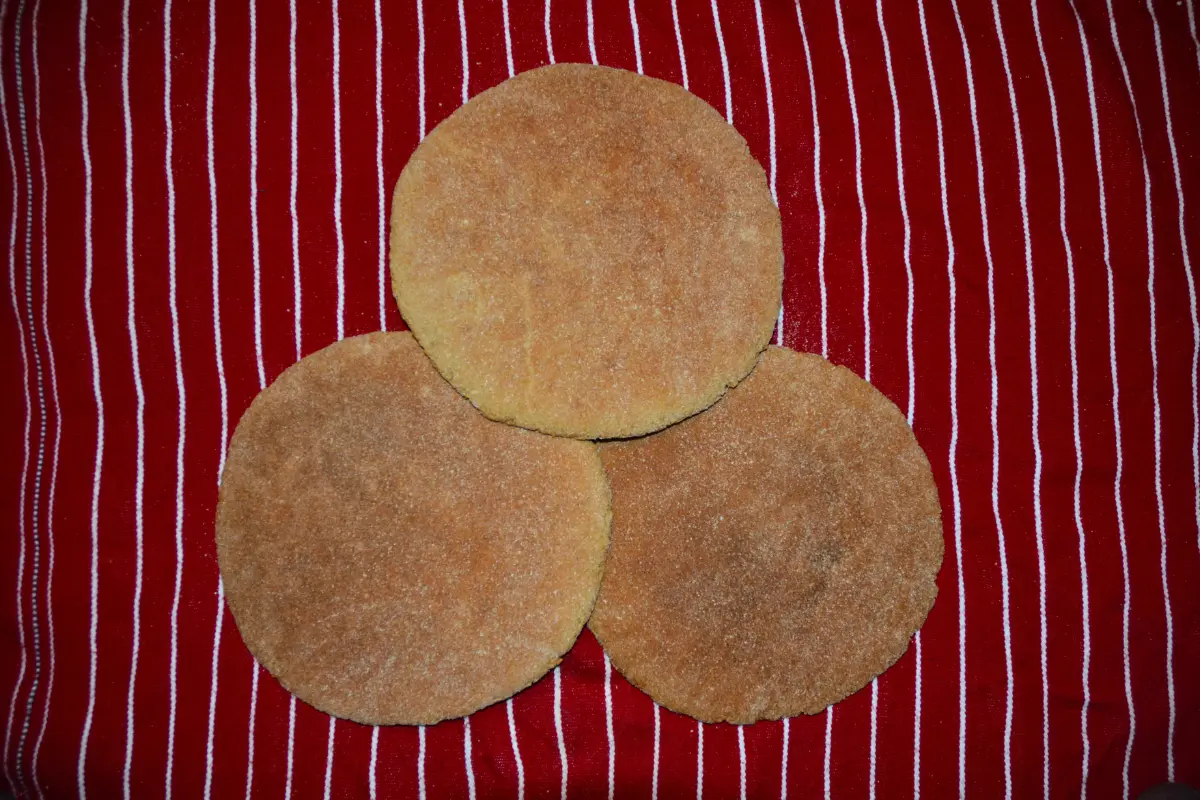
The most common Moroccan bread name is khobz (also spelled khubz), the round, crusty everyday loaf served at nearly every meal. Msemen is the layered, pan-fried flatbread of breakfast and tea time. Around them sit rghaif, baghrir, harcha, batbout and warqa-based pastries, each with its own texture, name and moment at the table.
Key Takeaways
- Khobz is the general word for bread and the name of the round everyday loaf used to scoop up tagines and salads.
- Msemen is a laminated, pan-cooked flatbread, folded in layers, eaten with honey, butter, cheese or stuffed with onions and herbs.
- Many other Moroccan breads are griddle-cooked rather than oven-baked: rghaif, baghrir, harcha and batbout.
- Thin warqa pastry and layered doughs show up in pastries such as pastilla and m'hancha, so the line between "bread" and "pastry" is blurry.
- Names and spellings vary by region and by family, so treat transliterations as flexible.
What Is the Moroccan Bread Name for Everyday Bread?
Ask for bread anywhere in Morocco and the word you will hear is khobz. It is the Arabic word for bread in general, and in daily speech it usually means the round, slightly domed loaf that arrives in a basket or cloth beside almost every meal. Spellings in English include khobz, khubz and khebz. They all point to the same thing.
The word does a lot of work. Khobz can mean a fine white loaf from a neighbourhood bakery, a denser whole wheat or barley version, or a simple home-baked round. Other breads get their own names, which is where it gets interesting: msemen, rghaif, baghrir, harcha, batbout and more. Those names often describe the technique (folded, griddled, "thousand holes") rather than the ingredients.
For wider context on how bread sits in Moroccan daily life, from communal ovens to modern kitchens, see our companion piece on Moroccan bread culture, from clay ovens to modern tables.
Moroccan Bread Types and Names at a Glance
This table sums up the main breads you will meet in Moroccan homes, bakeries and cafés. Treat the descriptions as typical rather than strict, because households and regions vary.
| Name | What it is | Cooked how | Usually eaten |
|---|---|---|---|
| Khobz | Round yeasted loaf, crusty outside, soft inside | Baked in an oven | With tagines, salads, soups, any meal |
| Msemen (msemmen) | Laminated, folded square flatbread | Pan-fried on a griddle | Breakfast, tea time, or stuffed as a snack |
| Rghaif (rghayef) | Thinner, stretched and folded layered bread | Griddle-cooked | Breakfast with honey, butter or cheese |
| Baghrir | Semolina pancake with a honeycomb of tiny holes | Cooked on one side only | Drenched in butter and honey |
| Harcha | Semolina griddle cake, crumbly and buttery | Pan-cooked | With jam, cheese or honey |
| Batbout | Small, soft, pita-like round | Griddle-cooked, puffs slightly | Split and stuffed with fillings |
| Warqa-based pastries | Paper-thin pastry sheets | Baked or fried | Pastilla, briouats, festive dishes |
What Is Moroccan Khobz and How Is It Made?
Moroccan bread khobz is an enriched-by-simplicity loaf: flour, water, salt and yeast, sometimes with a little sugar and a handful of semolina or whole wheat. The dough is usually kneaded firmly, left to rise, shaped into rounds, and given a short second rest before baking. The result has a crust that crackles when pressed and a crumb that is soft enough to soak up sauce without collapsing.
In many neighbourhoods, families shape the dough at home and take the rounds to a communal oven (a ferran) to be baked. The practice is still part of daily life in some places, though many households now bake in a home oven.
The texture you are aiming for
- Crust: thin but crisp, never thick or hard.
- Crumb: tender and a bit open, strong enough to scoop and tear.
- Flavour: mildly sweet and wheaty, with sesame or anise seeds in some versions.
If you want to bake it yourself, our Homemade Moroccan Khobz (Everyday Bread) recipe gives exact quantities and timings. As a general guide for a home oven, expect a hot bake at around 220°C / 430°F for roughly 20 to 25 minutes, until the underside sounds hollow when tapped.
Regional and household variations
Whole wheat and barley khobz are common in many homes, and some versions add semolina for a more rustic bite. Anise or sesame seeds can be sprinkled on top or kneaded in. Because there is no single official recipe, a bread called khobz in one family may look quite different in another.
What Is Msemen and Why Is It Different From Khobz?
Moroccan bread msemen is a completely different animal. Instead of rising in an oven, msemen is built from thin sheets of dough that are brushed with fat, folded into squares, and cooked on a hot griddle until golden and flaky outside, soft and chewy within. The dough is typically a simple mix of flour, fine semolina, salt, a touch of sugar and water, rested so it stretches without tearing.
The lamination step
Lamination is what separates msemen from a plain flatbread. After a short rest (about 15 to 20 minutes for shaped balls is a reasonable guide), each ball is flattened very thin on an oiled surface, brushed with a mixture of oil and often butter or smen, and folded over itself. Repeating that folding creates layers that separate as the bread cooks.
Cooking takes only a few minutes per side over medium heat. You want colour and steam rather than a hard crust. Our Msemen (Moroccan Pancakes) recipe walks through the stretch and fold in detail.
How msemen is eaten
- Simple: hot, torn, with honey and butter alongside mint tea.
- Savoury: with soft cheese, olive oil, olives or a fried egg.
- Stuffed: folded around a seasoned filling of onions and herbs, as in Stuffed Msemen with Onions and Herbs (Msemen Mahshi).
- In a dish: torn up and layered under chicken and lentils in rfissa, covered below.
How Is Rghaif Different From Msemen?
Rghaif (also spelled rghayef or rghifa) is the msemen's thinner, more delicate cousin. The dough is stretched out further, then folded into a flatter, flakier piece. Msemen tends to be squarer with more defined, slightly thicker layers. In practice the two names overlap, and in some households the words are used almost interchangeably. If you are travelling, the local term and shape will be the best guide.
Both are usually made on a griddle, both are at their best straight from the pan, and both are served with sweet or savoury toppings. If you are learning, start with msemen. The thicker dough is more forgiving, and once the folding feels natural, rghaif is a short step further.
Which Moroccan Breads Are Made on a Griddle?
Many of the best-loved Moroccan breads never see an oven. A hot, lightly oiled pan or flat griddle does the job, and the results are quick enough for breakfast.
- Baghrir: a semolina-based batter that is poured onto a pan and cooked on one side only. Bubbles rise and burst, leaving the characteristic pitted top that soaks up butter and honey.
- Harcha: a thick, round semolina cake with a crumbly edge and tender middle, often split and filled with cheese or jam.
- Batbout: a small, soft, pita-like bread that is cooked on a griddle and often split and stuffed with savoury fillings.
If you want to see how these fit into the morning table, our guide to Moroccan breakfast traditions covers the full spread.
What Are the Moroccan Pastry Breads Made With Warqa?
At the pastry end of the spectrum, bread dough gives way to warqa (also spelled ouarka), a paper-thin sheet of pastry stretched over a hot surface. It is the foundation of festive dishes, and it is where the line between bread and pastry becomes blurry.
- Pastilla: layers of warqa wrapped around a filling, famously sweet and savoury at once. See our Pigeon Pastilla Pastry Sheet recipe for how the sheets themselves are made.
- Briouats: small folded parcels, fried or baked, with sweet or savoury fillings.
- M'hancha: a coiled "snake" of almond-filled pastry, a showpiece at celebrations.
Warqa is a craft in its own right. If it interests you, the free chapter "The Warqa Legacy: Pastry as Palace Art" in the ebook Tables of Fez is a good place to start, and you can browse more doughs in our Breads & Pastries recipes.
How Do Moroccans Eat Bread With a Meal?
Bread is not just a side dish. At a traditional table, khobz is the utensil. People tear a piece with the right hand and use it to scoop tagine sauce, salads, and vegetables from the shared dish. Because of this, the crumb has to be sturdy and a little absorbent.
Bread is also treated with respect in many households. It is generally not thrown away carelessly, and leftovers are often reused, turned into breadcrumbs or given away. Specific habits vary, so take this as a general cultural pattern rather than a rule.
Classic pairings
- Khobz with tagines, kefta, and cooked salads such as zaalouk.
- Khobz or batbout with soups like harira.
- Msemen, rghaif and baghrir with honey, butter, jam, cheese and mint tea.
- Msemen torn in Rfissa (Chicken with Lentils and Msemen), where the bread soaks up a fenugreek-scented broth.
For a deeper cultural look, Wikipedia's overview of Moroccan cuisine places these breads in the wider culinary picture.
What Are Common Mistakes and Pantry Substitutions?
Most problems with Moroccan breads come down to dough resting, heat and flour choice. The table below covers the swaps that work for a Western pantry.
| If you do not have... | Try... | Note |
|---|---|---|
| Fine semolina | Fine cornmeal-free semolina, or durum flour | Avoid coarse semolina for msemen. It makes the dough gritty. |
| Smen (preserved butter) | Ghee or clarified butter | Milder flavour, but good richness and layering. |
| Moroccan bakery flour | All-purpose or bread flour | Bread flour gives chewier khobz and msemen. |
| A large flat griddle | A heavy skillet or cast-iron pan | Cook in batches and keep finished pieces covered. |
| A communal or clay oven | A preheated baking stone or steel | Gives a crisper base on khobz. |
Mistakes to avoid
- Skipping the rest: unrested msemen dough springs back and tears. Give it time.
- Heat too high: msemen burns outside before cooking within. Medium heat is enough.
- Over-flouring: too much flour on the surface makes layers dry and stops them from sticking together.
- Under-baked khobz: pale, heavy bread. Bake until deeply golden and hollow-sounding.
Storage
Khobz is best the day it is baked. Wrap it in a cloth once cool and refresh it in a hot oven for a few minutes. Msemen freezes well: stack with baking paper between each piece, freeze, and reheat in a dry pan so the layers crisp up again.
Frequently Asked Questions
What is the Moroccan word for bread?
The Moroccan word for bread is khobz (also written khubz or khebz). It usually means the round, crusty everyday loaf, but it is also the general word for bread. Specific breads have their own names, such as msemen, rghaif, batbout and harcha.
What is the difference between khobz and msemen?
Khobz is a yeasted, oven-baked loaf with a crust and an airy crumb, used to scoop up tagines and salads. Msemen is a laminated flatbread of folded layers, pan-fried and eaten mostly at breakfast or tea time with honey, butter or cheese.
Is msemen the same as rghaif?
They are close relatives but not identical. Both are folded, pan-cooked layered doughs. Msemen is usually folded into a square with thicker layers, while rghaif is stretched thinner and folded into a more delicate, flaky piece. Names and shapes vary by region and family.
Do Moroccans eat bread with a knife and fork?
Traditionally, no. Bread is the utensil. Diners tear off a piece of khobz with the right hand and use it to scoop tagine sauce, salads and vegetables from the shared dish. Spoons appear for soups like harira, but bread is still on the table.
Can I make Moroccan bread with all-purpose flour?
Yes. All-purpose or bread flour works for khobz and msemen. For a more authentic texture, mix in some fine semolina or whole wheat flour. Semolina gives msemen a slight crispness and khobz a more rustic crumb, and it is the main ingredient in baghrir and harcha.
Conclusion
Once you know the Moroccan bread name for each type, the table makes more sense: khobz for scooping, msemen and rghaif for slow breakfasts, baghrir and harcha for semolina comfort, batbout for stuffing, and warqa for celebration pastries. Start with a simple khobz or a batch of msemen, and you will quickly see how much one dough can do. For more ideas, keep exploring our Breads & Pastries collection or the wider Moroccan recipe library.