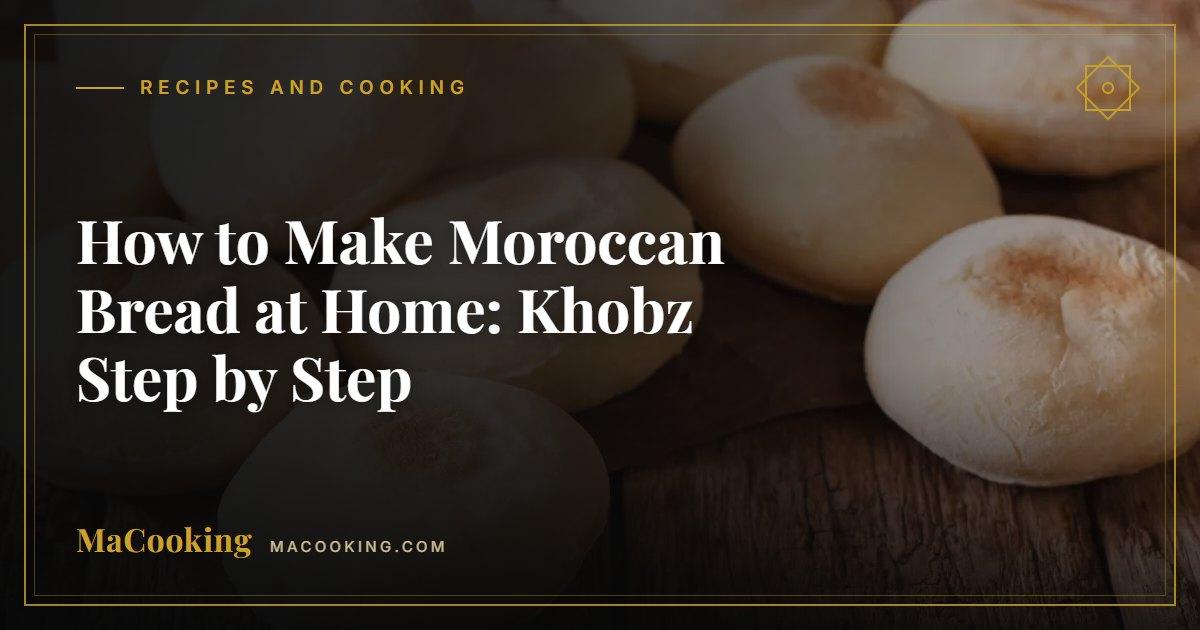
Here is how to make Moroccan bread at home: mix bread flour with a little fine semolina, yeast, salt and warm water into a soft dough, knead for about 10 minutes, let it rise, shape two round loaves, rest them again, then bake at 230°C (450°F) for roughly 20 minutes until golden and hollow-sounding.
Key Takeaways
- Khobz is a round, soft-crumbed everyday loaf, made with wheat flour (often with semolina) and used at the table to scoop up tagines, salads and dips.
- A slightly tacky, well-kneaded dough and a full second rise are what give you a light crumb instead of a dense one.
- A very hot oven and a preheated baking surface (stone, steel or heavy tray) give a crisp base and a golden crust.
- Khobz freezes well, so it is worth baking two loaves at a time.
- Once you have mastered the base dough, you can move on to related breads such as batbout, harcha and msemen.
What Is Moroccan Khobz, and Why Is It on Every Table?
Khobz (also written khobz or khobz dyal dar, "home bread") is the everyday loaf of Morocco. It is usually a flat-domed round, a couple of centimetres thick, with a thin crust and a tender, slightly springy interior. Unlike many Western breads, it is not sliced for sandwiches first. It is torn by hand and used as both fork and spoon, scooping up saucy tagines, lentils, olive-oil-dressed salads and soups.
Bread has a particular standing in Moroccan food culture. It is a staple at nearly every meal, and tradition treats it with respect. In many neighbourhoods, families shape dough at home and bring it to a communal oven (ferran) to be baked, while others bake in their home oven or on a stovetop. If you want a broader view of the different loaves, from pan-fried to oven-baked, our pillar guide to Moroccan breads is a good companion to this recipe, and you can browse the full Breads & Pastries recipes collection for more.
This article walks you through the method in detail, explains why each step matters, and shows how to adapt it to a Western home kitchen. If you prefer a condensed recipe card, see our Homemade Moroccan Khobz (Everyday Bread) recipe.
What Ingredients Do You Need for Moroccan Bread?
Khobz is a simple dough, so the quality and balance of a few ingredients matter. This recipe makes two loaves of about 400 g (14 oz) each.
- 400 g (about 3⅓ cups) bread flour, or strong white flour in the UK
- 100 g (about ¾ cup) fine semolina or fine whole wheat flour
- 7 g (2¼ tsp) instant yeast, or 10 g fresh yeast
- 10 g (1 ½ tsp) fine salt
- 1 tsp sugar, to help the yeast along
- 340-370 ml (1⅓-1½ cups) lukewarm water, about 30-35°C (86-95°F)
- 1 tbsp olive oil (optional, for a slightly softer crumb)
- Extra semolina or flour for dusting the surface and the baking tray
Flour and substitution guide
| Ingredient | Best choice | Acceptable substitute | What changes |
|---|---|---|---|
| Main flour | Bread flour (12-13% protein) | All-purpose flour | Softer, less chewy loaf; use 20-30 ml less water |
| Fine semolina | Fine semolina (not couscous) | Fine whole wheat flour | Nuttier, denser crumb; add 1-2 tbsp more water |
| Yeast | Instant yeast | Active dry (use 25% more, proof first) | Slightly longer first rise |
| Water | Lukewarm tap water | Half water, half milk | Softer crust, richer flavour |
| Oil | Olive oil | Neutral oil or omit | Minor change in softness |
Semolina is the quiet hero here. It gives khobz its faintly sweet, wheaty character and the sandy bottom crust you see on bakery loaves. If you only have coarse semolina, pulse it in a spice grinder or blender for a few seconds so it blends into the dough.
How to Make Moroccan Bread Step by Step
If you are wondering how to make Moroccan bread from scratch without any special equipment, the answer is a bowl, your hands and a hot oven. Follow these steps in order.
Step 1: Mix the dough
- In a large bowl, combine the flour, semolina, yeast, sugar and salt. Keep the salt and yeast on opposite sides of the bowl at first if you like, though in this quantity it is not critical.
- Add 340 ml of the lukewarm water and the olive oil. Stir with your hand or a wooden spoon until no dry flour remains.
- Add the remaining water a tablespoon at a time if the dough feels stiff. You want a soft, slightly tacky dough that holds together but is not wet like batter.
Step 2: Knead for 10 to 12 minutes
Turn the dough onto a lightly oiled (not floured) surface. Knead by pushing the dough away with the heel of your hand, folding it back, giving it a quarter turn and repeating. Moroccan home bakers knead energetically, and this bread rewards it. After 10 to 12 minutes, the dough should feel smooth, elastic and springy, and it should stretch into a thin, translucent sheet without tearing when you pull a small piece (the "windowpane test"). A stand mixer with a dough hook needs about 6 to 8 minutes on medium-low speed.
Resist the urge to add flour. Extra flour tightens the dough and produces a heavy loaf. If it sticks to your hands, oil them lightly instead.
Step 3: First rise
Shape the dough into a ball, place it in a lightly oiled bowl and cover with a damp cloth or plastic wrap. Let it rise in a warm spot for 60 to 90 minutes, until roughly doubled. In a cool kitchen this can take up to two hours. The dough is ready when a floured finger pressed into it leaves a dent that springs back slowly.
Step 4: Divide and shape
- Tip the dough onto a surface and divide it into two equal pieces (about 480 g each, depending on your water).
- Flatten each piece gently to release large bubbles, then fold the edges in toward the centre to form a tight ball, seam side down.
- Cup your hand over the ball and rotate it against the counter so the surface tightens and becomes smooth.
- Dust a baking tray or a cloth generously with semolina. Place each ball on it and press down gently with your palm until it is about 2 cm (¾ inch) thick and 18-20 cm (7-8 inches) wide.
Step 5: Second rise
Cover the loaves loosely with a cloth and let them rest for 45 to 60 minutes. They should look puffy and feel airy, and a gentle fingertip press should leave a mark that fills in slowly. Meanwhile, set a baking stone, steel or upside-down heavy tray on the middle rack and preheat the oven to 230°C (450°F) for at least 30 minutes.
Just before baking, prick each loaf several times with a fork. This is traditional and helps prevent a large blister from forming on top.
Step 6: Bake
Slide the loaves, on parchment if you like, onto the hot surface. Bake for 18 to 22 minutes, until the crust is golden brown and the loaf sounds hollow when you tap the base. For a softer crust, brush the hot loaves lightly with water or olive oil and cover them with a clean cloth as they cool.
How Long Does Each Stage Take?
Khobz is not difficult, but it is not instant. Plan around roughly three and a half hours from start to table, most of it hands-off.
| Stage | Time | What to look for |
|---|---|---|
| Mixing | 5 minutes | No dry flour left; shaggy dough |
| Kneading | 10-12 minutes | Smooth, elastic, passes windowpane test |
| First rise | 60-90 minutes | Doubled in size |
| Shaping | 10 minutes | Tight, smooth rounds |
| Second rise | 45-60 minutes | Puffy; slow spring-back when pressed |
| Oven preheat | 30 minutes (overlaps) | 230°C / 450°F with the stone inside |
| Baking | 18-22 minutes | Golden crust; hollow sound underneath |
| Cooling | 15 minutes | Rest on a rack before tearing |
Can You Make Khobz Without a Bread Oven or Stone?
Yes. A home oven is not a Moroccan communal oven, but you can get close with a few adjustments.
- Heavy tray method: Turn a sturdy baking sheet upside down on the middle rack and preheat it with the oven. Slide the loaves onto it on parchment.
- Dutch oven method: Preheat a cast-iron pot, drop in one loaf on parchment, cover for the first 12 minutes and uncover for the last 8 to 10. The trapped steam gives a very soft crust.
- Steam for softness: Place a small pan of hot water on the lowest rack. Khobz should have a thin, tender crust, not a thick artisan one, so a little steam helps.
- Stovetop in a pinch: Cook a loaf in a lidded, heavy, lightly oiled skillet over low-medium heat for 8 to 10 minutes per side. The result is closer to a pan bread, but it still works for scooping.
Whatever you use, avoid opening the oven door during the first 12 minutes, as sudden heat loss can make the loaves collapse slightly.
Why Did My Moroccan Bread Turn Out Dense or Pale?
Most failed khobz has one of a handful of simple causes. This table helps you diagnose and fix them.
| Problem | Likely cause | Fix |
|---|---|---|
| Dense, heavy crumb | Under-kneaded dough, too little water or short second rise | Knead the full 10 minutes, keep the dough tacky, wait for the loaves to puff |
| Pale, soft crust | Oven not hot enough or no preheated surface | Bake at 230°C on a hot stone or tray; move the loaf up for the last 3 minutes |
| Hard, thick crust | Too much steam or too long in the oven | Bake closer to 18 minutes, then wrap in a cloth while cooling |
| Large blister on top | Loaf not pricked | Prick with a fork all over before baking |
| Flat, spread-out loaf | Over-proofed or dough too wet | Shorten the second rise; use slightly less water next time |
| Bland flavour | Too little salt or too short a rise | Use the full 10 g of salt and allow the full first rise |
How Do You Eat and Serve Moroccan Bread?
Khobz is designed to be used, not just admired. Tear off a piece with your right hand, fold it around a bite of food and use it to pinch and scoop. At a Moroccan table, it accompanies almost everything:
- Tagines and stews: Use the bread to mop up the sauce. The thick sauce of a chicken or lamb tagine is exactly what khobz is made for.
- Soups: Serve alongside a bowl of authentic Moroccan harira, especially during Ramadan evenings.
- Salads and dips: Zaalouk, taktouka, cooked carrot salad and olive oil with olives all work well with khobz.
- Roasted meat: Bread is the natural companion to a feast like mechoui, the Moroccan roast lamb, where tender pieces are eaten with bread and cumin-salt.
- Breakfast: Slice and toast it, then serve with olive oil, butter, honey, jam or soft cheese, with mint tea on the side.
For a more detailed look at Moroccan dining customs, the Moroccan cuisine overview on Wikipedia gives helpful general context.
What Other Moroccan Breads Should You Try After Khobz?
Once you can bake a good khobz, the rest of Morocco's bread repertoire opens up. Several are close relatives that use the same skills.
- Batbout: Small, soft rounds cooked in a pan that puff up and can be split into pockets for stuffing. Try our batbout (Moroccan pita bread) recipe.
- Harcha: A quick semolina pan bread with a crisp outside and crumbly inside, no yeast required. See our harcha recipe.
- Msemen: A square, layered flatbread folded and griddled, which needs a different technique entirely. Our guide to making Moroccan msemen walks you through it.
If you want to go further into the subject, the full ebook The Royal Moroccan Table — Part 2: The Art of Spice includes a chapter titled "Moroccan Breads — The Deep Guide" for readers who want a more detailed reference alongside the recipes here.
How Do You Store and Reheat Homemade Khobz?
Homemade khobz has no preservatives, so it is best on the day it is baked. After that:
- Room temperature: Wrap the cooled loaf in a clean cloth or paper bag for up to two days. Avoid sealed plastic, which softens the crust and encourages mould.
- Freezer: Freeze whole or pre-sliced loaves, tightly wrapped, for up to one month.
- Reheating: Sprinkle the loaf lightly with water and warm it in a 180°C (350°F) oven for 5 to 8 minutes. It will taste close to fresh.
- Leftovers: Stale khobz makes excellent breadcrumbs, or can be cubed, toasted and served with soup.
Variations to Try Once You Know the Basic Dough
The base recipe is a canvas. These changes keep the character of the bread while adding variety:
- Sesame or nigella seeds: Brush the loaf with a little water after shaping and sprinkle seeds over the top before the second rise. For a cumin-and-sesame version, see our cumin bread with sesame.
- Whole wheat khobz: Replace up to half the bread flour with whole wheat and add 1-2 tbsp more water.
- Aniseed khobz: Add 1 tsp of aniseed to the dry ingredients for a gently sweet, aromatic loaf.
- Smaller rolls: Divide into 6 pieces and bake for 12 to 15 minutes. These are handy for sandwiches and lunchboxes.
Frequently Asked Questions
What flour is best for Moroccan khobz?
Bread flour with a little fine semolina or whole wheat gives the best result. Bread flour provides the structure for a springy crumb, while semolina adds a slightly sweet, nutty flavour and a sandy crust. All-purpose flour also works, but add a few tablespoons less water and expect a softer, less chewy loaf.
Can I make khobz without an oven stone?
Yes. Preheat an upside-down heavy baking tray for 30 minutes and slide the loaves onto it on parchment. A cast-iron Dutch oven also works well. The goal is strong bottom heat, which helps the loaf rise and gives the base a crisp, golden finish.
Why is my Moroccan bread dense?
The usual causes are too little kneading, dough that is too stiff, old yeast, or cutting the second rise short. Knead until the dough is smooth and elastic, keep it soft and slightly tacky, and let the shaped loaves puff up visibly before baking at a high temperature.
How do you store homemade khobz?
Keep it at room temperature in a cloth or paper bag for up to two days. For longer storage, freeze whole or sliced loaves wrapped tightly for up to a month. Refresh thawed bread in a hot oven for five to eight minutes so the crust becomes crisp again.
Is khobz the same as pita?
No. Khobz is a thick, round, risen loaf with a soft crumb, usually used to scoop up tagines and salads. Batbout is the Moroccan bread closer to pita, because it is thinner, cooked in a pan and can be split open into a pocket.
Can I add whole wheat or other grains?
Yes. Many Moroccan households make khobz with whole wheat flour, barley or a mix of grains. Replace up to half the white flour with whole wheat, and add a little more water because whole grains absorb more. The loaf will be denser, nuttier and a little darker.
Conclusion: Bake Khobz Once and It Becomes a Habit
Learning how to make Moroccan bread is less about complicated technique and more about attention: a soft dough, patient kneading, two proper rises and a very hot oven. Do those four things and you will have a loaf with a tender crumb and a golden crust that suits everything from a simple olive-oil breakfast to a long Sunday tagine. Bake it a few times, adjust the water to your flour, and you will soon know the dough by feel. When you are ready for the next step, explore the wider collection of Moroccan recipes on MaCooking and bring a fresh loaf to the table.