Ras el Hanout — The Complete 30-Spice Formula
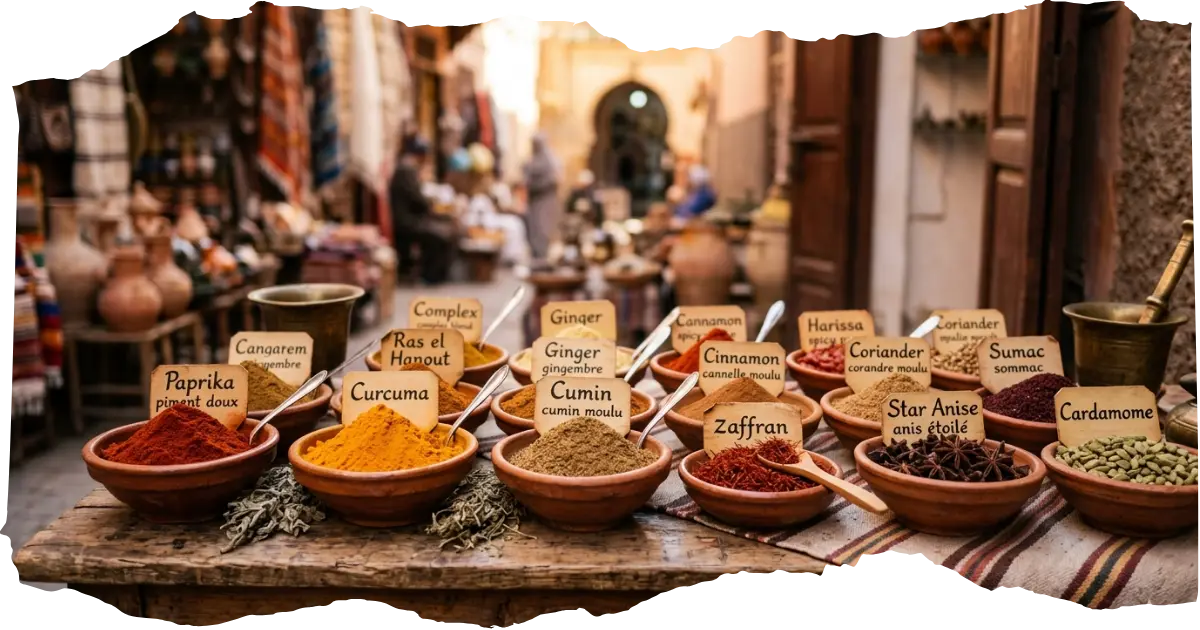
There is a moment in every Moroccan market — the exact second you step beneath the wooden archway of the spice souk — when the air itself changes. It thickens. It presses against your face like warm breath. Cumin, rose petals, dried ginger, black pepper, something sweet you cannot name yet, something medicinal that catches at the back of your throat. Before you see a single spice jar, before your eyes adjust to the dimness, your nose has already told you: you are somewhere ancient. You are somewhere that knows things your kitchen does not. That smell — that magnificent, impossible compound of thirty distinct voices — is Ras el Hanout.
What the Name Means, and Why It Matters
Ras el Hanout (رأس الحانوت) translates literally as "head of the shop" — meaning the very best a spice merchant has to offer. Not the dregs. Not the discounted surplus. The head. When a Moroccan cook sends her husband to the spice souk with a folded note and instructions to bring back Ras el Hanout, she is asking the merchant to put his reputation into a paper bag. She will smell it the moment she opens it. She will know immediately whether he has been generous or careless, whether the rose petals are fresh from this season or two years old, whether the grains of paradise are genuine or substituted with something cheaper. The name is not romantic exaggeration. It is a literal commercial promise.
This is why Ras el Hanout cannot be reduced to a simple formula. Every spice merchant in Morocco — from the grand souks of Fes el-Bali to the modest market stalls of Tiznit — guards his precise blend as a trade secret. I have spoken with merchants whose families have been blending since the reign of Moulay Ismail in the seventeenth century. They do not measure. They feel. They smell. They have adjusted the same formula across hundreds of batches and thousands of seasons, adding a touch more mace when the nutmeg was particularly mild that year, pulling back on the dried rose when the harvest came in stronger than expected. The blend is alive. It breathes with the seasons.
Ras el Hanout cannot be purchased in a supermarket. What is sold there is a memory of the idea — faded, simplified, safe. Real Ras el Hanout smells like danger.
For the purposes of this chapter — and for this entire volume — I am going to give you something I have never published before: a complete, exact, 30-spice formula built on my family's blend from Fes, cross-referenced with regional variations from Marrakech, Tétouan, and the Saharan south. I will give you every gram. But I will also give you the understanding that makes this formula yours to adapt, because the greatest Moroccan cooks do not follow recipes. They follow principles. By the end of this chapter, you will understand Ras el Hanout the way a musician understands a chord — not as a fixed thing, but as a relationship between forces.
A Brief History Written in Spice
Morocco sits at the crossroads of everything. For more than a thousand years, the great caravan routes from Sub-Saharan Africa terminated at Moroccan cities — Marrakech, Fes, Sijilmasa. The goods that moved along these routes were salt, gold, enslaved people, and spices. Simultaneously, Morocco's Atlantic and Mediterranean coastlines made it a trading partner for Europe and the Levant. Arab scholars, Andalusian refugees, Berber traders, Saharan nomads, Portuguese merchants, Sephardic Jewish spice dealers — all of them passed through Moroccan souks, and all of them left something behind in the spice jars.
This is why Ras el Hanout contains spices that seem geographically impossible for a North African blend. Grains of paradise (Aframomum melegueta) come from West Africa, carried north by trans-Saharan traders who had used them medicinally for centuries before Moroccan cooks discovered their smoky, peppery warmth. Long pepper (Piper longum) entered Morocco through Arab trade networks that connected the Mediterranean world to South Asia before the Portuguese arrived at Calicut. Dried rose petals — perhaps the most surprising ingredient to Western cooks — came to Moroccan spice blends through the Andalusian tradition, where the perfumed gardens of Islamic Spain had elevated the rose to an almost sacred culinary status. When the Muslims were expelled from Spain in 1492, they carried their recipes, their seeds, their spice knowledge, and their rose gardens to Morocco. The rose petals in your Ras el Hanout are, in a very real sense, the last fragrance of Al-Andalus.
There is also a darker history here, one that most spice books politely avoid. Among the thirty spices in the most traditional Ras el Hanout formulas, several were historically included for their supposed aphrodisiac properties — a fact that gives the blend its old reputation as something slightly illicit, something that belonged more to the herbalist's shop than the kitchen. Monk's pepper (Vitex agnus-castus), ash berries, and dried belladonna leaves appeared in some antique formulas. These have been removed from modern blends for obvious reasons, but their ghostly presence explains why traditional spice merchants spoke about Ras el Hanout in lowered voices, why it was sometimes stored behind the counter rather than displayed openly, and why the name — the head of the shop — carried a weight of prestige that went beyond cooking. You were buying the merchant's most powerful product. You were buying knowledge.
A Memory From Fes
I was seven years old the first time my grandmother, Lalla Khadija, allowed me to touch the Ras el Hanout tin. This was a significant event. The tin lived on the highest shelf of her pantry, above the preserved lemons and below the dried herbs she hung from iron hooks in the ceiling. It was an old biscuit tin — Huntley and Palmers, the English brand, because those tins were airtight and she trusted nothing else — painted blue and red and dented from decades of use. You could smell it through the lid.
She handed it down to me on a Tuesday morning in November, when the light in Fes el-Bali comes in sideways and makes everything look golden. She told me to open it slowly — "comme si tu ouvres une lettre de quelqu'un qui t'aime" — like you are opening a letter from someone who loves you. I did. And the smell that came out of that tin was the most complex thing I had ever encountered. It was warm and cold at the same time. It was sweet and bitter and sharp. It smelled like everything and nothing I could name. I remember standing there with the open tin in my hands, completely still, while my grandmother watched me from the doorway with an expression I would not understand for twenty years. She was watching me learn to smell.
She blended her own Ras el Hanout twice a year — once before Ramadan and once before the Aid el-Kebir celebrations. She would lay all the spices out on a large copper tray, each in its own small mound, and she would smell each one individually before adding it to the mortar. "Chaque épice a sa journée," she told me. Every spice has its day — meaning some days a spice is at its peak and some days it is tired, and a good cook knows the difference. She was teaching me that spices are not static ingredients. They are living substances, drying out, oxidizing, releasing and losing their volatile compounds with every day that passes. The Ras el Hanout you grind on Monday is not the Ras el Hanout you grind on Friday. This is why I will always advocate for grinding your own.
The Architecture of the Blend — Understanding Before Measuring
Before I give you the formula, I want to give you the framework. Ras el Hanout, like all great spice blends, is built in layers. Understanding these layers will allow you to adjust the blend intelligently — to push it toward Marrakech's warmth or Fes's delicacy, to make it sing in a lamb tagine or whisper in a bastilla. There are four structural layers.
Layer One — The Foundation (الأساس)
These are the high-volume spices that form the body of the blend. They provide warmth, earthiness, and the baseline aroma. Cumin, coriander, and ginger dominate this layer. They are the walls of the house — you need more of them than anything else, and if they are low quality, nothing else can save the blend. Use whole cumin seeds that you toast yourself. Use coriander seeds with a slight citrus brightness. Use dried ginger that is fibrous and pale yellow, not dusty brown. The foundation determines everything.
Layer Two — The Warmth (الدفء)
Cinnamon, black pepper, white pepper, long pepper, and allspice compose this layer. They do not dominate but they define the temperature of the blend — that quality Moroccan cooks call "skhoun" (warm) that makes a dish feel embracing rather than aggressive. Cinnamon in Ras el Hanout should be Ceylon cinnamon if possible — softer, more complex, less aggressive than the cassia variety that dominates Western supermarkets. Black and white pepper work together to create a lingering heat that is different from chili heat — it blooms slowly and fades slowly, and it pairs beautifully with sweet spices in a way that chili cannot.
Layer Three — The Perfume (العطر)
This is where Ras el Hanout becomes something beyond a spice blend and enters the territory of perfumery. Rose petals, lavender, mace, cardamom, and nutmeg live here. They are present in smaller quantities but their impact is disproportionate. The rose petals are not decorative — they contribute genuine flavor, a floral astringency that cuts through the richness of slow-cooked lamb and adds a quality of lightness that prevents the blend from becoming heavy. The mace and nutmeg together create a warm, woody sweetness that connects the earthy foundation to the floral top notes. If the foundation is the walls and the warmth is the furniture, the perfume layer is the light that fills the room.
Layer Four — The Depth (العمق)
Turmeric, saffron, paprika, cayenne, galangal, grains of paradise, and dried orris root work at the lowest level of the blend — the bass notes that you feel more than you consciously taste. They extend the finish of the blend, keeping it on the palate long after you have swallowed. They also provide the golden-red color that Moroccan dishes are famous for. This layer is where the African and Saharan influence is most strongly felt. Grains of paradise, in particular, are the most distinctly West African element in the blend — smoky, piney, with an almost metallic edge that gives the blend its complexity and makes it impossible to mistake for any other spice mixture on earth.
Regional Variations — Morocco Is Not One Voice
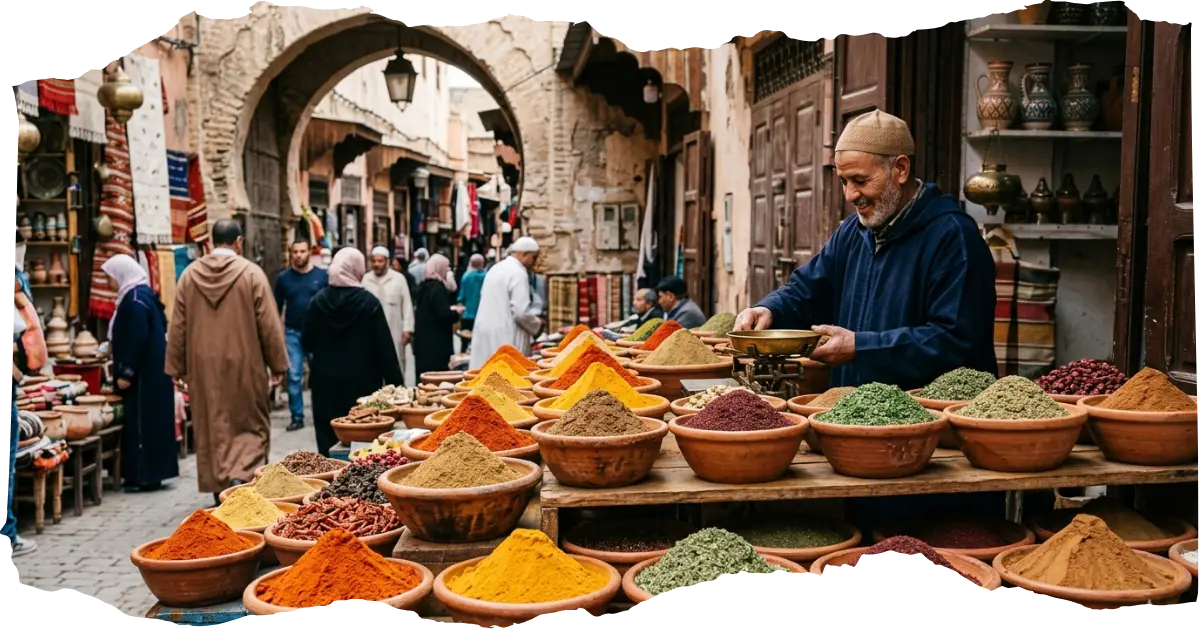
One of the most important things I can teach you about Moroccan cooking is that Morocco is not a monolith. The country spans an extraordinary range of geography, climate, and cultural influence — from the Mediterranean coast of Tétouan to the Atlantic cliffs of Essaouira, from the imperial grandeur of Fes to the Saharan extremity of Merzouga. Each region has its own relationship with Ras el Hanout, and understanding these differences will deepen your cooking in ways that no single formula can.
The Complete 30-Spice Formula
What follows is the most precise version of a living tradition that I know how to give you. This formula makes approximately 120 grams of Ras el Hanout — enough for three to four months of regular cooking, stored correctly. I have calibrated it toward the Fes tradition while incorporating elements that make it versatile across the full range of dishes you will encounter in this series. Where I have made choices between regional variations, I have noted them. Where you can adjust, I have told you how.
How to Use Ras el Hanout — The Principles
A spice blend is only as good as the cook who uses it, and Ras el Hanout requires more finesse than most. Because it contains thirty components spanning four flavor layers, it responds differently to different cooking methods. Understanding these differences will make everything you cook in Part III and Part IV more successful.
When you add Ras el Hanout to cold oil at the beginning of cooking — what Moroccan cooks call the chermoula stage — the heat of the oil blooms the fat-soluble aromatic compounds first, releasing the deep base notes before anything else. This is the technique for tagines and slow braises. The spice has time to fully integrate with the meat, and the result is seamless — you cannot separate the spice from the food because they have become the same thing over two or three hours of heat. This is the most traditional application.
When you add Ras el Hanout to a hot pan — when you are finishing a sauce or adjusting seasoning at the end — you are using the volatile top-note compounds, the rose and lavender and coriander that have not yet been driven off by long cooking. A half-teaspoon of Ras el Hanout stirred into a finished sauce at the last moment adds brightness and lift in a way that the long-cooked method cannot achieve. My grandmother used both techniques in the same dish: a generous amount at the beginning for depth, a pinch at the end for life.
The third application — one that Western cooks rarely consider — is using Ras el Hanout as a finishing spice, sprinkled over a completed dish the way a French chef might add fleur de sel. A pinch over a bowl of harira soup, a light dusting over a plated couscous, a small amount mixed into argan oil for dipping bread. In this application, you are eating the spice blend in its most naked form, and the quality of your blend is fully exposed. Use the best.
The Spice Merchant's Final Teaching
I want to leave you with something my grandmother said on the day she handed me her Ras el Hanout tin — words I did not fully understand until I had been cooking for twenty years. She said: "Les épices ne font pas la cuisine. Les épices révèlent le cuisinier." Spices do not make the cooking. Spices reveal the cook.
What she meant, I believe, is this: a bad cook given perfect Ras el Hanout will still produce mediocre food, because Ras el Hanout is a magnifying glass. It amplifies whatever is already there. A beautiful piece of lamb, treated with care, salted properly, given time — Ras el Hanout will make it transcendent. A mediocre piece of lamb, rushed, under-salted, impatient — Ras el Hanout will tell you so immediately, because there is nothing for it to magnify except haste. This is why the greatest Moroccan cooks are also the most patient ones. They know their spice blend is honest, and they must be honest in return.
You have now made your first batch of Ras el Hanout. Keep the tin close. Smell it regularly. Get to know it the way my grandmother got to know hers — as a living presence, something that changes with time, something that asks to be used with intention and respected with attention. In the chapters ahead, you will reach for this blend again and again — in chermoula, in preserved lemon paste, in the marinade for mechoui, in the bastilla filling, in the couscous broth that will, I promise you, make someone at your table fall completely silent from pure pleasure.
The tin of Ras el Hanout is never just a spice jar. It is a decision. Every time you open it, you are choosing to cook with your whole self.
What Comes Next
Ras el Hanout is the masterpiece, but it cannot stand alone. In the Moroccan kitchen, it works always in partnership — most crucially with chermoula, the herb and spice marinade that is the second great pillar of Moroccan flavor. If Ras el Hanout is the soul of a dish, chermoula is its voice. And in the next chapter, I am going to show you not one chermoula but five: the red chermoula of Marrakech that turns swordfish into something extraordinary, the green chermoula of the Atlantic coast that belongs inside whole sea bream, the simplified everyday version that my family uses on everything from roasted vegetables to fried eggs, and the two preserved variants — the chermoula that you make in large quantities and keep in the refrigerator for the week ahead, the kind that makes a Tuesday dinner taste like it took all weekend. You have built your foundation. Now we give it a voice.