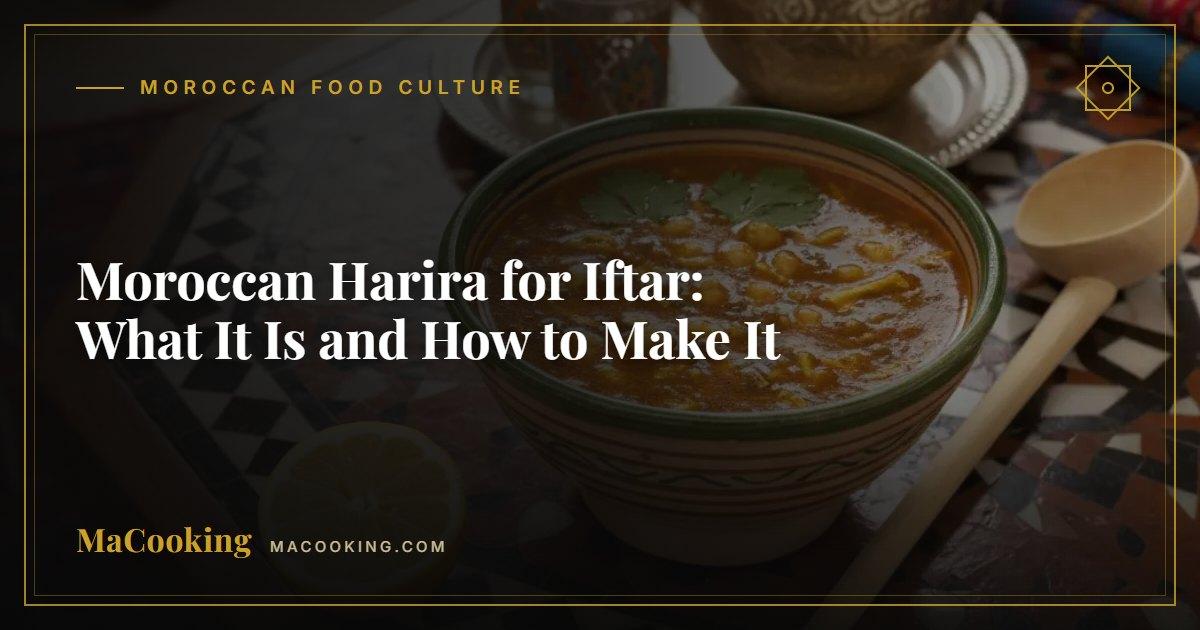
What is Moroccan harira? It is Morocco's best-loved soup: a tomato-based broth thickened with flour and enriched with lentils, chickpeas, fresh herbs and warm spices, often with small pieces of lamb or beef. It is the traditional dish that opens the fast at Ramadan iftar, usually served alongside dates and sweets.
Key Takeaways
- Harira is a thick, fragrant tomato soup with lentils, chickpeas, celery, cilantro, parsley and spices, and it is the classic Moroccan iftar starter.
- It tastes savory, herbal and lightly tangy, with gentle warmth from ginger, pepper and cinnamon rather than chili heat.
- A flour-and-water slurry called tadouira gives harira its silky body; adding it slowly while stirring prevents lumps.
- Recipes differ from family to family, so lamb, beef, chicken or no meat at all can all be "right".
- Calories depend on the meat, fat and noodles you use, but a bowl made at home is usually a moderate, filling portion.
What Is Moroccan Harira?
Harira (الحريرة) is a Moroccan soup built on tomatoes, legumes and a generous handful of fresh herbs. The name is related to the Arabic word for silk, which hints at the texture cooks aim for: a broth that is thick and smooth rather than watery. If you want a general reference, the Wikipedia entry on harira gives a useful overview of its variants across the Maghreb.
In Morocco the soup is strongly associated with Ramadan, but it is not limited to it. It appears in cafés and homes in the colder months, on tables after a long day, and as a light supper. During the holy month, though, it becomes the centerpiece of iftar, and almost every household has its own version, with its own balance of herbs, spice and thickness.
The core components
Almost every harira has the same skeleton, even when the details change:
- A tomato base, fresh, grated or canned, which gives color and gentle acidity.
- Legumes, typically brown or green lentils and chickpeas.
- Aromatics and herbs: onion, celery (leaves included), cilantro and flat-leaf parsley, used in quantity.
- Spices: ginger, turmeric, black pepper and cinnamon are common; saffron appears in richer versions.
- A thickener: tadouira, a slurry of flour and cold water, sometimes with a beaten egg stirred in at the end.
- A small starch: vermicelli or broken rice, added near the end.
What Does Moroccan Harira Soup Taste Like?
The first impression is fresh and herbal, because the parsley and cilantro go in generously and often twice, once early for depth and once late for brightness. Under that sits the sweet-tart body of tomato, the earthiness of lentils and the creamy, nutty softness of chickpeas.
The spices are warm rather than hot. Ginger and pepper give a quiet tingle, turmeric adds an earthy note and cinnamon lends a faint sweetness that surprises first-time eaters. A squeeze of lemon at the table lifts everything. If you use lamb, the broth takes on a rounder, savory depth; a vegetarian harira tastes lighter and more vegetal but is still satisfying.
Texture matters as much as flavor. Good harira is thick enough to coat a spoon, but it should still pour. It is not a puree, so you should be able to see whole lentils and chickpeas and the small threads of vermicelli.
Why Is Harira Served at Iftar?
Harira suits the moment the fast ends. It is warm and soft, easy to eat after a day without food or drink, and substantial enough to take the edge off hunger before the main meal. Tomato, legumes, herbs and a little starch in one bowl make it feel complete without being heavy.
It also has a place in the ritual of the table. In many Moroccan homes, iftar begins with dates, milk or water, then harira, often with hard-boiled eggs, bread and sweets such as chebakia on the side. For a wider picture of what else appears on the table, see our guide to Moroccan Ramadan food and a typical daily menu, and for the cultural side of the soup, read Harira Soup in Ramadan: Morocco's Nourishing Tradition.
What Goes Into Harira, and What Can I Substitute?
Most ingredients are easy to find in Western supermarkets. The table below shows what each element does and what you can use if you cannot find it.
| Ingredient | Role in the soup | Western pantry substitute |
|---|---|---|
| Fresh tomatoes (grated) | Color, sweetness, acidity | Canned crushed tomatoes plus 1 tbsp tomato paste |
| Brown or green lentils | Body and earthiness; no soaking needed | French green (Puy) lentils; avoid red lentils, which dissolve |
| Chickpeas | Creaminess, protein | Canned chickpeas, drained and rinsed |
| Celery with leaves | Savory, slightly bitter aromatic backbone | Celery stalks plus a little extra parsley |
| Cilantro and parsley | Freshness and the signature green flavor | No real substitute; use the freshest bunches you can find |
| Smen (preserved butter) | Rich, tangy depth in traditional versions | Regular butter or olive oil |
| Tadouira (flour and water) | Thickening and silky texture | All-purpose flour whisked in cold water |
| Vermicelli or broken rice | Light starch | Broken angel-hair pasta or any small soup pasta |
| Lamb shoulder or neck | Savory depth | Beef chuck, chicken thighs, or omit |
How Do You Make Moroccan Harira Soup With Lamb?
This is a home-style lamb harira for 6 to 8 servings. It takes about 20 minutes of active work and roughly 1 hour 30 minutes in total. Quantities are a starting point; Moroccan cooks adjust herbs and thickness by eye, and you should too. For other approaches, compare it with our traditional harira recipe, or take the long route in How to Cook Authentic Moroccan Harira From Scratch.
Ingredients
- 250 g (9 oz) lamb shoulder or neck, trimmed and cut into small 1.5 cm (½ in) cubes
- 2 tbsp olive oil, plus 1 tbsp butter or smen
- 1 large onion, grated
- 3 celery stalks with leaves, finely chopped
- 1 tsp ground ginger, 1 tsp turmeric, 1 tsp black pepper, ½ tsp cinnamon, a pinch of saffron (optional)
- 800 g (about 28 oz) crushed tomatoes, or 1 kg ripe tomatoes, grated or blended
- 1 tbsp tomato paste
- 1 large bunch cilantro and 1 large bunch flat-leaf parsley, finely chopped (keep about one-third aside)
- 100 g (½ cup) brown or green lentils, rinsed
- 1 can (400 g) chickpeas, drained and rinsed
- 2 litres (8 cups) hot water
- 50 g (about ½ cup) vermicelli, broken into short pieces
- Salt, to taste (about 1½ tsp, adjusted at the end)
For the tadouira: 3 tbsp all-purpose flour whisked into 250 ml (1 cup) cold water. To finish: 1 egg (optional) and lemon wedges.
Method
- Brown the lamb gently. Heat the oil and butter in a large pot over medium heat. Add the lamb, onion and spices and cook for 5 minutes, stirring, until the onion softens and the spices smell fragrant.
- Add the base. Stir in the celery, two-thirds of the herbs, the tomatoes, the tomato paste and the lentils. Pour in the hot water and bring to a boil.
- Simmer until tender. Reduce the heat, partly cover and simmer for 45 to 60 minutes, until the lamb is tender and the lentils are soft. Skim any foam that rises early on.
- Add the chickpeas. Stir them in and simmer for another 10 minutes.
- Thicken with tadouira. Whisk the flour slurry again, then pour it into the pot in a thin stream while stirring constantly. Simmer for 10 to 15 minutes, stirring often, until the soup is silky and the raw flour taste is gone.
- Add the vermicelli and fresh herbs. Drop in the vermicelli and the reserved herbs and cook for 4 to 5 minutes, until the noodles are tender.
- Finish. For an egg-enriched harira, beat the egg and pour it slowly into the simmering soup while stirring so it forms fine threads. Taste, adjust salt and pepper, and serve hot with lemon wedges.
Prefer no meat? Our vegetarian harira soup shows how to keep the depth with legumes, herbs and olive oil.
What Mistakes Should You Avoid When Making Harira?
- Dumping the slurry in at once. Pour tadouira slowly while stirring, or it will clump. If it does, whisk vigorously or press the lumps against the pot wall.
- Skimping on herbs. The green flavor is the point. If your harira tastes flat, more fresh cilantro and parsley near the end usually fixes it.
- Using red lentils. They break down completely and turn the soup into a puree. Stay with brown or green lentils.
- Adding vermicelli too early. It overcooks and swells, especially if you plan to reheat the soup.
- Cutting the meat too large. Small cubes tenderize faster and distribute flavor through every spoonful.
- Salting too early. Season at the end, once the soup has thickened and reduced.
Harira rewards patience: let it simmer after thickening, taste, then adjust. The last five minutes of fresh herbs and lemon do more than any spice.
How Many Calories Are in Moroccan Harira?
There is no single number for Moroccan harira calories, because the recipe changes from kitchen to kitchen. As a rough guide, a generous bowl made at home with a modest amount of lamb and oil is often estimated at around 200 to 300 calories. Treat that as an approximation, not a measured value.
What shifts the total:
- Meat and fat: lamb with more fat, plus butter or smen, increases calories; a vegetarian version made with olive oil and legumes is usually lighter.
- Starch: more vermicelli, rice or flour in the tadouira makes the soup thicker and more calorie-dense.
- Portion size: a small cup before a main meal is very different from a large bowl that serves as dinner.
- Sides: dates, bread, eggs and sweets at iftar add to the meal as a whole.
If you track calories closely, enter your exact ingredients into a nutrition calculator, since the result will be more accurate than any generic figure.
How Should You Serve and Store Harira?
Serve harira piping hot in deep bowls with lemon wedges, bread and dates. Many families add hard-boiled eggs, a pinch of cinnamon or a dusting of black pepper at the table. Sweet pastries like chebakia on the side are traditional at Ramadan.
| Situation | What to do |
|---|---|
| Fridge storage | Cool, cover and keep for about 3 days; the soup thickens as it rests |
| Reheating | Warm gently, adding hot water to loosen, then adjust salt and lemon |
| Freezing | Freeze without vermicelli or egg; add fresh noodles and herbs after reheating |
| Making ahead for iftar | Cook through the tadouira stage earlier in the day; add vermicelli and herbs just before serving |
Because the herbs lose brightness in storage, a handful of freshly chopped cilantro and parsley added when reheating makes a noticeable difference. For more soups worth keeping in rotation, browse our soup recipes.
If you enjoy understanding why Moroccan recipes are structured the way they are, the full ebook The Royal Moroccan Table: The Soul of Morocco includes a chapter titled "The Art of Harira".
Frequently Asked Questions
What is Moroccan harira made of?
Moroccan harira is made from tomatoes, lentils, chickpeas, onion, celery, fresh cilantro and parsley, and warm spices such as ginger, turmeric, pepper and cinnamon. It is thickened with a flour-and-water slurry called tadouira. Many versions include small pieces of lamb or beef, and a little vermicelli or rice.
Is harira vegetarian?
Harira can be made without meat, but traditional versions often use lamb or beef, and sometimes butter or smen for flavor. A vegetarian harira uses vegetable broth or water, olive oil and extra chickpeas and lentils. It stays hearty because of the legumes, herbs and thickener.
Why do Moroccans eat harira at iftar?
Harira is warm, gentle on an empty stomach and filling, thanks to legumes, tomato, herbs and a thickened broth. It is customarily served with dates and sweets to open the fast. Beyond nutrition, it is simply the expected dish: a Ramadan table in Morocco without harira feels incomplete to most families.
How many calories are in Moroccan harira?
There is no single figure, because recipes vary. A generous bowl of homemade harira is often estimated at roughly 200 to 300 calories. Lamb, oil or butter, vermicelli and the amount of flour all raise the total. A vegetarian version made with less fat usually comes in lower.
Can I make harira ahead and freeze it?
Yes. Harira keeps in the fridge for about three days and thickens as it sits, so loosen it with hot water when reheating. For freezing, make the soup without vermicelli and the egg, freeze in portions, then add fresh noodles and herbs when you reheat.
Conclusion
Moroccan harira is a soup that is easy to love: tomato-rich, herb-heavy, softly spiced and thick enough to feel like a meal. It marks the end of the fast in Moroccan homes, yet it is simple enough to cook on any cold evening. Start with the lamb version above, adjust the thickness and lemon to your taste, and you will quickly find your own best Moroccan harira recipe.