
The Tagine — Philosophy & Mastery
Close your eyes for a moment. Imagine a narrow lane in the medina of Fes, just after the morning call to prayer. The air is cool and still carries the night. A woman in a djellaba walks past carrying a clay pot sealed with a conical lid, its rim still warm from the neighborhood ferran — the communal bread oven where families bring their pots to cook slowly through the morning while the day's business begins. By the time she returns, the lamb inside will have surrendered completely to the heat. The bones will separate at a touch. The sauce will have reduced to something almost sacred. This is the tagine. Not a dish. A philosophy.
What the Tagine Really Is
Every culinary tradition has a vessel that defines it. The French have their copper pot. The Japanese their donabe. The Moroccans have the tagine — and to understand Morocco, you must first understand what this object does, why it was designed this way, and what that design says about the people who made it.
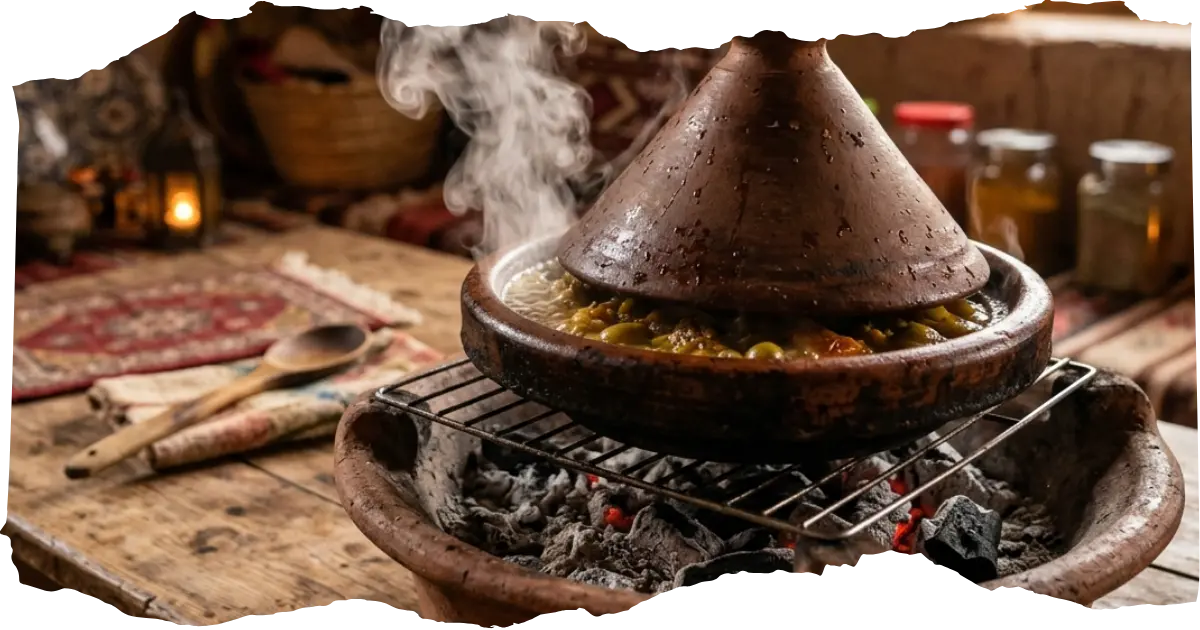
The word 'tagine' — طاجين in Arabic — refers both to the vessel and the dish cooked inside it. The vessel itself is ancient. Archaeological evidence places conical clay cooking pots in North Africa as far back as the Roman period, though the distinctly Moroccan form we recognize today evolved over centuries of Amazigh craftsmanship, refined through Arab culinary influence, shaped by trade routes that brought spices from sub-Saharan Africa, the Middle East, and Andalusia. What emerged is a masterpiece of passive engineering.
The secret is the cone. As food cooks below, steam rises into the tall conical lid. The cone's walls are cool enough that the steam condenses and runs back down into the pot. The tagine is self-basting. It circulates moisture constantly, without any intervention from the cook. You can leave a tagine unattended for hours and return to find something impossibly tender, its sauce reduced and concentrated, its aromas deepened beyond what any open pot could achieve in the same time. The Moroccan concept of cooking on النار الهادئة — the slow fire — was literally built into the shape of this vessel.
The tagine does not cook food. It transforms it. There is a difference, and it is everything.
A Memory From My Grandmother's Kitchen
My grandmother, Lalla Khadija, lived in the old medina of Fes el-Bali, on a street so narrow that neighbors across the alley could pass bread through their windows to each other. Her kitchen was barely two meters wide. She had a single butane burner, a shelf of spices organized by memory rather than label, and three tagines of different sizes — one for everyday cooking, one for guests, and one reserved only for special occasions, which she called 'the wedding tagine.' I never once saw her measure a single ingredient.
When I was eight years old, I watched her make lamb tagine with prunes and almonds — tagine barkouk — for a family gathering. She worked with absolute calm. The lamb first, browned in fat. Then the onion, which she grated rather than chopped. Then her fingers moving through spice jars, pinching and pressing, each addition placed near the rim of the nose before it touched the pot. She sealed the lid, set the pot over the lowest possible flame, and walked away to go greet guests. She did not look at a clock. She did not open the lid to check. When she returned — perhaps two hours later — and lifted that cone-shaped cover, the steam that rose made every person in the room fall silent for a moment. That smell. I have been chasing it my whole life, and I believe every recipe in this volume is one step closer to it.
What I did not understand as a child is that she was cooking with knowledge, not recipes. The knowledge was in her hands, her nose, her understanding of the fire and the clay and the particular lamb from the butcher she had trusted for thirty years. This book cannot give you thirty years. But it can give you the principles — and if you absorb those principles, cook these recipes with patience and attention, you will build knowledge of your own. That is the real purpose of this volume.
The Geography of the Tagine — Regional Variations
Morocco is not a single culinary voice. It is a conversation between cities, landscapes, and histories that have layered over one another for centuries. The tagine speaks differently in each place, and understanding those differences will make you a more complete cook.
The Tools — Choosing and Seasoning Your Tagine
Before you cook a single gram of anything, you must understand your vessel. There are three types of tagine available to modern cooks, and choosing correctly matters enormously.
The traditional unglazed clay tagine is the oldest and, in the right hands, the finest. It must be seasoned before first use — submerged in water for 24 hours, then rubbed with olive oil and placed in a cold oven brought slowly to 150°C for two hours. This process hardens the clay and opens its pores so that the vessel absorbs and distributes heat evenly. An unseasoned clay tagine will crack on its first use. Once seasoned, it requires gentle treatment — never place it over direct high heat without a heat diffuser, never subject it to thermal shock by adding cold liquid to a hot dry pot. Care for it and it will outlast you.
The glazed ceramic tagine is more practical for home use. It goes from stovetop (with a diffuser) to oven to table, it cleans easily, and it does not require seasoning. The trade-off is that it does not breathe like unglazed clay — it is a more passive vessel, less interactive with the cooking process. Many excellent cooks use glazed tagines their entire lives and produce magnificent food.
The enameled cast iron tagine — made popular by French cookware brands — is the most forgiving and arguably the most practical for kitchens outside Morocco. It distributes heat beautifully, retains temperature with extraordinary consistency, and requires no special care beyond ordinary cleaning. The cone-shaped lid still does its work. If you are new to tagine cooking, starting with cast iron is sensible. As your skill grows, you may feel called toward clay — and that is a journey worth making.
The Master Recipe — Lamb Tagine with Preserved Lemon and Olives
This is the foundational tagine. Learn this dish completely — every step, every smell, every moment of transformation — and you will understand the logic that underlies every other tagine in this book. This recipe uses the Ras el Hanout from Part II and the preserved lemons from Part II. If you have not made those yet, you may substitute store-bought versions, but make a note to yourself: the versions you made with your own hands will produce something different. Something alive.
Understanding What Just Happened — The Science and the Soul
Let us pause here and understand what you just produced, because the knowledge will make every future tagine better. The lamb shoulder you chose is a working muscle — it moved constantly during the animal's life, building dense connective tissue made of collagen. At high heat, collagen tightens and squeezes out moisture, producing the dry, chewy meat that most people have suffered through at bad dinner parties. At low, sustained heat between 70°C and 90°C, something extraordinary happens instead: the collagen slowly unravels and converts into gelatin. Gelatin is the ingredient that gives the sauce its silky, slightly viscous quality — that coating sensation on your lips when you eat well-made tagine. It is not a cooking technique. It is a chemical transformation that requires time and patience as its only ingredients.
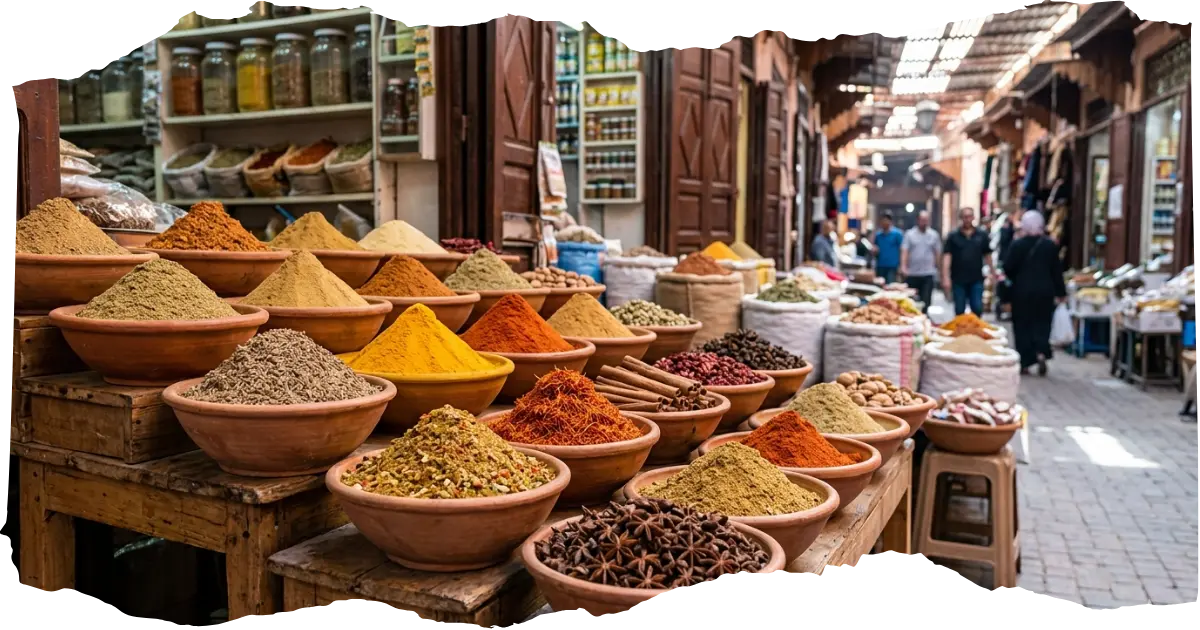
The saffron you bloomed in the first step has released safranal and picrocrocin — the compounds responsible for its particular golden color and its complex honey-hay-floral flavor. Heat destroys some of these compounds if saffron is added directly to a very hot pot, which is why blooming in warm water first extracts the flavor safely. The grated onion, rather than chopped, has released its water and sugars in a way that allows it to almost disappear into the sauce while contributing enormous sweetness. These are not accidents. They are the accumulated wisdom of Moroccan cooks, encoded in technique before food science existed to explain them.
The Seven Tagines You Must Learn
This chapter introduces the philosophy and the master recipe. In the chapters that follow, we will build a complete repertoire of the tagines that define Moroccan cuisine. Each one introduces a new technique, a new flavor principle, a new piece of the cultural picture. They are presented in order of increasing complexity, so that each recipe you cook prepares you for the next.
Tagine Kefta Mkaouara — the spectacular tagine of spiced meatballs cooked in a fragrant tomato sauce, finished with eggs cracked directly into the pot and set in the residual heat. This is the tagine of Marrakech's Jemaa el-Fna square, eaten standing at midnight, the smoke of a hundred braziers in the air. It is also one of the fastest tagines to make — thirty minutes from start to table — and it will convert any non-believer.
Tagine Djaj Bil Zaytoun — chicken with olives and preserved lemon, the most elegant and perhaps most beloved tagine in the Fessi tradition. The technique here introduces a different approach to browning and a crucial finishing technique that produces a sauce of extraordinary glossiness. Where the lamb tagine teaches patience, the chicken tagine teaches precision.
Tagine Mrouzia — the mythic sweet lamb tagine with raisins, honey, and smen, traditionally associated with Aid el Kebir, the feast of sacrifice. This is one of the oldest recipes in Moroccan cooking, with roots in medieval Andalusian cuisine, and cooking it is an act of connection with something much larger than a single meal.
Tagine Hout — the fish tagine of the Atlantic coast, built on a foundation of chermoula and cooked in a fraction of the time of meat tagines. This recipe demands different attention — not the passive patience of the slow fire, but an active, present engagement with rapidly changing ingredients. The spicing from Part II will be used in a different ratio here, teaching you to think in flavors rather than formulas.
Tagine Khodra — the great vegetable tagines: potato with preserved lemon, artichoke with peas, root vegetables with preserved apricot and almonds. These are not the afterthought vegetable options of many cookbooks. In Morocco, a well-made vegetable tagine is a marker of a cook's true skill — there is no rich meat to carry the flavor. Everything depends on spice, technique, and respect for the vegetable itself.
A tagine without patience is just a stew. Patience is the ingredient that cannot be purchased. It must be brought by the cook.
How to Serve — The Hospitality That Surrounds the Food
In Morocco, food is never simply sustenance. It is an act of communication between host and guest, between family members, between a cook and everyone they love. The tagine arrives at the table in its pot, still sealed — the lid is not removed until every guest is seated and present. This is not theatrical, though it is beautiful. It is an expression of the belief that the meal is a shared moment, and no one should experience it alone or out of sequence.
The traditional table has no individual plates for tagine. Everyone reaches toward the pot with bread in hand, taking from the section directly in front of them. The best piece — the richest cut, the largest portion of sauce — is placed by the host in front of the most honored guest. In my grandmother's house, when a guest reached across the pot to take from another section, she would gently redirect their hand with a smile. 'Your section is here,' she would say. 'Everything you need is right in front of you.' I have thought about that gesture many times since. It contains an entire philosophy of hospitality.
Accompany the tagine with warm khobz — the round Moroccan bread that you will find in the next section of this volume — and a simple Moroccan salad of diced tomatoes, cucumber, fresh parsley, olive oil, and cumin. Nothing more is required. The tagine is complete in itself. A glass of cold water or fresh-squeezed orange juice is the appropriate drink. Moroccan tea comes after the meal, in its own time, as its own ceremony — which we will explore fully in Part V.
A Final Note Before You Cook
When you cook the recipe above for the first time, something will be imperfect. The sauce might be slightly too thin, or the lamb slightly more firm than the ideal, or the saffron bloom shorter than it should have been. This is not failure. This is the beginning of knowledge. Write a note in the margin — what happened, what you think caused it, what you will change. Lalla Khadija, who never measured a single ingredient, was not born with that knowledge. She cooked the same dishes hundreds of times, through failure and adjustment, through seasons and occasions, through the accumulated learning that only repetition produces. You are beginning that journey now. The clay remembers heat. The cook remembers everything.
In the next chapter, we turn to what I consider the most theatrical and joyful tagine in the entire Moroccan repertoire: Tagine Kefta Mkaouara — the meatball tagine with eggs. This is the dish that fills the night markets of Marrakech with its particular perfume of spiced meat and sweet tomato. It is quick enough for a weeknight and spectacular enough for company. And it will teach you something about Moroccan spicing that no amount of explanation can replace — it must be experienced at the table, sauce still bubbling in the pot, egg yolk barely set, bread warm from the oven. That chapter begins on the next page. I suggest you read it before you sleep, and shop for it in the morning.