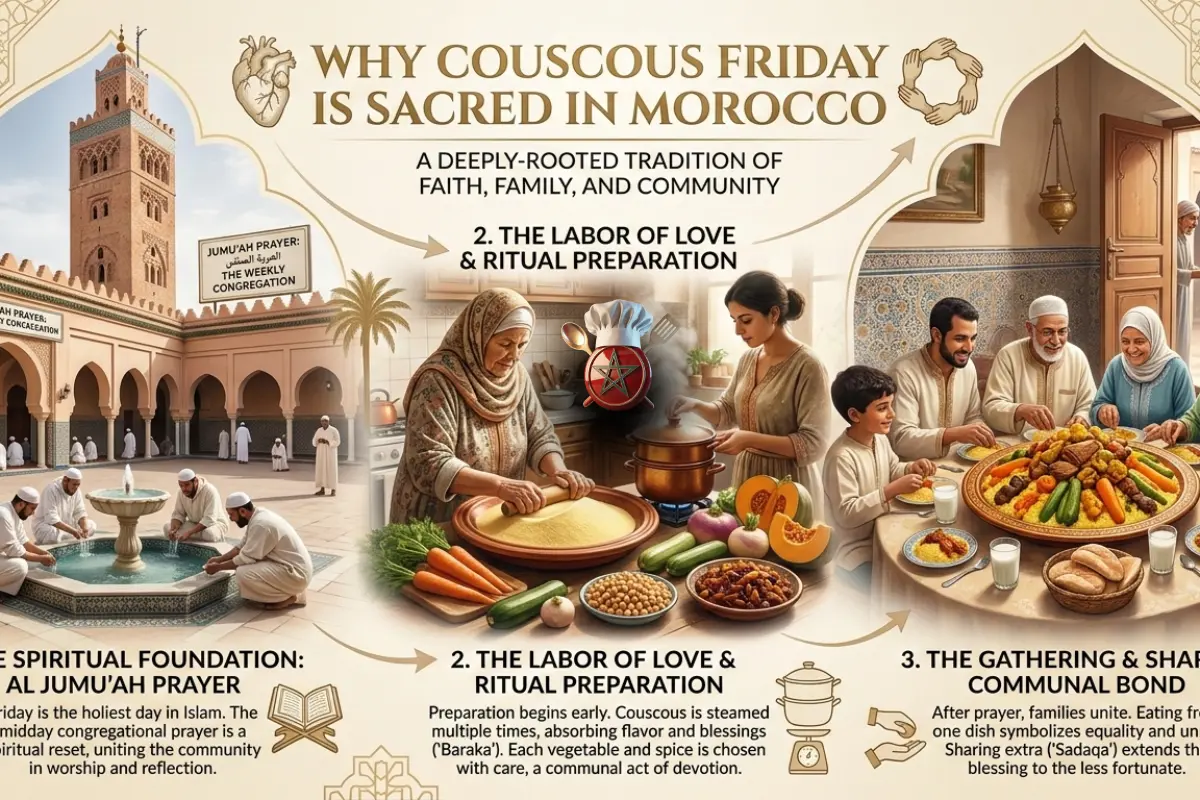
Introduction: The Week Revolves Around Friday
Ask any Moroccan child what day of the week it is, and they might answer in an unexpected way: "It's three days until couscous day" or "Two days after couscous." In Morocco, the entire week orbits around Friday—not just because it's the Islamic holy day, but because Friday means couscous.
Every Friday, across Morocco—from the Atlas Mountains to the Atlantic coast, from royal palaces to humble village homes—the same ritual unfolds. Families gather around massive platters of steaming couscous crowned with tender meat and seven vegetables. Hands reach in together, forming small balls of couscous and vegetables, eating communally from the shared dish. This is not just lunch. This is the most important meal of the Moroccan week.
The Friday couscous tradition is so deeply embedded in Moroccan culture that it shapes the rhythm of daily life:
- 🕌 Thursday night, women begin preparing vegetables and meat
- 🌅 Friday morning, the couscoussier steams while families attend mosque
- 👨👩👧👦 Friday afternoon, the entire family—sometimes three generations—gathers around one plate
- 💤 Friday evening, the "couscous nap" is sacred (you don't schedule meetings Friday afternoon!)
But why? Why has this one meal, on this one day, become so profoundly important that it defines Moroccan identity? Why does skipping Friday couscous feel like missing a religious obligation? Why do Moroccans living abroad describe Friday couscous as their strongest connection to home?
The answer weaves together Islamic spirituality, Berber tradition, family bonds, social structure, and food as sacred ritual. Friday couscous is where religion meets culture, where the spiritual becomes edible, where a grain of semolina carries the weight of centuries.
This is the complete story of Friday couscous—exploring its religious foundations, historical evolution, social functions, regional variations, and enduring power as Morocco's most sacred weekly ritual. From the spiritual significance of Jummah (Friday prayer) to the practical magic of communal eating, from ancient Berber harvest celebrations to modern diaspora nostalgia—this is why Friday couscous is not just a meal, but the beating heart of Moroccan culture.

Chapter 1: The Religious Foundation
Jummah: The Blessed Day
☪️ Friday in Islamic Tradition:
"The best day on which the sun has risen is Friday." — Prophet Muhammad (peace be upon him)
In Islam, Friday holds special spiritual significance:
| Aspect | Religious Significance | Practical Expression |
|---|---|---|
| Jummah Prayer | Obligatory congregational prayer for men | All Muslim men attend mosque Friday afternoon |
| Day of gathering | Community comes together | Families reunite, extended family visits |
| Blessings multiplied | Good deeds on Friday carry extra reward | Charitable acts, family care emphasized |
| Recommended practices | Special prayers, reading Quran, bathing | Friday becomes day of spiritual renewal |
| Social obligation | Strengthen community bonds | Visiting family, sharing meals |
The Quranic foundation: Surah Al-Jumu'ah (The Friday) commands:
"O you who have believed, when the call to prayer on Friday is made, hasten to the remembrance of Allah and leave trade. That is better for you, if you only knew." (Quran 62:9)
This verse established Friday as the Muslim weekly gathering day—the Islamic equivalent of Jewish Sabbath or Christian Sunday, but with its own unique character.
Why Food Became Central to Jummah
🍽️ The Sacred Meal:
Islam has always connected spirituality and food:
- Breaking fast together (iftar during Ramadan)
- Eid feasts after fasting month
- Sacrificial meat sharing (Eid al-Adha)
- Communal eating as worship (eating together = reward)
Friday specifically: The Prophet Muhammad encouraged making Friday special through cleanliness, good clothes, and good food. Hadith (prophetic traditions) mention:
- "Whoever takes a bath on Friday... and goes early to the mosque... it will be as if he offered a sacrifice."
- "Friday is the best of days... make it special."
- "The best day for breaking bread together is Friday."
The Moroccan interpretation: Moroccans took this general Islamic emphasis on Friday's importance and created a specific, elaborate food ritual that became more central than in any other Muslim culture.
Why couscous specifically?
- It's abundant (one large platter feeds many—embodies generosity)
- It's communal (eaten from shared dish—embodies unity)
- It's labor-intensive (requires effort—embodies devotion)
- It's Moroccan (connects Islamic practice to North African identity)
The Spiritual Symbolism
🕊️ What Friday Couscous Represents:
| Element | Physical Reality | Spiritual Meaning |
|---|---|---|
| Seven vegetables | Carrots, turnips, zucchini, cabbage, pumpkin, chickpeas, tomatoes | Completeness, perfection (7 is sacred number in Islam) |
| Shared platter | Everyone eats from same dish | Equality before God, family unity, breaking social barriers |
| Hands (no utensils) | Eating with right hand, forming couscous balls | Humility, following Prophetic tradition (Sunnah) |
| Communal preparation | Mother, daughters, sometimes neighbors help | Community bonds, women's solidarity, shared blessing |
| Meat portion | Lamb or chicken at center of platter | Abundance, celebration, honoring the sacred day |
| Timing (after prayer) | Served after Jummah prayer returns | Spiritual fulfillment → physical nourishment |
| Regularity (every week) | Never skipped, always Friday | Devotion through consistency, ritual as worship |
Chapter 2: The Berber Roots
Before Islam: Ancient Harvest Celebrations
🌾 The Indigenous Tradition:
Plot twist: Friday couscous predates Islam in Morocco.
Archaeological and anthropological evidence suggests Berber peoples celebrated weekly or seasonal communal meals long before the 7th-century arrival of Islam. Key facts:
- Couscous is Berber invention: The word "couscous" comes from Berber "seksu" (well-rolled/formed)
- Berber calendar had weekly cycles: Seven-day weeks existed in Berber culture (though days had different names)
- Harvest celebrations: After grain harvests, Berber tribes held communal feasts
- Grain as sacred: Wheat and barley were considered divine gifts in agricultural Berber society
The fusion: When Islam arrived in Morocco (7th-8th centuries), it encountered this existing tradition of communal grain-based meals. Rather than replace it, Islam absorbed and sanctified it, connecting the Berber weekly feast to the new Islamic Friday observance.
The Islamization of Couscous
☪️ How a Berber Dish Became Islamic Ritual:
Timeline of transformation:
| Period | Development | Significance |
|---|---|---|
| Pre-700 CE | Berber communal couscous meals, no specific day | Indigenous tradition |
| 700-800 CE | Islam arrives, brings Friday as holy day | New religious framework |
| 800-900 CE | Berber couscous tradition shifts to Friday | Fusion begins |
| 900-1200 CE | Friday couscous becomes standard across Morocco | Tradition solidifies |
| 1200-1500 CE | Religious scholars codify it as "recommended" (mustahab) | Religious legitimation |
| 1500-Present | Friday couscous becomes unbreakable tradition | Cultural identity marker |
Why this fusion worked:
- Both traditions emphasized community gathering
- Both centered on weekly cycles
- Both used shared meals as social glue
- Both treated food as sacred, not just fuel
The result: A tradition that feels simultaneously Berber and Islamic, where ancient North African culture and Muslim spirituality became inseparable.

Chapter 3: The Social Architecture
Friday Couscous as Social Contract
What Friday Couscous Enforces
The Modern Tension
⚡ Tradition Meets Contemporary Life:
The conflict: Friday couscous was designed for a world where:
- Extended families lived near each other
- Women didn't work outside the home
- Friday afternoon was universally free
- Everyone lived in the same city/country
Modern Morocco is different:
- ✈️ Young people move to cities or abroad for work
- 💼 Many women work full-time jobs
- 🕐 Friday afternoon meetings/work exist in global business
- 🌍 Families scattered across continents
How families adapt:
| Challenge | Traditional Expectation | Modern Adaptation |
|---|---|---|
| Working women | Cook from scratch Friday morning | Cook Thursday night, reheat Friday OR buy ready-made couscous OR share cooking duties with husband |
| Distance | Attend in person every week | Video call during meal, visit monthly instead of weekly |
| Friday work | Never schedule Friday afternoon obligations | Family couscous moves to Friday evening or Saturday |
| Diaspora | Maintain exact tradition abroad | Make couscous but on weekends when family available |
| Small nuclear families | Multi-generational gathering | Invite friends, create chosen family |
The controversy: Some Moroccans see adaptations as necessary evolution. Others see them as erosion of sacred tradition. This tension plays out in families across Morocco weekly.

Chapter 4: The Preparation Ritual
The Thursday-Friday Process
⏰ 24-Hour Journey from Raw Ingredients to Sacred Meal:
Thursday Evening (الخميس عشية):
| Time | Task | Who | Significance |
|---|---|---|---|
| Thursday 6:00 PM | Plan menu, check pantry | Mother | Mental preparation begins |
| 7:00 PM | Soak chickpeas (if using dried) | Mother or daughter | Overnight soaking essential |
| 8:00 PM | Cut meat into pieces, refrigerate | Mother | Saves time Friday morning |
| 9:00 PM | Peel/cut vegetables (carrots, turnips, onions) | Mother + daughters | Communal prep, teaching moment |
Friday Morning (الجمعة صباح):
| Time | Task | What's Happening |
|---|---|---|
| 8:00 AM | Start preparing couscous grain | If hand-rolling (traditional): mix semolina with water, roll grains (1 hour). If using pre-made: skip this step |
| 9:00 AM | Begin cooking broth/stew | Meat, onions, chickpeas, spices start simmering in bottom of couscoussier |
| 10:00 AM | First steaming of couscous | Couscous goes in steamer basket over broth (20-30 minutes) |
| 10:30 AM | Remove couscous, fluff, oil, rest | Break up lumps, add olive oil, let rest |
| 11:00 AM | Add vegetables to broth | Harder vegetables first (carrots, turnips, potatoes) |
| 11:30 AM | Second steaming of couscous | Return couscous to steamer (20-30 minutes) |
| 12:00 PM | Add softer vegetables | Zucchini, cabbage, tomatoes added to broth |
| 12:30 PM | Men leave for mosque | Women continue monitoring cooking |
| 1:00 PM | Third steaming (optional) | For extra-fluffy couscous |
| 1:30 PM | Final seasoning, arrangement | Taste broth, adjust salt/spices |
| 2:00 PM | Men return from mosque | House smells incredible! |
| 2:15 PM | Plating/assembly | Mound couscous on large platter, arrange vegetables, place meat on top, ladle broth |
| 2:30 PM | THE MEAL BEGINS | "Bismillah" - family gathers around |
The Women's Labor
👩 The Invisible Work:
Truth: Friday couscous represents 5-6 hours of labor, almost entirely performed by women.
The physical toll:
- Standing for hours steaming, stirring, checking
- Heat from the stove in summer
- Heavy pots and platters
- Precise timing required (can't leave the house)
The emotional labor:
- Feeding potentially 10-20 people
- Meeting family expectations/criticism
- Perfection expected ("not as good as mother/grandmother")
- No days off—every single Friday
The knowledge required:
- Perfect grain texture (fluffy, not clumpy)
- Right amount of broth (moist but not soupy)
- Vegetable doneness (tender but not mushy)
- Meat tenderness
- Spice balance
- Timing everything to finish together
The modern question: As more Moroccan women work outside the home, who will cook Friday couscous? This is a real, ongoing tension in Moroccan society:
- Some husbands learn to cook couscous (revolutionary!)
- Some families share duties (women cook, men chop vegetables)
- Some buy ready-made couscous (considered "cheating" by traditionalists)
- Some skip it entirely (rare, causes guilt and family judgment)
The Technique That Matters
🌾 Why Proper Steaming is Sacred:
The defining characteristic of proper Friday couscous: It must be steamed at least twice in a couscoussier (special double pot).
Why this matters:
| Method | Result | Acceptability |
|---|---|---|
| Triple-steamed in couscoussier | Light, fluffy, separate grains, perfect texture | ✅ Gold standard, grandmother-approved |
| Double-steamed in couscoussier | Very good, fluffy, acceptable | ✅ Minimum acceptable for Friday couscous |
| Instant couscous (pour boiling water) | Adequate texture, lacks depth | ⚠️ Acceptable for weekday meals, NOT for sacred Friday couscous |
| Boiled like pasta | Mushy, clumpy, wrong texture | ❌ Unacceptable, "not real couscous" |
The symbolism of proper steaming:
- Shows devotion (easy way exists, but you choose hard way)
- Demonstrates respect for tradition
- Proves skill (not everyone can do it well)
- Creates superior product (instant couscous really is inferior)
"You can't microwave love": Moroccan saying that captures why shortcuts are rejected. Friday couscous is supposed to be labor-intensive—the labor is part of the offering.
Chapter 5: Regional & Family Variations
How Friday Couscous Differs Across Morocco
🗺️ One Tradition, Many Expressions:
Fes (فاس) - The Refined Version:
- Style: Most elaborate, sophisticated
- Vegetables: Seven vegetables precisely (symbolic perfection)
- Meat: Lamb or chicken, always
- Spicing: Complex ras el hanout with saffron
- Presentation: Artistic arrangement, vegetables displayed beautifully
- Attitude: "Our couscous is the best in Morocco" (every Fassi believes this!)
Marrakech (مراكش) - The Sweet Touch:
- Style: Sweeter than other regions
- Vegetables: Includes pumpkin/squash (adds sweetness)
- Meat: Lamb with tfaya (caramelized onion-raisin topping)
- Unique element: Sweet elements (raisins, caramelized onions, sometimes honey)
- Spicing: Cinnamon more prominent than in Fes
Casablanca (الدار البيضاء) - The Urban Pragmatic:
- Style: More modern, practical
- Vegetables: Whatever is fresh at market (less strict about "seven")
- Meat: Sometimes beef (more common in cities than lamb)
- Shortcuts: More accepting of instant couscous or buying ready-made
- Attitude: "We're too busy for 6-hour cooking" (but most still do it!)
Atlas Mountains (الأطلس) - The Berber Original:
- Style: Rustic, simple, closest to ancient Berber couscous
- Grain: Sometimes barley couscous (traditional Berber grain)
- Vegetables: Wild herbs, seasonal mountain vegetables
- Meat: Whatever available (goat, sheep, chicken, sometimes none)
- Spicing: Minimal—cumin, salt, pepper, wild herbs
- Unique: May include buttermilk or lben poured over couscous
Coastal Cities (Essaouira, Safi, Agadir) - The Lighter Version:
- Style: Influenced by Mediterranean freshness
- Vegetables: More tomatoes, lighter vegetables
- Meat: Sometimes fish! (Controversial—some say "not real Friday couscous")
- Spicing: Lighter, more herbs than heavy spices
Family Secret Ingredients
🔐 What Makes Each Family's Couscous Unique:
Every Moroccan family believes their mother/grandmother makes the best couscous. Why? Secret ingredients and techniques:
Common family "secrets":
- Smen (preserved butter): Added to couscous for richness (some families, not all)
- Specific ras el hanout blend: Family recipe, ratio of spices
- Mother's touch: Literally—hand-rolling couscous or hand-fluffing creates unique texture
- Broth technique: Some reduce it more, some keep it brothier
- Vegetable ratio: More of favorite vegetables, less of others
- "The timing": Some mothers insist on exact cooking times others won't share
- Prayer/blessing: Some families believe blessing the food while cooking makes it better
The belief: Most Moroccans genuinely believe their family's couscous is objectively superior, not just preference. This isn't arrogance—it's proof that couscous is emotional, not just culinary.

Chapter 6: The Diaspora Experience
Friday Couscous Abroad
🌍 Maintaining Tradition in Foreign Lands:
For Moroccans living abroad (estimated 5+ million worldwide), Friday couscous is the strongest connection to home.
Why it matters more abroad:
- Recreates Morocco in foreign apartment
- Teaches children their heritage
- Maintains family identity against assimilation
- Provides taste/smell of home (nostalgia in edible form)
- Weekly ritual that structures time
The challenges abroad:
| Challenge | In Morocco | Abroad (France, Belgium, etc.) |
|---|---|---|
| Ingredients | Everything available in markets | Must find specialty stores, substitute some vegetables |
| Couscoussier | Every household has one | Must bring from Morocco or buy online |
| Family gathering | Extended family nearby | Often nuclear family only, or Moroccan friends as chosen family |
| Friday timing | Friday afternoon free for everyone | Work schedules, school—often moved to Saturday or Sunday |
| Children | Automatically absorb tradition | Must actively teach, compete with local culture |
| Judgment | Everyone knows proper couscous | Non-Moroccan partners/children may not understand importance |
The Second Generation Dilemma
👶 Born Abroad, Moroccan at Heart?
For children of immigrants, Friday couscous is complicated:
The parents' perspective:
- "If they don't eat couscous, they'll lose their identity"
- "Friday couscous is non-negotiable"
- "This is who we are"
The children's perspective:
- "It's just food, why so serious?"
- "I have soccer/plans on Friday afternoons"
- "I like couscous but don't feel religious about it"
- "My friends think it's weird we MUST eat the same thing every Friday"
What often happens:
- Childhood (0-12): Attend Friday couscous without question
- Teenage years (13-18): Push back, want to be like peers, skip sometimes
- Young adulthood (18-25): Away at university/work, rarely attend
- Late 20s-30s: Nostalgia hits, actively seek Friday couscous
- Parenthood: Make Friday couscous for own children, the cycle continues
The pattern: Reject tradition → miss it → reclaim it → pass it on. This is happening in Moroccan diaspora communities worldwide.
Video Calls & Virtual Couscous
📱 Technology Meets Tradition:
COVID-19 pandemic accelerated a trend: Families eating couscous together via video call.
How it works:
- Mother in Morocco cooks couscous
- Daughter in France cooks couscous
- Video call connects them Friday afternoon
- They "eat together" across thousands of miles
- Talk, laugh, maintain connection
Reactions are mixed:
- ✅ Pro: Better than no connection, maintains ritual spirit
- ❌ Con: "Not real gathering," loses communal plate aspect
- ✅ Pro: Allows weekly contact despite distance
- ❌ Con: "Technology can't replace physical presence"
The question: Is virtual Friday couscous authentic? Moroccans are still deciding.
Chapter 7: What Happens When You Skip It
The Guilt
😔 The Weight of Absence:
Missing Friday couscous triggers disproportionate guilt in Moroccans. Why?
Because skipping Friday couscous signals:
- ❌ You don't care about family
- ❌ You've forgotten your roots
- ❌ You prioritize other things over sacred ritual
- ❌ You're becoming "too Western/modern"
- ❌ You don't respect your mother's labor
The pressure is real:
- Mother will call: "Where are you? Why aren't you here?"
- Siblings will comment: "Too good for family now?"
- Grandmother may invoke blessings/curses
- You'll be discussed at the table: "Where is [name]? What's more important than family?"
Acceptable excuses (very few):
- ✅ Serious illness (your own or immediate family)
- ✅ Travel (work or vacation, but you'll be missed)
- ✅ Living very far away (but should try to attend when possible)
- ⚠️ Work (marginally acceptable, but better to reschedule work)
Unacceptable excuses:
- ❌ "I'm tired"
- ❌ "I have plans with friends"
- ❌ "I don't feel like it"
- ❌ "I ate out"
- ❌ "I made other food"
The Family Drama
💥 Real Social Costs:
Case studies of what happens when Friday couscous is missed:
Scenario 1: Young adult skips repeatedly:
- First time: Questions, mild guilt-tripping
- Second time: Concerned calls from extended family
- Third time: Intervention from respected family elder
- Fourth time: Serious family meeting about "losing touch with values"
- Ongoing: Relationship strain, seen as family outsider
Scenario 2: Married couple alternates families:
- Husband's family: "Why does she take you away every other week?"
- Wife's family: "He's stealing our daughter"
- Result: Constant negotiation, both families somewhat dissatisfied
Scenario 3: Working woman can't cook every week:
- If she buys ready-made: Judgment from mother-in-law ("Can't even cook properly")
- If husband helps cook: Eyebrows raised ("Is he not a real man?")
- If they skip: Family shame
- Result: Exhaustion trying to meet expectations
The stakes are high: Friday couscous attendance/absence can make or break family relationships.
Conclusion: Why It Endures
In Morocco's rapidly modernizing society—where young people study abroad, women enter workforce, global business demands weekend work, nuclear families replace extended ones—Friday couscous persists.
Despite every practical obstacle, despite generational tensions, despite the 6-hour cooking commitment, despite the challenge of gathering scattered family members, the vast majority of Moroccans still observe Friday couscous.
Why?
🕊️ Because Friday Couscous Is:
- More than food—it's prayer in edible form
The labor, the gathering, the sharing = worship - More than family time—it's cultural DNA transmission
This is how Moroccan identity passes to the next generation - More than tradition—it's resistance to erasure
In a globalizing world, Friday couscous says "we are Moroccan and that matters" - More than obligation—it's chosen belonging
People attend because deep down, they want to belong to something ancient and meaningful - More than a meal—it's weekly proof that some things are sacred
In secular modern life, Friday couscous remains untouchable, holy, non-negotiable
👵 From the Grandmother:
"You ask why we must have couscous every Friday? Why the same day, the same meal, year after year, generation after generation? I'll tell you. Because Friday is when God made Adam, peace be upon him—the first human. Every Friday, we remember we are human, we are family, we are Moroccan, we are Muslim. All of this—in one plate of couscous.
When you sit around that platter with your family, eating with your hands, sharing from one dish, you are doing what your great-great-great-grandparents did. You are connected to every Moroccan who ever lived. The couscous is not just food. It's memory. It's identity. It's love made visible.
So yes, I cook for six hours every Friday. Yes, I will do it until I cannot stand anymore. And then my daughter will do it. And then her daughter. Because some things—some sacred, beautiful things—we do not allow to die. Friday couscous is one of those things. May Allah preserve it forever."
🌟 The Sacred in the Ordinary:
Friday couscous proves that the sacred doesn't require temples or formal ceremonies. Sometimes, holiness is simply showing up—week after week, year after year—to sit with family, share food, and acknowledge that some bonds transcend convenience.
It's a reminder that ritual creates meaning. The repetition isn't boring; it's what transforms ordinary semolina grains into spiritual practice. The predictability isn't limiting; it's what creates safety, identity, and connection across time.
In a world that increasingly values flexibility, efficiency, and individual choice, Friday couscous stubbornly insists: Some things are worth being inflexible about. Some things are worth the inefficiency. Some things we do not because they're easy or convenient, but because they connect us to something larger than ourselves.
Download Your Friday Couscous Resources:
- 📖 Traditional Friday Couscous Recipe (Detailed PDF)
- 🕌 Friday Spiritual Significance Guide (Islamic Context)
- 👨👩👧👦 Friday Couscous Family Traditions Guide
- 🌍 Diaspora Guide: Maintaining Friday Couscous Abroad
- 📅 Friday Preparation Timeline (Printable Kitchen Guide)
- 📜 Friday Duas & Meal Blessings (Arabic/English)
Share your Friday couscous tradition! Tag #MaCookingFriday with photos of your family gathering!
May your Fridays always be blessed. May your family always gather. May the couscous always be fluffy, the vegetables tender, and the love abundant.
جمعة مباركة - Jumu'a Mubaraka (Blessed Friday)