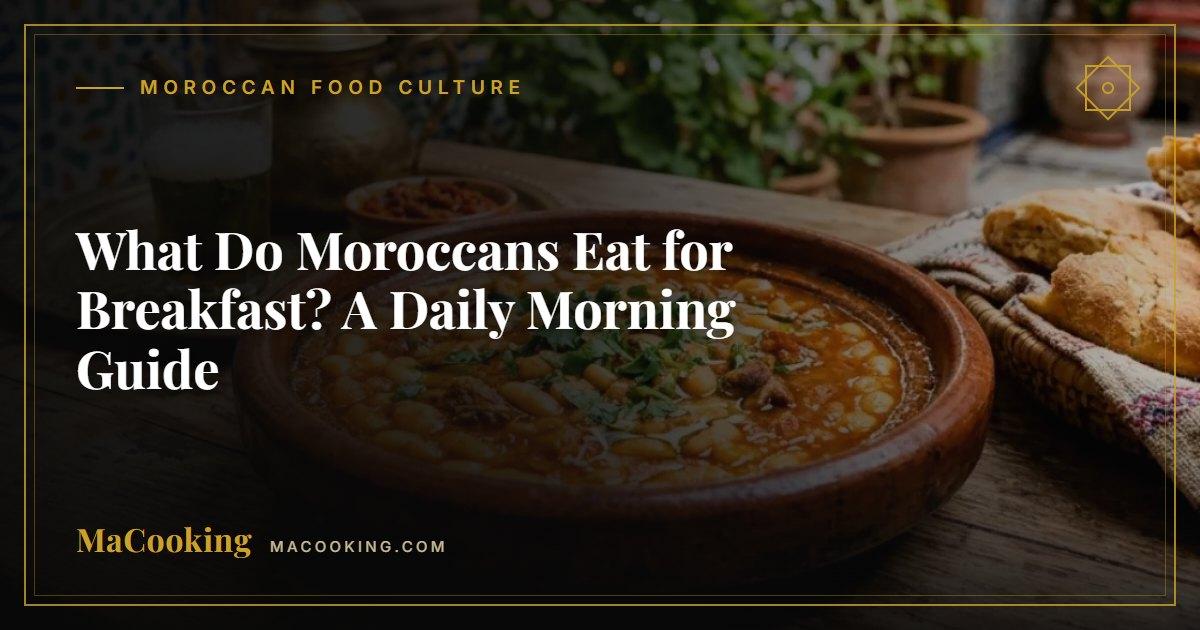
Most Moroccans eat a light, bread-based breakfast: msemen, baghrir, harcha or khobz with olive oil, butter, jam, honey, cheese or amlou, served with sweet mint tea or café au lait. Eggs, olives and fried sfenj are common additions, while bissara soup warms winter mornings, and weekends are more elaborate.
Key Takeaways
- Moroccan breakfast is built around bread and griddled semolina or flour pancakes, not meat-heavy plates.
- Olive oil, butter, honey, jam, soft cheese and amlou are the usual toppings, with olives and eggs on the savory side.
- Mint tea, café au lait and orange juice are the classic drinks, and tea is almost always sweetened.
- Weekdays are quick and simple; weekends, holidays and guests call for several breads, eggs and a bigger spread.
- Most Moroccan breakfast dishes can be made with Western pantry staples such as fine semolina, butter and honey.
What Do Moroccans Eat for Breakfast on an Ordinary Weekday?
If you asked many Moroccan households what they eat for breakfast on a school or work morning, the answer would be modest: fresh bread, olive oil or butter, maybe some jam or cheese, and a glass of tea or a bowl of milky coffee. It is quick, filling and easy to share around a low table or a kitchen counter.
The key habit is eating with bread. Bread is the tool for scooping olive oil, mopping up egg yolk and carrying a spoonful of honey. That is why Moroccan breakfast looks less like a plated meal and more like a set of small things placed in the middle of the table for everyone to dip into.
A very ordinary weekday spread might include:
- Khobz (round Moroccan bread) or a piece of msemen, often reheated on a dry pan.
- A small dish of olive oil, sometimes with a pinch of salt or cumin for dipping.
- Butter, jam or honey, and sometimes processed cheese portions or fresh jben (soft white cheese).
- A handful of black or green olives.
- Mint tea or coffee with milk.
For a wider cultural picture of the morning meal, our guide to Moroccan breakfast traditions goes deeper into how families, cafés and regions shape it.
Which Moroccan Breakfast Breads and Pancakes Are the Most Popular?
When people search for Moroccan breakfast foods, they are usually looking for these griddle breads. Each one has a different texture, and you will often see two or three of them side by side on a weekend table.
| Dish | What it is | Texture | Typically served with |
|---|---|---|---|
| Msemen | Square, layered flatbread of flour and semolina, folded and cooked on a griddle | Flaky, chewy, crisp at the edges | Honey, butter, jam, cheese |
| Baghrir | Semolina pancake cooked on one side only, with a surface full of tiny holes | Soft, spongy, absorbent | Melted butter and honey, or amlou |
| Harcha | Thick semolina griddle cake made with butter or oil | Crumbly outside, tender inside | Jam, cheese, honey, or butter |
| Batbout | Soft pan-cooked round bread that can be split | Light, slightly chewy | Eggs, cheese, olives, or a stuffing |
| Sfenj | Ring-shaped, yeasted fried doughnut | Crisp outside, airy inside | Sugar, tea, or coffee |
| Khobz | Round, everyday loaf | Dense, soft crumb | Olive oil, eggs, jam, cheese |
Msemen: the weekend favorite
Msemen is made by stretching a soft dough very thin, brushing it with oil or butter, folding it into a small square and flattening it again before cooking. The folds create the layers. Many home cooks make a big batch, cook them lightly and freeze the extras. A variation called rghaif is folded and cooked in a similar way, and cooks use the two names in slightly different ways depending on the region and family.
Baghrir: the pancake with a thousand holes
Baghrir is often called the "thousand-hole" pancake. The batter is thin, usually made with fine semolina, a little flour and a raising agent, and it bubbles as it cooks, leaving a honeycomb surface. Because only one side is cooked, the top stays pale and soft. Traditionally it is drenched in a warm mix of butter and honey, and the holes soak up every drop.
Harcha: the easiest to start with
Harcha is a rustic semolina cake cooked slowly in a skillet. It is the simplest of the group if you are new to Moroccan breakfast ideas because there is no stretching, folding or resting, only a quick dough.
Quick home harcha (makes about 6 cakes):
- Mix 250 g (about 1½ cups) fine semolina with 1 tablespoon sugar, 1 teaspoon baking powder and ½ teaspoon salt.
- Rub in 100 g (7 tablespoons) soft or melted butter until the mixture looks like damp sand.
- Add about 120 ml (½ cup) milk, a little at a time, until the dough holds together. Rest it for 10 minutes so the semolina hydrates.
- Shape into discs about 1.5 cm (½ inch) thick. Press a little semolina onto the surface for texture.
- Cook in a dry or lightly greased skillet over medium-low heat for 5 to 6 minutes per side, until golden and cooked through.
- Serve warm, split open and filled with butter, honey, jam or cheese.
Common mistake: cooking on high heat. The outside colors fast and the center stays raw. Keep the heat gentle and be patient.
What Do Moroccans Drink With Breakfast?
Drinks matter as much as the food. The usual choices are:
- Mint tea (atay): green tea with fresh mint and plenty of sugar, poured from a height into small glasses. Our free chapter, "The Moroccan Tea Ceremony: The Complete Guide", is free to read online and explains the ritual in detail.
- Café au lait or nous-nous: coffee with milk, with nous-nous (roughly "half-half") being the café order for equal parts coffee and milk.
- Orange juice: fresh-squeezed from seasonal oranges where they are in season, which is common in Moroccan cafés.
- Milk or hot milk with a little coffee or cocoa: especially for children.
If you want to extend the idea beyond breakfast, the Moroccan food pairing guide shows how different drinks match different dishes across the day.
What Savory Moroccan Breakfast Dishes Are There?
Sweet toppings get most of the attention, but savory breakfasts are very much part of the picture, especially on weekends and in cooler months.
Eggs, olive oil and cumin
Eggs are cooked quickly in a small pan, often with olive oil, a pinch of salt and a little ground cumin on the side. They may be fried, scrambled or cooked in a small clay dish placed on the table, and everyone dips bread straight into the yolk.
Eggs with khlii
Khlii is a traditional preserved meat, typically beef, spiced, dried and stored in its own fat. Fried with eggs, it makes a rich and savory breakfast. If you cannot find khlii, you can approximate the effect with a little well-seasoned dried beef or pastrami-style meat, though the flavor will be different.
Bissara: a warm bean soup for cold mornings
Bissara is a thick soup of dried fava beans (or split peas in some homes), garlic, olive oil, cumin and paprika. It is eaten in the cooler months, often with bread and sometimes from simple street stalls or small cafés. It is a good example of how a Moroccan morning meal can be both humble and deeply satisfying. For a bean dish that is more at home at lunch, try our loubia (Moroccan white beans), a recipe you could also make ahead and reheat.
Sfenj from the street
Sfenj, the ring doughnut, is typically bought fresh rather than made at home. In many Moroccan towns, small stalls fry them in the morning and sell them by the piece, often strung on a palm strip or wrapped in paper. They go well with tea or coffee. Our guide to Moroccan street food covers more of what you can find on the street.
Olives, jben and amlou
Olives and soft fresh cheese are quiet, everyday companions. Amlou is the standout: a thick spread of ground roasted almonds, argan oil and honey, closely associated with the Souss region in the southwest. It is rich and a little goes a long way, so spread it thinly on msemen or baghrir, or put a small bowl on the table for dipping.
How Does Moroccan Breakfast Change by Region and Season?
Morocco is a large country with very different landscapes, so breakfast varies. The table below gives a general picture rather than strict rules, since households everywhere cook in their own way.
| Context | What you may find | Why |
|---|---|---|
| Cities, weekdays | Bread, butter or cheese, coffee with milk, tea | Speed and convenience |
| Weekends and guests | Msemen, baghrir, harcha, eggs, olives, juice, several spreads | More time and a wish to share |
| Southwest (Souss) | Amlou, argan oil, honey with bread | Almonds and argan are local products |
| Colder months and mountains | Bissara, hot soups, warm bread with olive oil | Warming food for cold mornings |
| Oases and the south | Dates with milk or tea, local bread | Date palms are central to local life |
| Ramadan | A pre-dawn meal (suhoor) instead of breakfast | Fasting from dawn to sunset |
What about Ramadan?
During Ramadan the idea of breakfast changes completely. The morning meal is replaced by suhoor before dawn and the evening meal that breaks the fast, called ftour in Morocco. If you are interested in that side of Moroccan eating, see our overview of Moroccan suhoor dishes for the traditions behind that meal.
How Can You Build a Moroccan Breakfast at Home?
You do not need a Moroccan kitchen to put together a convincing spread. Start with one bread, two toppings, one savory item and a hot drink. Here are some practical swaps for Western pantries:
| Moroccan ingredient | Easy substitute | Note |
|---|---|---|
| Fine semolina | Fine semolina or "semolina flour" from a supermarket or health food shop | Avoid coarse couscous-grade semolina for baghrir and harcha |
| Smen (aged butter) | Good unsalted butter, plus a pinch of salt | Smen is funky and strong; butter is milder |
| Jben (fresh cheese) | Fresh ricotta, farmer's cheese or fresh goat cheese | Drain well so it spreads neatly |
| Amlou | Almond butter blended with a little argan or olive oil and honey | Taste and adjust sweetness |
| Khlii | Dried beef or well-spiced cured meat | The taste will differ from the original |
| Moroccan mint tea | Gunpowder green tea, fresh spearmint, sugar | Steep briefly to avoid bitterness |
A simple weekend menu
- Make a batch of harcha (recipe above) or buy frozen msemen from a North African grocer and reheat on a dry pan.
- Put out butter, honey, jam, olives and fresh cheese in small bowls.
- Fry a few eggs in olive oil and place a small dish of cumin and salt on the table.
- Brew mint tea and pour it into small glasses, and add coffee with milk for those who prefer it.
- Serve everything at once and let people build their own plates.
If you like to plan ahead, browse the full list of Moroccan recipes for dishes that suit the rest of the day, and consider a few from our Moroccan kitchen essentials shop such as teapots and glasses if you want to serve tea the traditional way.
Moroccan Breakfast Near Me: How Do You Find It Outside Morocco?
If you are searching for a Moroccan breakfast near you, the options depend on where you live. I cannot point to specific venues, but these approaches work in most large cities in the US, UK, Canada, Australia and Europe:
- Search maps for "Moroccan café", "Moroccan bakery" or "North African restaurant", then check menus for msemen, baghrir, harcha, sfenj or bissara.
- Visit halal grocers and North African shops, which often sell frozen msemen, semolina, olives and spices.
- Look at weekend brunch menus at Moroccan restaurants, where breakfast dishes tend to appear.
- Check cities with long-established Moroccan communities, such as Paris, Brussels, Amsterdam, Montreal and London, where bakeries and cafés are more common.
If there is nothing close, making breakfast at home is realistic. Msemen takes practice, but baghrir and harcha are forgiving, and a good tea routine takes only a few minutes.
For readers who want to go further into the subject, the full ebook The Royal Moroccan Table, Part 5: Sweet Morocco includes a chapter titled "The Moroccan Breakfast Table". If you want a broader reference on the cuisine as a whole, Wikipedia's overview of Moroccan cuisine is a reasonable starting point.
Frequently Asked Questions
What is the most typical Moroccan breakfast?
There is no single dish, but a typical breakfast is bread or a griddled pancake such as msemen, baghrir or harcha, served with olive oil, butter, jam, honey or cheese, plus mint tea or coffee with milk. Eggs, olives and fresh orange juice often join the table.
Do Moroccans eat eggs for breakfast?
Yes, though they are not required every day. Eggs are often fried or scrambled with olive oil and cumin, and sometimes cooked with khlii, a preserved spiced meat. They are eaten with bread, which serves as the scoop and the fork.
What is amlou and how is it eaten?
Amlou is a thick spread from southwestern Morocco made from ground roasted almonds, argan oil and honey. It is spread on msemen, baghrir or plain bread, or dipped into with torn pieces of bread. It is rich, so a thin layer is enough.
Is Moroccan breakfast sweet or savory?
Both, though everyday breakfasts lean mildly sweet and bread-centered. Honey, jam and amlou sit alongside savory olives, cheese, eggs and, in colder months, bissara, a warm fava bean soup. Most tables mix the two rather than choosing one.
What do Moroccans drink with breakfast?
The most common drinks are sweet mint tea (made with green tea), coffee with milk, and fresh orange juice where it is available. Many people also drink a half-and-half coffee called nous-nous in cafés. Strong coffee is usually served in small glasses or cups.
How can I find a Moroccan breakfast near me?
Search for Moroccan or North African cafés, bakeries and halal grocers, and look for msemen, baghrir, harcha, sfenj or bissara on the menu. Weekend brunch menus at Moroccan restaurants often include them. If nothing is nearby, msemen and harcha are easy to make at home.
Conclusion: A Morning Built Around Bread, Tea and Sharing
So, what do Moroccans eat for breakfast? In short: bread and pancakes, olive oil, butter, honey and jam, sometimes eggs, olives or soup, and always a hot drink. The pleasure lies less in complicated recipes than in warm bread, good ingredients and a table people share. Start with harcha and mint tea this weekend, add baghrir or msemen when you feel confident, and you will soon have your own version of a Moroccan morning. If you want to continue with more Moroccan eating habits, our suhoor recipes are a good next step for hearty, energizing early meals.