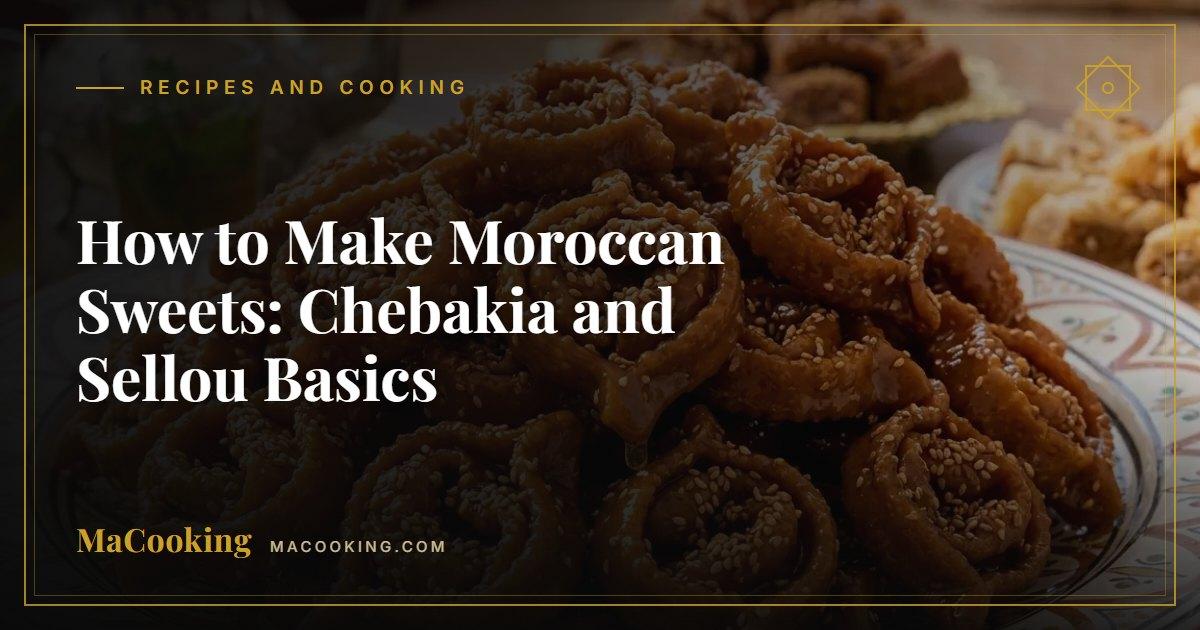
To make Moroccan sweets at home, start with two classics: chebakia, a rolled, folded and fried sesame dough soaked in honey, and sellou, a crumbly mix of toasted flour, almonds, sesame, spices and butter. Both rely on gentle toasting, aromatic spices and patience rather than special equipment.
Key Takeaways
- Chebakia is fried dough shaped into a rose and dipped in warm honey. Sellou (also called sfouf) is a no-bake, spoonable mix built on toasted flour.
- Both sweets are closely tied to Ramadan, but they keep well and suit tea time, gifting and dinner parties all year.
- Toasting is the step that matters most: sesame, almonds and flour should be golden and fragrant, never scorched.
- Oil temperature of about 160-170°C (320-340°F) and warm, not boiling, honey give chebakia their crisp, glossy finish.
- Most ingredients are easy to find in Western supermarkets; orange blossom water and aniseed are the two worth seeking out.
What Are Chebakia and Sellou, and Why Do They Matter?
Learning how to make Moroccan sweets usually begins with these two, because together they show the range of the tradition. Chebakia is a labour of hands: rolling, cutting, slitting and folding dough into a flower, then frying and soaking it. Sellou is the opposite, a quiet, patient dish of toasting and stirring that ends in a pale golden, sandy mixture you press into a mound and decorate.
Both are most associated with Ramadan, when chebakia often appears next to a bowl of harira at the evening meal and sellou is eaten for energy. Their flavours are distinctly Moroccan: sesame, almond, cinnamon, aniseed and orange blossom. You can read more about chebakia on Wikipedia, and about how these treats fit into festive tables in our guide to Moroccan sweets for special occasions.
| Feature | Chebakia | Sellou (Sfouf) |
|---|---|---|
| Texture | Crisp outside, honey-soaked within | Soft, crumbly, sandy |
| Cooking method | Fried, then dipped in honey | Toasted and mixed, no frying |
| Key flavours | Sesame, saffron, cinnamon, aniseed, orange blossom | Toasted flour, almond, sesame, cinnamon, aniseed |
| Difficulty | Moderate (shaping takes practice) | Easy (toasting needs attention) |
| Active time | About 2 hours, plus resting | About 45 minutes |
| Best served | With harira or mint tea | With tea or coffee, by the spoonful |
How to Make Moroccan Sweets: Which Ingredients and Tools Do You Need?
The pantry for these sweets is short and mostly familiar. The key is quality: fresh spices, good almonds and a mild honey. For tools, you need a heavy-bottomed pan or Dutch oven for frying, a rolling pin, a pastry wheel or sharp knife, a skillet or baking tray for toasting, and a thermometer if you have one.
| Ingredient | Role | Western pantry substitute |
|---|---|---|
| Toasted sesame seeds | Flavour and texture in both sweets | Plain white sesame seeds, toasted at home |
| Aniseed (ground) | Classic sweet-spice note | Fennel seed, ground, in a smaller quantity |
| Orange blossom water | Floral fragrance in dough and syrup | A few drops of rose water, or a little orange zest |
| Smen (aged clarified butter) | Traditional sellou fat, with a deep savoury note | Ghee or good unsalted butter |
| Saffron threads | Colour and aroma in the chebakia dough | A pinch of turmeric for colour only (flavour will differ) |
| Blanched almonds | Body and richness in sellou | Skin-on almonds, blanched and peeled yourself |
A note on spices
Buy whole sesame, aniseed and cinnamon sticks when you can and grind them just before using. The aroma difference is obvious the moment the spices hit warm flour or hot oil.
How Do You Make Chebakia Step by Step?
This is a basic framework for roughly 40 pieces. For a complete version, see our Chebakia with Honey and Cinnamon recipe, and compare the quantities if you want to adjust spicing or yield.
Ingredients
- 500 g (4 cups) all-purpose flour
- 60 g (about ½ cup) toasted sesame seeds, ground, plus 2 tbsp whole for finishing
- 1 tsp ground cinnamon, 1 tsp ground aniseed, ½ tsp ground ginger
- A generous pinch of saffron threads, steeped in 2 tbsp warm water
- 1 tsp fine salt and 1 tsp instant yeast
- 1 egg and 60 g (¼ cup) melted butter
- 2 tbsp white vinegar and 2 tbsp orange blossom water
- About 150 ml (⅔ cup) warm water, added gradually
- Neutral oil for deep frying
- For the syrup: 400 g (about 1⅓ cups) mild honey, 100 ml (⅓ cup) water, 1 tbsp orange blossom water
Method
- Make the dough. Mix the flour, ground sesame, spices, salt and yeast. Add the egg, butter, saffron with its water, vinegar and orange blossom water. Add warm water a little at a time and knead for 8-10 minutes until smooth, soft and not sticky.
- Rest. Cover and rest for 30 minutes so the gluten relaxes and the dough rolls thinly without springing back.
- Roll and cut. Work in small batches. Roll the dough to about 2 mm thick and cut rectangles roughly 10 x 8 cm. Keep the unused dough covered.
- Slit and fold. Make four parallel cuts down the length of each rectangle, leaving about 1 cm uncut at each end. Thread one end through the middle slits, twist, and curl the piece into a loose rose. Press the ends together so the shape holds in the oil.
- Fry. Heat the oil to 160-170°C (320-340°F). Fry in small batches for 2-3 minutes, turning, until deep golden. If the oil is too hot, the outside darkens before the inside cooks.
- Make the syrup. Warm the honey with the water and orange blossom water over low heat for about 5 minutes. Do not boil hard, which darkens the flavour.
- Dip and finish. Drop the hot chebakia into the warm honey for 1-2 minutes, turning once. Lift out, drain on a rack and sprinkle with sesame seeds immediately, while the honey is tacky.
Let the chebakia dry for several hours before stacking. They firm up and become noticeably crisper as they cool.
How Do You Make Sellou (Sfouf)?
Sellou is simple, but it rewards attention. The aim is flour toasted to a pale biscuit colour, nuts and sesame roasted until fragrant, and just enough fat to bind everything into a mixture that holds when pressed. This outline serves about 8-10. Our Sellou (Sfouf) recipe gives a full version, and the sellou preparation guide covers the tradition and nutrition in more depth.
Ingredients
- 500 g (4 cups) all-purpose flour
- 250 g (1¾ cups) blanched almonds
- 100 g (¾ cup) sesame seeds
- 150 g (1 cup plus 2 tbsp) icing sugar, sifted
- 1 tbsp ground cinnamon and 1 tsp ground aniseed
- A pinch of salt
- 150 g (⅔ cup) butter, ghee or smen, melted
- 2 tbsp honey (optional)
Method
- Toast the flour. Spread it on a baking tray and bake at 180°C (350°F) for 15-20 minutes, stirring every 5 minutes, until pale gold and nutty. Alternatively, stir it constantly in a dry skillet over medium-low heat.
- Toast the sesame. Dry-toast in a skillet for 3-4 minutes until golden. Shake the pan constantly, as sesame can burn quickly.
- Roast the almonds. Roast at 170°C (340°F) for 8-10 minutes until lightly golden. Cool completely.
- Grind. Pulse the cooled almonds in short bursts to a coarse, sandy meal. Stop before they turn oily. Grinding with a spoonful of the sugar helps prevent clumping.
- Combine. Sift the cooled flour into a large bowl. Add almonds, sesame, sugar, cinnamon, aniseed and salt.
- Bind. Pour in the warm melted butter gradually, mixing with your hands, until the mixture holds when squeezed. Add honey if you like a slightly more cohesive texture.
- Shape. Press the sellou into a mound or shallow dish, then decorate with almonds, sesame or cinnamon patterns.
Think of sellou as a dry, spiced dough that never gets baked. Every step is about flavour, so toast patiently and let the ingredients cool before combining.
What Are the Most Common Mistakes When Making These Sweets?
Most failures come down to temperature and moisture. The table below summarises the usual problems and fixes.
| Problem | Likely cause | Fix |
|---|---|---|
| Chebakia are pale and greasy | Oil too cool | Heat to 160-170°C (320-340°F) and fry in small batches |
| Chebakia are dark but raw inside | Oil too hot or dough too thick | Lower the heat and roll thinner |
| Chebakia unfold while frying | Ends not pressed together | Pinch firmly and keep dough pieces covered while you work |
| Chebakia go soft after a day | Humidity or stacking while damp | Rest on a rack for several hours, then store airtight |
| Sellou tastes bitter | Flour, sesame or nuts scorched | Toast at lower heat and stir constantly |
| Sellou crumbles when pressed | Not enough fat or too fine a grind | Add melted butter a tablespoon at a time and grind nuts more coarsely |
| Sellou is greasy or clumpy | Butter added too hot or nuts over-ground | Cool slightly before adding butter and pulse the nuts briefly |
How Can You Serve These Sweets at a Dinner Party?
Both sweets work for a Moroccan dessert course because you can make them well ahead. Pile chebakia on a platter and set a small bowl of sellou beside it with spoons and small plates. Serve with fresh mint tea or strong coffee and a bowl of dates, fresh oranges sprinkled with cinnamon, or fresh fruit to balance the sweetness. If you are planning the whole evening, our guide to hosting a Moroccan dinner party shows how the courses fit together.
Moroccan dessert ideas beyond these two
Once you are comfortable with honey, sesame and almonds, explore the wider repertoire of traditional Moroccan dessert recipes: crumbly almond ghriba, fekkas biscotti, or filled pastries such as m'hancha. Browse the Desserts & Sweets recipes to see the full range.
What about chocolate?
Chocolate is not a traditional ingredient in chebakia or sellou. If you want a modern twist, stir a handful of chopped dark chocolate into cooled sellou, or drizzle melted chocolate over finished chebakia once the honey has set. Use a dark chocolate with real cocoa flavour so the spices still come through. Treat it as a contemporary variation, not the classic version.
How to store and make ahead
- Chebakia: Store in an airtight tin, layered with parchment, for about two weeks. Keep away from humidity.
- Sellou: Store airtight in a cool place for about two weeks, or refrigerate in warm weather. Bring to room temperature before serving.
- Make-ahead plan: Toast the flour, sesame and almonds a day or two before. On the day, grind, mix and press the sellou, and fry the chebakia the day before serving so they have time to dry.
Frequently Asked Questions
Can I make chebakia without deep frying?
Not with the traditional result. Chebakia gets its crisp, blistered texture from frying in hot oil, then soaking in honey. Baking produces a drier, biscuit-like cookie that does not absorb syrup the same way. If you must avoid deep frying, shallow-fry in 3-4 cm of oil and turn the pieces often.
What is the difference between sellou and sfouf?
They are two names for the same family of sweets: toasted flour, ground almonds, sesame, spices, sugar and fat. Names and details vary by region and household. Some versions are finer and sandier, others coarser, and some add honey or more spices. Both are eaten in spoonfuls, often with tea.
How long do chebakia and sellou keep?
Stored in airtight containers in a cool, dry place, chebakia keeps for about two weeks and sellou for roughly the same. Keep chebakia away from humidity, which softens them. Because sellou contains butter and nuts, refrigerate it in hot weather, and bring it back to room temperature before serving.
Can I use honey alternatives for chebakia syrup?
Yes, but the flavour changes. Maple syrup or agave can be warmed with a little orange blossom water and used for dipping, though they are thinner and may not set as firmly as honey. For the closest texture, use a mild liquid honey and simmer it gently without letting it darken.
Is there a chocolate version of Moroccan sweets?
Chocolate is not part of traditional chebakia or sellou, but some modern cooks add dark chocolate chips to sellou or drizzle melted chocolate over cooled chebakia. If you try it, use good dark chocolate so the sesame, almond, anise and cinnamon flavours still come through.
Conclusion
Chebakia and sellou are a strong starting point for anyone learning how to make Moroccan sweets: one teaches shaping, frying and syrup, the other teaches toasting and balance. Master the basics, keep your toasting gentle and your oil temperature steady, and you will have sweets that look and taste properly Moroccan. Once you are comfortable, move on to the wider range of Moroccan cookies and pastries and build your own dessert table.