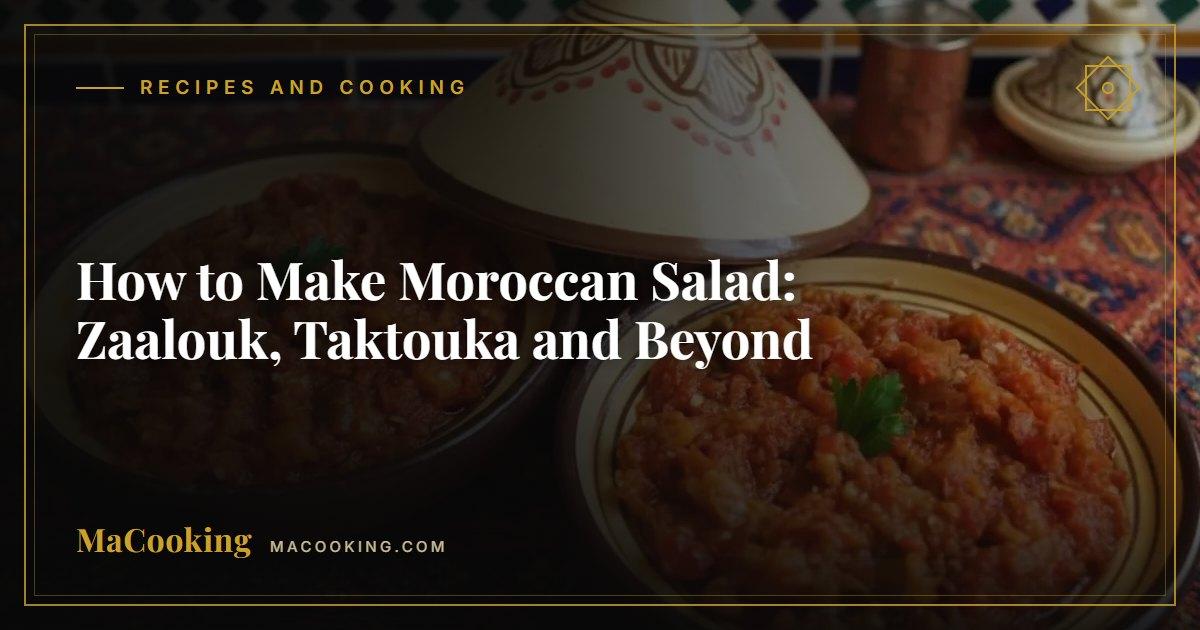
Here is how to make Moroccan salad: cook or chop vegetables, then season them with garlic, cumin, paprika, olive oil, lemon or vinegar and fresh herbs. Cooked salads like zaalouk (eggplant) and taktouka (peppers and tomato) simmer slowly until jammy, while carrot and tomato salads are dressed raw or lightly boiled. Serve at room temperature with bread.
Key Takeaways
- A Moroccan salad is often a small, seasoned dish for scooping with bread, not a bowl of dressed leaves.
- Zaalouk and taktouka are cooked salads. Their texture comes from patient reduction, not from extra oil.
- Carrot salad can be cooked or raw. The cooked version is soft and garlicky, while the raw one is bright and citrusy.
- Cumin, paprika, garlic, lemon, cilantro and parsley do most of the work, and every one is easy to find in a Western supermarket.
- Most of these salads taste better after resting, so they suit make-ahead entertaining.
What counts as a Moroccan salad?
In Morocco the word shlada (salad) covers much more than raw vegetables in a dressing. A Moroccan table often opens with several small dishes: a smooth, spiced eggplant mash, roasted peppers and tomato cooked down to a jam, grated carrots, beets, and a chopped tomato and cucumber salad. Some are served cold, some barely warm, and all are meant to be eaten with torn pieces of bread rather than a fork.
That is the first mental shift for cooks outside Morocco. These salads are closer to a mezze spread or a set of vegetable dips than a side salad. They can be made ahead, held at room temperature, and combined in whatever quantity suits your table. For a wider look at the whole family, our guide to 15 Moroccan salads, cooked and fresh is a good companion to this article. If you like to browse by recipe, the Salads & Appetizers category collects them in one place.
How to Make Moroccan Salad: The Basic Method Behind Every Recipe
Once you see the pattern, most Moroccan salads follow the same logic, and you can improvise with confidence.
- Prepare the vegetable. Roast, steam, boil, char or grate it, depending on the dish.
- Build a flavor base. Garlic, olive oil (sometimes mixed with a neutral oil), paprika and cumin are the usual starting point.
- Cook it down or dress it. Cooked salads simmer uncovered until the water has evaporated and the oil starts to separate. Raw salads are dressed with lemon juice or vinegar.
- Finish with herbs and acid. Chopped cilantro and flat-leaf parsley go in at the end, with a squeeze of lemon if the salad needs lifting.
- Rest it. Give it at least 30 minutes at room temperature. The flavors will meld.
The pantry: what you need and what to swap
You do not need specialty shopping for most of these dishes. The table below shows the usual ingredients and practical swaps for Western kitchens.
| Ingredient | Role in the salad | Easy substitute |
|---|---|---|
| Sweet paprika | Color and mild sweetness | Mild smoked paprika, used a little more sparingly |
| Ground cumin | Earthy, warm backbone | Toast and grind whole cumin seeds for more depth |
| Fresh cilantro and flat-leaf parsley | Freshness at the finish | All parsley, if cilantro is not to your taste |
| Preserved lemon | Salty, floral citrus note | Fresh lemon zest and juice, plus a pinch of extra salt |
| Orange blossom water | Perfumed note in sweet carrot salads | Fresh orange juice and a little zest |
| Ripe tomatoes | Body and acidity in cooked salads | One 400 g (14 oz) can of whole peeled tomatoes for 4 fresh ones |
| Olive oil | Richness and sheen | None needed, though a little neutral oil can lighten the finish |
If you want to make your own preserved lemons for the savory salads, there is a step-by-step guide to preserved lemons at home. They take a few weeks to mature, but they keep well.
How do you make Moroccan eggplant salad (zaalouk)?
Zaalouk is the dish most people mean by Moroccan eggplant salad. Eggplant and tomato are cooked together with garlic, cumin and paprika into a thick, spoonable salad that sits somewhere between a dip and a stew. You can read more about its character in our piece on zaalouk as a Mediterranean-style spread. The method below follows the same approach as our full zaalouk recipe. If you prefer more heat, try the spicy zaalouk with roasted garlic.
Ingredients (serves 4 to 6 as part of a spread)
- 2 large eggplants (about 900 g / 2 lb)
- 4 ripe tomatoes (about 600 g / 1⅓ lb), or one 400 g (14 oz) can whole tomatoes
- 4 garlic cloves, minced
- 3 tbsp olive oil
- 1 tsp sweet paprika
- 1 tsp ground cumin
- ¼ tsp cayenne or chili flakes (optional)
- ½ tsp salt, plus more to taste
- ¼ cup finely chopped cilantro and parsley, mixed
- 1 to 2 tsp lemon juice, to finish
Method
- Cook the eggplant. Heat the oven to 220°C (425°F). Prick the eggplants, roast on a tray for 40 to 45 minutes until collapsed, then cool slightly. Traditional cooks often steam peeled, cubed eggplant instead. Either way works.
- Drain and chop. Scoop the flesh from the skins, let it sit in a colander for 5 minutes, then chop it roughly. Do not purée it; you want some texture.
- Prepare the tomatoes. Grate the fresh tomatoes on a box grater and discard the skins, or crush canned tomatoes by hand.
- Build the base. Warm the olive oil in a wide pan over medium heat. Add the garlic, paprika, cumin and cayenne, and stir for 30 seconds until fragrant but not browned.
- Simmer. Add the tomatoes and salt. Cook uncovered for 15 to 20 minutes, stirring now and then, until the sauce has thickened and the oil begins to separate.
- Combine. Add the eggplant and mash it into the sauce with a wooden spoon or fork. Cook for another 10 to 15 minutes over low heat until thick and glossy.
- Finish. Stir in the herbs and lemon juice, then taste for salt. Serve warm or at room temperature.
Common zaalouk mistakes
- Watery result. This usually means the tomatoes were not reduced enough before the eggplant went in. Be patient with step 5.
- Bitter or raw garlic taste. Add the garlic to warm, not smoking, oil and keep it moving.
- Pasty texture. A blender turns zaalouk into baby food. Mash by hand and keep a little structure.
What is taktouka and how do you make it?
Taktouka is a cooked salad of roasted peppers and tomatoes, seasoned with garlic, cumin and paprika. It is sweeter and lighter than zaalouk, and the charred peppers give it a gentle smokiness. It is served across Morocco as part of a cooked-salad spread. Our taktouka recipe with tomatoes and peppers has the full version. Here is the essential method.
Ingredients (serves 4 to 6)
- 4 green bell peppers (or 3 bell peppers and 1 or 2 mild green chilies)
- 4 ripe tomatoes (about 600 g / 1⅓ lb)
- 4 garlic cloves, finely chopped
- 3 tbsp olive oil
- 1 tsp sweet paprika
- 1 tsp ground cumin
- ½ tsp salt
- 3 tbsp chopped cilantro or parsley
Method
- Char the peppers. Blister them under a hot grill, over a gas flame or in a 230°C (450°F) oven for 20 to 25 minutes, turning until blackened in spots.
- Steam and peel. Put the hot peppers in a bowl, cover with a plate for 10 minutes, then peel, seed and chop into small pieces.
- Prepare the tomatoes. Peel (score and blanch for 30 seconds), seed if very watery, and chop finely.
- Cook the base. Heat the oil in a pan, add the garlic, paprika and cumin, then the tomatoes and salt. Simmer uncovered for 20 to 25 minutes until jammy.
- Add the peppers. Stir them in and cook for 10 to 15 minutes more, until most of the liquid has gone and the oil glistens on top.
- Finish with herbs. Cool to room temperature before serving.
Good taktouka and good zaalouk are both made by reduction. If the pan looks wet, keep cooking before you add the final ingredient.
How do you make Moroccan carrot salad?
The classic moroccan salad carrot comes in two main styles, and both are worth knowing. The cooked version is made from sliced carrots boiled until tender, then marinated in garlic, cumin, paprika, lemon and olive oil. The raw version uses grated carrots with citrus and often a perfumed note from orange blossom water. Both are quick, and neither needs special equipment.
Cooked carrot salad with cumin and garlic
- Peel 500 g (1 lb) carrots, about 4 large, and slice into rounds about 5 mm (¼ inch) thick.
- Boil in salted water for 8 to 10 minutes until just tender, with a little resistance. Drain well.
- While still warm, toss with 1 minced garlic clove, 1 tsp ground cumin, ½ tsp sweet paprika, 2 tbsp lemon juice, 2 tbsp olive oil, ½ tsp salt and a pinch of sugar.
- Stir in 2 tbsp chopped parsley. Rest for at least 30 minutes before serving.
Raw shredded carrot salad with citrus
- Grate 500 g (1 lb) carrots on the coarse side of a box grater.
- Whisk 3 tbsp orange juice, 1 tbsp lemon juice, 1 tbsp olive oil, 1 tsp sugar or honey, ¼ tsp salt and ½ tsp ground cinnamon or cumin.
- Toss with the carrots, add ½ tsp orange blossom water if you have it, and chill for 20 minutes.
- Top with a small handful of raisins or chopped nuts if you like a sweeter finish.
For a fuller version of the raw style, see our Moroccan shredded carrot salad (shlada zrodiya).
Which other Moroccan salad recipes should you try?
Once zaalouk, taktouka and carrot salad are in your repertoire, a few quick additions will fill out the table. The comparison below shows how the main salads differ in effort, style and timing.
| Salad | Main ingredients | Style | Active + cooking time |
|---|---|---|---|
| Zaalouk | Eggplant, tomato, garlic, cumin, paprika | Cooked, thick, served warm or cool | About 1 hour |
| Taktouka | Roasted peppers, tomato, garlic, cumin | Cooked, jammy, served cool | About 55 minutes |
| Cooked carrot salad | Carrots, garlic, cumin, lemon | Boiled and marinated | About 20 minutes |
| Raw carrot salad | Grated carrots, orange, lemon, orange blossom | Raw, sweet and bright | About 10 minutes |
| Tomato and cucumber salad | Tomato, cucumber, onion, herbs, olive oil | Raw, chopped | About 10 minutes |
| Beet salad | Boiled beets, cumin, garlic, vinegar | Cooked, marinated | About 50 minutes, mostly unattended |
Tomato and cucumber salad
Dice 4 ripe tomatoes, 1 cucumber and ½ small red onion into small, even pieces. Add 2 tbsp chopped parsley or cilantro, 2 tbsp olive oil, 1 tbsp lemon juice or white wine vinegar, ½ tsp cumin and salt. Dress it just before serving, because the vegetables release water quickly. A little finely chopped preserved lemon rind makes a good addition.
Beet salad
Boil 4 medium beets (about 600 g / 1⅓ lb) for 40 to 50 minutes until a knife slides in easily. Peel, dice, and toss with 1 minced garlic clove, 1 tsp cumin, 1 tbsp red wine vinegar, 2 tbsp olive oil, salt and chopped parsley. Let it sit for an hour so the beets absorb the dressing.
Roasted eggplant with pepper and garlic
If you like the flavor of zaalouk but want something lighter and less spoonable, try roasted eggplant with pepper and garlic. It is simpler and works well when you are short of time.
How do you serve a Moroccan salad table?
Serving is where the cooking comes together. A traditional spread is not about one salad, but about contrast. Offer something creamy (zaalouk), something sweet and soft (taktouka), something crisp and bright (tomato and cucumber or raw carrot), and one earthy dish (beet or cooked carrot).
- Bread is the tool. Offer crusty rounds or warm flatbread for scooping. Pita works if you cannot find Moroccan khobz.
- Serve at room temperature. Take cooked salads out of the fridge 20 to 30 minutes ahead. Cold dulls the spices.
- Use small bowls. Several modest dishes look generous and let guests choose.
- Pair with a main. The salads are a natural opening to a tagine, grilled meat or a Friday meal. If couscous is on your menu, see how to make authentic Moroccan couscous.
Readers who want to go further into menu planning may enjoy the chapter "The Moroccan Mezze — Salads & Starters" inside the full ebook The Royal Moroccan Table — Part 4: The Royal Banquet.
Can you make Moroccan salads ahead, and how do you store them?
Yes, and in most cases you should. Cooked Moroccan salads are better after a rest, which makes them ideal for entertaining or packed lunches.
| Salad | Make ahead? | Fridge storage | Notes |
|---|---|---|---|
| Zaalouk | Yes, up to 2 days | About 4 days | Reheat gently or serve at room temperature |
| Taktouka | Yes, up to 2 days | About 4 days | Flavor often improves on day two |
| Cooked carrot salad | Yes | About 4 days | Refresh with a squeeze of lemon before serving |
| Raw carrot salad | A few hours | 1 to 2 days | Texture softens over time |
| Tomato and cucumber salad | Chop ahead, dress later | Same day | Releases water once dressed |
| Beet salad | Yes | About 4 days | Will stain other salads if stored touching |
Store in airtight containers. Cooked salads can be frozen, but the texture of peppers and tomato softens, so they are better fresh. Eggplant-based dishes freeze somewhat better than the others, though fresh is still the best option.
For a sense of why these dishes are valued beyond flavor, see our overview of the benefits of Moroccan salads. For background on the wider cuisine, Wikipedia's article on Moroccan cuisine is a reasonable starting point.
Frequently Asked Questions
What is the most popular Moroccan salad?
Zaalouk, the cooked eggplant and tomato salad, is among the best known, along with taktouka and spiced carrot salad. In Morocco these usually arrive together as a spread of small dishes. The diced tomato and cucumber salad is the everyday raw option and appears at lunch and dinner.
Are Moroccan salads served hot or cold?
Most are served at room temperature or lightly chilled, even the cooked ones. Zaalouk and taktouka are simmered on the stove, then cooled so the spices settle. They taste fuller after resting. Fresh salads such as tomato and cucumber are best made shortly before serving.
Can I make zaalouk without frying the eggplant?
Yes. Roasting or steaming the eggplant gives a lighter result than frying and uses far less oil. Roast whole eggplants at 220°C (425°F) for 40 to 45 minutes until collapsed, scoop out the flesh, then simmer it with the tomato and spice base until thick and glossy