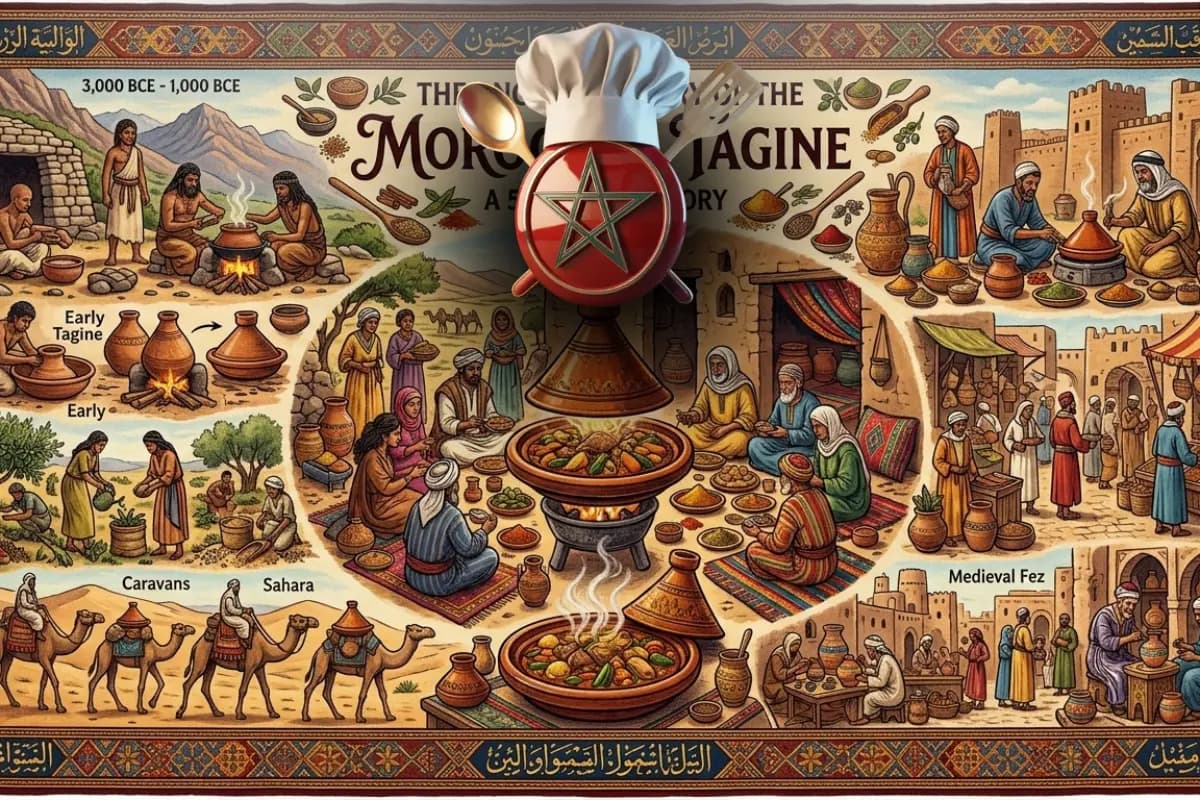
Introduction: A Dish That Predates Nations
In the archaeological museums of Morocco, among Roman coins and Phoenician pottery, sits a humble clay vessel that looks remarkably familiar. It's 2,000 years old, excavated from ancient Berber settlements in the Atlas Mountains. The shape is unmistakable: a shallow circular base topped by a conical lid with a small opening at the peak. It is, without question, a tagine.
This single artifact tells us something profound: the tagine is older than Morocco itself. Older than Islam. Older than Arabic as a language in North Africa. The tagine existed when Rome was building its North African provinces, when Carthaginians sailed the Mediterranean, perhaps even when the Pharaohs ruled Egypt. For at least 5,000 years, and possibly longer, humans in North Africa have been cooking in these distinctive conical clay pots.
But the tagine is more than an ancient cooking vessel. It's a technological marvel born from harsh geography, a cultural bridge connecting Berber, Arab, Andalusian, and African traditions, and a culinary philosophy that transformed scarcity into abundance. The story of the tagine is the story of Morocco itself—layered, complex, shaped by migration and conquest, yet fundamentally rooted in the land and the people who first cooked in these clay pots millennia ago.
In 2017, UNESCO recognized Moroccan cuisine—with the tagine as its centerpiece—as Intangible Cultural Heritage of Humanity. This wasn't just about food. It was acknowledgment that the tagine represents something irreplaceable: living history, transmitted through clay, fire, and the hands that cook.
This is the complete story of the tagine—from its prehistoric Berber origins through Roman influences, Islamic Golden Age refinement, colonial encounters, and modern global recognition. It's a 5,000-year journey through archaeology, anthropology, and the resilient culture of North Africa. Welcome to the ancient history of Morocco's most iconic dish.

Chapter 1: Prehistoric Origins (3000 BCE - 800 BCE)
The Berber Innovation
🏺 The Dawn of the Tagine:
The problem: Around 3000 BCE, Berber peoples inhabited North Africa's challenging landscape—the Atlas Mountains, the edge of the Sahara Desert, the Mediterranean coast. Water was scarce. Fuel was precious. Food preservation was difficult in extreme heat.
The solution: They invented a cooking vessel that conserved both water and fuel through brilliant design:
| Design Feature | Function | Why It Matters |
|---|---|---|
| Conical lid | Steam rises, hits cool surface, condenses, drips back down | Continuous moisture recycling—no water waste |
| Shallow base | Large surface area for even heat distribution | Efficient cooking with minimal fuel |
| Ceramic/clay material | Porous, absorbs heat slowly, releases gradually | Gentle, even cooking; retains heat after fire dies |
| Small opening at peak | Allows minimal steam escape, regulates pressure | Prevents explosion while maintaining moisture |
| Heavy lid | Creates seal with base | Traps steam and flavors inside |
Archaeological evidence: Clay vessels resembling tagines have been found in:
- Berber settlements in Morocco's Atlas Mountains (dated 2000-1500 BCE)
- Ancient dwellings in Algeria (pre-Roman period)
- Nomadic Berber sites in Tunisia
The Technology of Survival
💧 Why the Tagine Was Revolutionary:
Water conservation: In the Sahara fringe and mountain regions, water is life. The tagine's self-basting system meant a dish that would require 3 liters of water in an open pot could be cooked with less than 1 liter. The steam never escapes—it condenses on the cool lid and drips back onto the food. This is ancient sustainability.
Fuel efficiency: Wood and charcoal were scarce in desert regions. The tagine's clay construction absorbed heat, then radiated it slowly and evenly. A fire could be reduced to embers halfway through cooking—the clay would continue cooking the food. This saved precious fuel.
Flavor concentration: Because steam doesn't escape, neither do aromatic compounds. Every molecule of flavor—from spices, herbs, meat, vegetables—stays trapped in the pot, creating intensely flavorful dishes from simple ingredients.
Preservation through cooking: The slow, moist heat of tagine cooking preserved meat in an era before refrigeration. Meat cooked thoroughly in spiced sauce could last an extra day or two in hot climates.
The Berber Culinary Philosophy
🏔️ Cooking as Resource Management:
The tagine wasn't created by chefs in palaces. It was born from necessity in harsh environments. Berber cooking philosophy centered on:
- Waste nothing: Every ingredient was precious. Tagine cooking used every drop of moisture, every bit of flavor
- Cook communally: Large tagines fed entire families or tribes from one fire
- Adapt to availability: Whatever vegetables were available, whatever meat could be hunted or raised—the tagine accommodated
- Slow cooking equals tenderness: Tough desert game and aged livestock became tender through long, gentle cooking
- Spices as preservatives: Cumin, coriander, and other spices weren't just flavor—they had antimicrobial properties
Cultural continuity: These same principles guide Moroccan tagine cooking today, 5,000 years later.

Chapter 2: Phoenician & Roman Period (800 BCE - 700 CE)
Carthaginian Influence (800-146 BCE)
🚢 When Mediterranean Meets North Africa:
The Phoenicians (from modern-day Lebanon) established trading posts along Morocco's coast around 800 BCE, most famously Carthage in Tunisia. They brought:
- New ingredients: Olives and olive oil, grapes and wine, wheat varieties, chickpeas
- Preservation techniques: Salt-curing, brining, fermentation
- Trade spices: Cinnamon, black pepper, cassia (early cinnamon) from their Eastern Mediterranean trade routes
The tagine adapts: Berber cooks incorporated these new ingredients. The combination of olive oil + preserved foods + imported spices began creating what we recognize as the flavor profile of Moroccan tagine:
- Olives added to meat tagines
- Olive oil as cooking fat (replacing animal fats)
- Preserved lemons developed (salt-curing technique from Phoenicians)
- Wheat bread became the tagine's companion
Roman North Africa (146 BCE - 430 CE)
🏛️ The Imperial Kitchen:
Roman conquest of North Africa brought dramatic culinary changes. Morocco (called Mauretania Tingitana) became a Roman province. The tagine encountered Roman cooking culture:
What Romans brought:
- Garum: Fermented fish sauce (similar to modern Asian fish sauce)—used in many dishes
- Wine: As cooking ingredient and beverage
- Fruits: Dried fruits in savory dishes (dates, figs, raisins with meat)
- Sweet-savory combinations: Honey with meat, fruit compotes with poultry
- Complex spicing: Multi-spice blends similar to later ras el hanout
- Cookbooks: Written recipes (Marcus Gavius Apicius's "De Re Coquinaria" describes dishes remarkably similar to tagines)
Archaeological evidence: Roman-era North African sites have yielded:
- Tagine-like cooking vessels in Roman villas
- Written records mentioning "Mauretanian stews"
- Mosaics depicting communal meals with conical serving dishes
- Spice amphoras containing cumin, coriander, ginger
The fusion: Roman sweet-savory cooking + Berber tagine technique = early version of dishes like mrouzia (lamb with honey and almonds). This combination would become defining characteristic of Moroccan cuisine.
Why the Tagine Survived Rome
🎯 Resilience of Indigenous Technology:
Despite Roman influence, the tagine remained fundamentally Berber because:
- Superior to Roman pots: Roman cooking used open pots requiring more water and fuel. The tagine was simply more efficient
- Berber majority: Romans were elite minority. Most North Africans remained Berber, cooking as their ancestors had
- Rural continuity: Outside cities, Berber life continued unchanged. Tagine remained standard cooking method
- Practical superiority: In North African climate, water-conserving tagine beat water-wasting Roman pots
The pattern: Foreign rulers brought new ingredients and ideas, but the tagine as technology persisted because it was perfectly adapted to the environment. This pattern would repeat through Islamic, Ottoman, and French periods.
Chapter 3: Islamic Golden Age (700 CE - 1492 CE)
The Arab Conquest & Islamization (700-800 CE)
☪️ The Transformation:
711 CE: Arab armies crossed from Spain into Morocco, bringing Islam. This was the most transformative period in tagine history.
What Islam changed:
- Pork prohibition: Eliminated pig from diet, centered protein on lamb, chicken, beef
- Halal slaughter: Religious meat preparation standards
- Ramadan: Created need for special iftar dishes (harira, tagines for breaking fast)
- Friday couscous: Religious gathering day created Friday couscous tradition
- Pilgrimage exposure: Moroccans traveling to Mecca brought back Middle Eastern spices and techniques
New ingredients from Islamic world:
- Saffron (from Persia)
- Rose water and orange blossom water
- Preserved lemons (technique refined in Islamic period)
- Complex spice blends (early ras el hanout from Baghdad spice markets)
- Sugar (from Arab agricultural introduction to Morocco)
The Andalusian Refugees (1492 CE)

🕌 The Greatest Culinary Migration:
1492: Christian Reconquista expelled Muslims and Jews from Spain. Hundreds of thousands of Andalusian refugees fled to Morocco, bringing the most sophisticated cuisine in the medieval world.
What Andalusians brought to the tagine:
- Refinement: Andalusian cuisine was court food—delicate, complex, artistic
- Sweet-savory mastery: Perfected combinations (prunes with lamb, almonds with chicken, honey glazes)
- Pastilla technique: Layered pastry dishes (originally Andalusian, became Moroccan)
- Saffron usage: Lavish use of saffron (Andalusia was Europe's saffron producer)
- Fruit-meat combinations: Quinces, pomegranates, figs in savory dishes
- Urban sophistication: Converted simple Berber tagines into refined palace dishes
The fusion: Andalusian sophistication + Berber tagine technique + Arab Islamic ingredients = classical Moroccan tagine as we know it today.
Cities transformed: Fes, Meknes, Tetouan, Rabat—all absorbed Andalusian refugees who established culinary traditions still practiced:
- Fes became Morocco's culinary capital (Andalusian influence strongest)
- Tetouan cuisine shows clear Spanish-Moroccan fusion
- Sefrou's cherry tagines (Andalusian fruit-meat tradition)
The Ottoman Shadow (1500s-1700s)
🇹🇷 Indirect Influence:
Morocco was never conquered by Ottomans (one of few North African countries to resist). But Ottoman cultural influence reached Morocco through:
- Trade: Spices, coffee, techniques from Ottoman Empire
- Diplomacy: Gift exchanges included cookbooks and cooks
- Pilgrimage: Moroccan hajj pilgrims passed through Ottoman lands, learned techniques
Ottoman elements in tagine:
- Stuffed vegetable tagines (Ottoman dolma influence)
- Coffee culture (not tagine-specific but changed meal patterns)
- Certain spice combinations
But Morocco resisted: The tagine remained distinctly Moroccan, not Ottomanized like Algerian or Tunisian cuisine.
Chapter 4: The Imperial Cities Era (800 CE - 1912 CE)
The Rise of Palace Cuisine
👑 From Peasant Pot to Royal Table:
As Morocco's imperial cities (Fes, Meknes, Marrakech, Rabat) developed, so did palace tagine culture:
Court tagines vs. peasant tagines:
| Aspect | Palace Tagine | Common Tagine |
|---|---|---|
| Meat | Lamb, young chicken, pigeon, partridge | Tough older animals, seasonal game, often meatless |
| Spices | Expensive saffron, ras el hanout with 30+ spices | Basic cumin, paprika, ginger, turmeric |
| Fruits | Imported dried fruits, quinces, pomegranates | Local seasonal produce only |
| Nuts | Lavish almonds, pistachios, pine nuts | Occasional almonds if affordable |
| Honey | Best mountain honey, abundant | Used sparingly, expensive |
| Presentation | Decorated, garnished, served in fine tagines | Served in working clay tagine |
| Cooking time | Hours of attention, multiple cooks | One-pot meal, cook once |
The dadas (palace cooks): In Moroccan palaces, expert female cooks called "dadas" perfected tagine artistry. Their knowledge was:
- Transmitted orally from master to apprentice
- Guarded as palace secrets
- Refined over generations
- The origin of Morocco's most complex tagine recipes
Famous palace tagines:
- Mrouzia: Lamb with honey, almonds, raisins (originally Eid palace dish)
- Tfaya: Caramelized onion topping (Marrakech palace specialty)
- Pigeon with almonds: Meknes imperial tagine
- Seven vegetable tagine: Friday palace dish showing abundance
Regional Diversification
🗺️ Geography Shapes Flavor:
By 1800s, distinct regional tagine styles emerged based on local ingredients and cultural influences:
Fes (فاس):
- Most refined, Andalusian-influenced
- Signature: Chicken with preserved lemons and olives (became Morocco's most famous tagine)
- Lavish use of saffron
- Complex ras el hanout blends
Marrakech (مراكش):
- Sweet tagines (trans-Saharan trade influence brought dates, dried fruits)
- Signature: Lamb with prunes and almonds (mrouzia)
- Honey-based glazes
- Caramelized onion toppings (tfaya)
Coastal cities (Essaouira, Safi):
- Fish tagines (unique to coast)
- Lighter, herb-forward (chermoula marinades)
- Fresh, not preserved, ingredients
Atlas Mountains (Berber regions):
- Rustic, simple tagines
- Wild herbs, game meats
- Minimal spices (cumin, salt, pepper)
- Closer to original ancient Berber tagines
Tangier (طنجة):
- Spanish-Mediterranean fusion
- Tomato-based tagines
- More paprika, less cumin than interior
Chapter 5: Colonial Encounter (1912-1956 CE)
The French Protectorate
🇫🇷 Cultural Collision:
1912-1956: France controlled Morocco as a "protectorate." This brought the tagine into contact with European culinary culture for the first time.
French impact on tagine culture:
Negative aspects:
- Exoticization: French viewed tagine as "primitive" vs. "sophisticated" French cuisine
- Neglect: Colonial schools taught French cooking, not Moroccan
- Class division: Elite Moroccans adopted French food; tagine became "lower class"
- Recipe documentation ignored: French didn't document Moroccan recipes as valuable culinary heritage
Positive aspects:
- New ingredients: French vegetables (green beans, potatoes) added to tagines
- Written recipes: Some French ethnographers did document tagine recipes
- Global exposure: French brought tagine to European awareness (though often misrepresented)
- Pressure cooker introduction: Some Moroccans adapted pressure cookers for faster tagines
Resistance through food: Many Moroccans deliberately preserved tagine traditions as cultural resistance to French influence. Cooking tagines became an act of maintaining identity.
The Independence Movement
🇲🇦 Food as National Identity:
1940s-1956: As Moroccan independence movement grew, food became political:
- Nationalists promoted Moroccan cuisine as superior to French
- Friday couscous became symbol of Moroccan identity
- Tagine represented authentic Morocco vs. colonial influence
- Independence celebrations featured massive communal tagines
1956: Independence achieved. Post-independence Morocco saw revival of culinary pride:
- Tagine reclaimed as national treasure
- Palace recipes began to be shared publicly
- Moroccan cookbooks published for first time
- Fes proclaimed "culinary capital"

Chapter 6: Modern Era & Global Recognition (1956-Present)
The Diaspora Effect (1960s-1990s)
🌍 Morocco Goes Global:
1960s-1990s: Moroccan migration to France, Belgium, Netherlands, Spain spread tagine culture:
First wave (1960s-70s):
- Moroccan workers in Europe cooked tagines in cramped apartments
- European neighbors encountered tagine for first time
- Spice shops and Moroccan groceries opened in European cities
- Tagines appeared in ethnic restaurants
Second wave (1980s-90s):
- Second-generation Moroccans became chefs, opened restaurants
- Tagine moved from immigrant food to "exotic cuisine"
- European food writers "discovered" Moroccan food
- Tagine cookbooks published in European languages
The adaptation: Diaspora Moroccans modified tagines:
- Used available ingredients (bell peppers instead of Moroccan peppers)
- Simplified spice blends (European supermarkets lacked full range)
- Shortened cooking times (modern work schedules)
- Cooked in Dutch ovens (tagine pots unavailable)
The Tourism Boom (1990s-2010s)
✈️ When Tourists Discovered Tagine:
1990s onwards: Morocco became major tourist destination. Millions experienced tagine firsthand.
Tourism created two tagine worlds:
1. Tourist tagine:
- Standardized "chicken tagine with lemon and olives"
- Mild spicing (suited to European palates)
- Faster cooking (restaurants couldn't do 3-hour tagines)
- Decorative tagine pots (often not even used for cooking!)
- Higher prices, lower authenticity
2. Local tagine:
- Regional variations maintained
- Home cooking preserved traditions
- Friday family couscous continued
- Grandmother recipes passed down
The paradox: Tourism both preserved and diluted tagine culture. Economic value encouraged preservation, but commercialization simplified traditions.
The Celebrity Chef Era (2000s-2010s)
📺 Tagine Goes Mainstream:
Key figures who popularized tagine globally:
- Claudia Roden: "Arabesque" (1968) introduced tagine to English readers
- Paula Wolfert: "Couscous and Other Good Food from Morocco" (1973) - first comprehensive English tagine cookbook
- Mourad Lahlou: Moroccan-American chef, brought tagine to fine dining
- Yotam Ottolenghi: Featured Moroccan tagines in bestselling cookbooks
- Rick Stein, Jamie Oliver, Gordon Ramsay: TV shows filmed in Morocco, featured tagines
Impact:
- Tagine became "exotic but approachable" for Western home cooks
- Specialty stores began selling tagine pots globally
- Ras el hanout appeared in mainstream supermarkets
- "Tagine" entered international culinary vocabulary
UNESCO Recognition (2017)
🏆 Intangible Cultural Heritage:
December 2017: UNESCO added "Morocco's culinary heritage" to its Representative List of the Intangible Cultural Heritage of Humanity. The tagine was central to this recognition.
What UNESCO recognized:
- Not just recipes, but "practices, knowledge, and skills"
- Transmission of knowledge from generation to generation
- Social function of communal eating
- Connection to landscape, seasons, identity
- Living tradition that continues to evolve
UNESCO's criteria met:
- ✅ Ancient origins: Documented 2,000+ years (likely 5,000)
- ✅ Living tradition: Actively practiced daily across Morocco
- ✅ Community identity: Central to Moroccan cultural identity
- ✅ Transmitted knowledge: Passed through families, not written recipes
- ✅ Promotes creativity: Infinite variations while maintaining core principles
- ✅ Sustainable: Efficient use of resources, local ingredients
Significance: This placed tagine alongside other UNESCO-protected heritage like French gastronomic meal, Mediterranean diet, Japanese washoku. Global recognition that tagine is not just food—it's irreplaceable human heritage.
Modern Innovations (2010s-Present)
🔬 Ancient Meets Modern:
How tagine cooking has evolved in 21st century:
Technology adaptations:
- Pressure cooker tagines: Busy Moroccans use pressure cookers for 30-minute tagines (controversial but common)
- Slow cookers: Diaspora Moroccans use slow cookers to replicate tagine's gentle heat
- Induction-compatible tagines: Modern tagine pots designed for induction stoves
- Online recipe sharing: Moroccan food bloggers document grandmother recipes
Fusion experiments:
- Vegan tagines (traditional vegetables, no meat)
- Asian-Moroccan fusion (tagines with miso, soy sauce)
- Molecular gastronomy tagines (high-end restaurants)
- "Tagine spiced" dishes (applying spice blend to non-tagine cooking)
Preservation efforts:
- Moroccan government promotes tagine as tourism draw
- Cooking schools teach traditional tagine methods
- Fes Festival of Amazigh Culture celebrates Berber tagine origins
- Family recipe documentation projects

Chapter 7: The Tagine Today - Living Archaeology
Three Tagines Coexist
🍲 The Modern Tagine Landscape:
1. The Traditional Tagine (الطاجين التقليدي):
- Where: Moroccan homes, rural areas, traditional families
- Method: Clay pot, charcoal or gas, 2-3 hour slow cooking
- Who: Grandmothers, traditional cooks, cultural preservationists
- Recipes: Passed down orally, no measurements, "cook until it tastes right"
- Authenticity: Highest—closest to ancient methods
2. The Restaurant Tagine (طاجين المطعم):
- Where: Tourist restaurants, urban eateries
- Method: Often cooked in regular pots, transferred to decorative tagine for serving
- Who: Commercial kitchens, trained chefs
- Recipes: Standardized for consistency, modified for tourist palates
- Authenticity: Variable—ranges from genuine to "tagine-flavored tourist food"
3. The Global Tagine (الطاجين العالمي):
- Where: Home kitchens worldwide, diaspora communities
- Method: Dutch ovens, slow cookers, pressure cookers, adapted to available equipment
- Who: International food enthusiasts, Moroccan diaspora, fusion chefs
- Recipes: From cookbooks, blogs, YouTube, adapted to local ingredients
- Authenticity: Inspired by tradition, but creatively adapted
All three are "real": The tagine has always adapted while maintaining core principles. Today's diversity reflects 5,000 years of evolution.
The Science Behind the Magic
🔬 Why the Tagine Actually Works:
Modern food science has validated what Berbers discovered 5,000 years ago:
Thermodynamics:
- Clay is poor heat conductor = slow, even heating
- Conical shape creates convection currents
- Steam rises, hits cool lid surface, condenses, returns = closed water cycle
- Minimal evaporation = concentrated flavors
Flavor chemistry:
- Maillard reaction (browning) occurs at pot bottom
- Aromatic compounds stay trapped in steam
- Long cooking breaks down collagen in tough meat = gelatin = rich texture
- Spices infuse slowly, releasing compounds gradually
Nutrition:
- Vitamins preserved (less evaporation than open pot)
- Minerals stay in dish (not lost to evaporated water)
- Gentle heat preserves more nutrients than high-heat methods
Energy efficiency:
- Clay retains heat = can remove from fire, continues cooking
- Uses 40-60% less fuel than open pot cooking
- In modern terms: the tagine is a low-tech sustainable cooking technology
Cultural Significance Today
🇲🇦 What the Tagine Represents:
In Morocco:
- Friday identity: Friday couscous is the meal that defines Moroccan family life
- Hospitality: Offering tagine to guests is sacred duty
- Continuity: Link to ancestors, to land, to history
- Regional pride: Each city claims "best tagine" (especially Fes vs. Marrakech rivalry!)
- Mother-daughter bond: Cooking tagine together transmits culture
In diaspora:
- Nostalgia: Smell of tagine = home, childhood, belonging
- Identity maintenance: Cooking tagine = being Moroccan despite distance
- Teaching children: Passing culture to next generation
- Community building: Tagine dinners create Moroccan spaces abroad
Globally:
- Example of ancient wisdom: Sustainable cooking before "sustainability" existed
- Cultural bridge: Gateway to understanding North African culture
- Culinary diversity: Proves European cuisine isn't only "sophisticated" food
- Living history: Tangible connection to ancient civilizations
The Pottery Tradition: 5,000 Years of Clay
Traditional Tagine Making
🏺 The Artisan's Craft:
How traditional tagines are made (unchanged for millennia):
- Clay sourcing: Specific clays from riverbeds, mountains (each region has preferred clay)
- Preparation: Clay mixed with water, kneaded to remove air bubbles, left to age
- Shaping: Base formed on potter's wheel; lid shaped separately by hand
- Drying: Sun-dried for several days
- Glazing: Traditional unglazed (porous) OR modern glazed (easier to clean)
- Firing: Wood-fired kilns, 900-1000°C, 8-12 hours
- Cooling: Slow cool in kiln (prevents cracking)
Famous pottery centers:
- Safi (آسفي): Morocco's pottery capital, thousands of artisans
- Fes: Fes blue pottery (zellige-decorated tagines)
- Tamegroute: Green-glazed pottery from Sahara
- Salé: Traditional unglazed brown tagines
Seasoning a new tagine: Traditional process before first use:
- Soak tagine in water overnight
- Rub with olive oil inside and out
- Place in cold oven, heat gradually to 150°C, hold 2 hours
- Cool slowly
- First cooking: make mild vegetable tagine (seasons the pot)
Types of Tagines
| Type | Material | Use | Origin |
|---|---|---|---|
| Cooking tagine | Unglazed clay | Actual cooking | Ancient, traditional |
| Serving tagine | Glazed, decorated | Presentation only | Modern, commercial |
| Berber tagine | Rough clay, no glaze | Cooking over charcoal | Oldest type |
| Fes tagine | Clay with blue zellige | Serving, display | Islamic period |
| Cast iron tagine | Enameled cast iron | Modern cooking | 20th century |
Conclusion: The Eternal Tagine
Stand in a Moroccan kitchen today and watch someone cook tagine. The clay pot, the conical lid, the slow bubbling, the aromatic steam—this scene has repeated billions of times across 5,000 years. In Roman villas and Berber tents, in imperial palaces and humble villages, in diaspora apartments and tourist restaurants, the tagine endures.
It has survived empires: Phoenician traders, Roman legions, Arab armies, Berber dynasties, Ottoman sultans, French colonizers. It has absorbed influences: Mediterranean olives, Middle Eastern spices, Andalusian sophistication, African ingredients. Yet fundamentally, mysteriously, it remains what it has always been—a clay pot that turns humble ingredients into nourishment through patient heat and captured steam.
The tagine is living archaeology. When you cook in a tagine, you're using technology perfected in the Bronze Age. When you layer vegetables and meat and spices, you're following principles refined over three millennia. When you lift the conical lid and fragrant steam billows out, you're experiencing what Berber nomads, Roman centurions, Islamic scholars, and Andalusian refugees all experienced.
🏺 From the Potter:
"I make tagines the way my father made them, and his father before him, back through the generations until memory fades. The clay comes from the same riverbed. The shape follows the same ancient proportions. When I fire a tagine in my kiln, I am connected to the first potter who discovered that this conical shape captures steam, that this clay thickness distributes heat perfectly, that this design has never been improved upon because it was perfect from the beginning. Five thousand years ago, someone in these mountains created something so ingenious, so perfectly adapted to this land and its people, that it has never needed to change. That is not just a cooking pot. That is human genius, preserved in clay."
🌍 A Dish That Transcends Time:
The tagine's journey from prehistoric Berber innovation to UNESCO-recognized heritage is the story of human ingenuity adapting to environment, of culture persisting through conquest, of simple technology proving superior to complex alternatives.
It reminds us that:
- ✅ Ancient wisdom still has value in the modern world
- ✅ Sustainability is not new—it's how humans survived for millennia
- ✅ Cultural heritage is fragile and worth protecting
- ✅ Food is never just food—it's history, identity, art, science, and love
The next time you see a tagine—in a museum, in a market, on a dinner table—remember: you're looking at 5,000 years of human story, still bubbling, still nourishing, still connecting past to present through the simple magic of clay, fire, and food.
Download Your Tagine History Resources:
- 📜 Complete Tagine History Timeline (Printable)
- 🗺️ Interactive Map: Tagine's Geographic Evolution
- 📖 UNESCO Cultural Heritage Guide (Full Report)
- 🏺 Moroccan Pottery Traditions Guide
- 📚 Historical Tagine Recipes Through the Ages
- 🎓 Academic Research: Tagine Archaeology (Bibliography)
Share your tagine story! Tag #MaCookingHistory with photos of your tagine cooking—you're part of 5,000 years of tradition!
May the ancient wisdom of the tagine continue for another 5,000 years. May every pot connect past to future. May the clay, the fire, and the food forever tell the story of North Africa and its resilient, ingenious people.
تاريخ عريق - Tarikh 'ariq (Ancient history)