
Introduction
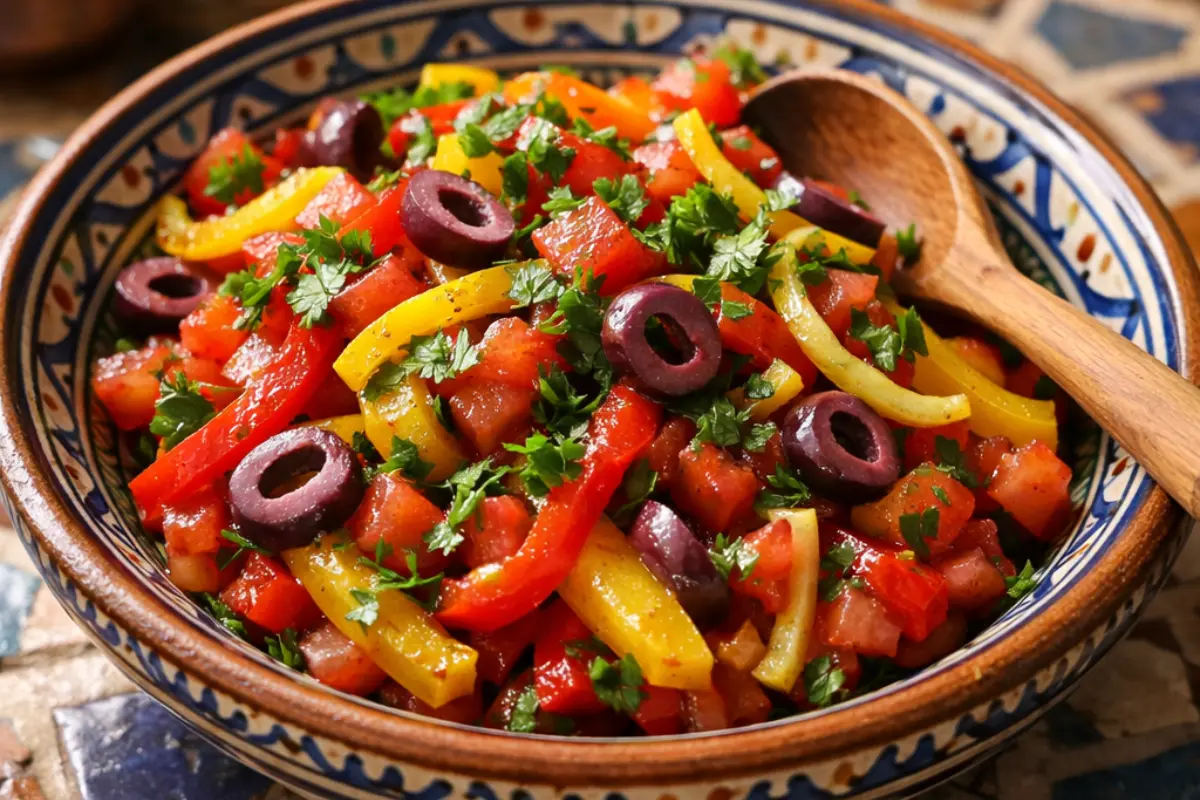
Moroccan Mixed Salad, often referred to as 'Shlada Mchawka' or simply 'Salade Marocaine,' is a celebration of colors, textures, and the bold, fresh flavors that define Moroccan cuisine. This is not a single rigid recipe but rather a family of salads that vary from home to home and region to region, united by the use of fresh, vibrant ingredients and aromatic spices [citation:6].
At its heart, this salad features a stunning combination of roasted peppers—their smoky sweetness from charring over an open flame—paired with the bright acidity of fresh tomatoes, the salty-tangy punch of preserved lemon, and the briny depth of Moroccan olives [citation:1][citation:3]. A simple yet fragrant dressing of olive oil, lemon juice, and a whisper of ground cumin ties everything together, while fresh herbs add a final flourish of green [citation:1][citation:5].
This dish embodies the Moroccan talent for transforming simple, fresh ingredients into something far greater than the sum of its parts. It's a staple on the Moroccan table, served alongside tagines and couscous, or as part of an elaborate mezza spread. Its vibrant colors and complex flavors make it a feast for the eyes and the palate, perfect for any occasion from a simple family lunch to a festive gathering.
About This Recipe
The 'Shlada Mchawka' (or simply 'Schlada') is a testament to the rich culinary exchange that has shaped Moroccan cuisine over centuries. This vibrant dish is a perfect example of how recipes traveled, transformed, and became embedded in local culture. Its distant ancestor is believed to be gazpacho, the cold Andalusian soup, which itself has Arabic roots—the word 'gazpacho' is thought to derive from an Arabic term meaning 'soaked bread' [citation:1][citation:3]. As this dish migrated with the Moors between North Africa and Spain, it evolved. When it returned to Morocco, it had acquired new ingredients like tomatoes and peppers, which were incorporated with distinctly Moroccan elements: the warm, earthy notes of cumin and the uniquely preserved, tangy-saltiness of pickled lemons [citation:3]. The result was 'Schlada,' a dish that maintains the refreshing, vegetable-forward character of its Andalusian cousin but is unmistakably Moroccan in its final flavor profile [citation:3]. In modern Morocco, this salad is a staple of home cooking and hospitality. Every family has its own variation, some including onions, others adding a touch of garlic, but the core elements of smoky roasted peppers, fresh tomatoes, and a cumin-laced dressing remain constant [citation:1][citation:3][citation:4]. Served as a first course, a side dish, or part of a larger spread, it embodies the Moroccan values of generosity, freshness, and the art of transforming simple, seasonal ingredients into a dish of extraordinary flavor and beauty.
Nutritional Info (per serving)
Recipe Tags
Understanding the Ingredients
Bell Peppers (Red, Green, Yellow)
A mix of colorful bell peppers forms the heart of this salad. They are traditionally roasted until the skins are blackened, which imparts a deep, smoky sweetness that is essential to the dish [citation:1][citation:3]. This charring can be done under a broiler/grill, over a gas flame, or on a barbecue. After roasting, they are steamed in a covered bowl or plastic bag, which makes the skins incredibly easy to peel off [citation:1][citation:5]. Once peeled and seeded, the flesh is silky and tender.
Fresh Tomatoes
Ripe, flavorful tomatoes provide a burst of fresh acidity and juiciness that balances the smoky peppers. To achieve a refined texture, the tomatoes are often peeled (by scoring, blanching, and shocking in ice water), then seeded to remove excess moisture before being chopped [citation:1][citation:5]. This prevents the salad from becoming watery and ensures every bite is packed with pure tomato flavor.
Preserved Lemon
This is the secret weapon of Moroccan cuisine, providing an intense, complex, salty-tangy flavor that fresh lemons simply cannot replicate [citation:1][citation:3]. Only the rind is used, as the pulp is too salty and intense. The preserved lemon rind is rinsed to remove excess salt, then finely slivered and sprinkled over the salad, where it acts as a seasoning, elevating all the other ingredients [citation:1][citation:5].
Moroccan Olives
A mix of purple and green Moroccan olives adds a briny depth that complements the other flavors beautifully. They can be left whole or pitted and roughly chopped. The olives contribute a final savory note and an authentic Moroccan touch.
Dressing: Olive Oil, Lemon, and Cumin
The dressing is simple, allowing the quality of the ingredients to shine. Extra virgin olive oil provides richness. Fresh lemon juice (from about 1/2 a lemon) adds brightness [citation:1][citation:3]. A pinch of ground cumin is the signature Moroccan spice, adding warm, earthy notes that tie all the flavors together [citation:1][citation:5]. Some versions also include a pinch of paprika for color and mild sweetness [citation:1][citation:3].
Aromatics and Herbs
Finely chopped fresh garlic is scattered over the salad, infusing it with its pungent flavor as it chills [citation:1][citation:5]. A generous amount of fresh cilantro and flat-leaf parsley, coarsely chopped, is essential for a final burst of freshness and color [citation:1][citation:3].
Step-by-Step Cooking Guide
Roast the Peppers
Preheat your oven's broiler/grill to its highest setting. Place 3 mixed bell peppers (whole or quartered and seeded) on a baking sheet, skin-side up. Grill for 10-15 minutes, until the skins are completely blackened and blistered [citation:1][citation:3]. Alternatively, you can char them directly over a gas flame using tongs, turning frequently.
Tip: Don't be afraid to get the skins really black—that's where the smoky flavor comes from. Keep an eye on them to avoid burning the flesh underneath.
Steam and Peel the Peppers
Immediately transfer the hot, charred peppers to a bowl and cover tightly with plastic wrap, or place them in a paper or plastic bag and seal it [citation:1][citation:3]. Let them steam for about 10-15 minutes. This process loosens the skin, making it incredibly easy to remove. Once cool enough to handle, use your fingers or a paper towel to rub off the blackened skins. Do not rinse under water, as this washes away flavor.
Tip: The steam created in the bag is the secret to easy peeling. Wearing disposable gloves can help keep your hands clean.
Prepare the Tomatoes
While the peppers steam, prepare the tomatoes. Bring a small pot of water to a boil. Score a small 'X' on the bottom of 4 large tomatoes. Prepare a bowl of ice water. Drop the tomatoes into the boiling water for 45-60 seconds, then immediately transfer them to the ice water [citation:1][citation:5]. The skins will slip right off. Once peeled, quarter the tomatoes, remove the cores and seeds, and chop the flesh into a small dice [citation:1][citation:5].
Tip: Peeling and seeding the tomatoes is a key step for achieving the perfect texture. It prevents the salad from becoming watery.
Prepare Other Ingredients
Once peeled, cut the roasted peppers into thin strips or small bite-sized pieces, discarding any remaining seeds and core [citation:1]. Place them in a serving bowl. Finely chop 2 garlic cloves [citation:1]. Rinse 1/4 of a preserved lemon under cold water, scrape away and discard the pulp and pith, then finely sliver the rind [citation:1][citation:3][citation:5]. Pit and roughly chop a handful of Moroccan olives. Coarsely chop a generous amount of fresh cilantro and flat-leaf parsley.
Tip: Take your time to cut all ingredients into similar-sized pieces for a uniform and elegant look. Prepare the herbs just before assembling to keep them vibrant.
Assemble and Marinate
To the bowl with the peppers, add the chopped tomatoes and scatter the minced garlic on top [citation:1]. In a small bowl, whisk together 2 tablespoons of olive oil, 2 tablespoons of fresh lemon juice, a good pinch of paprika, and a generous pinch of ground cumin [citation:1][citation:3]. Season with salt and pepper to taste. Pour the dressing over the vegetables and toss gently but thoroughly to combine.
Tip: For the best flavor, cover the salad and let it chill in the refrigerator for at least an hour. This allows the garlic and spices to meld with the vegetables [citation:1][citation:3].
Garnish and Serve
Just before serving, sprinkle the salad with the slivers of preserved lemon, the chopped Moroccan olives, and the fresh cilantro and parsley [citation:1][citation:3]. Give it one final gentle toss or leave the garnishes on top for a beautiful presentation. Serve chilled or at room temperature as a vibrant side dish [citation:1][citation:6].
Tip: The preserved lemon is potent—a little goes a long way. Taste before adding more. The fresh herbs should be added at the last moment to preserve their bright color and flavor.
Common Mistakes to Avoid
❌ Not Peeling the Peppers Properly
Solution: Failing to peel the charred skin will result in a bitter, unpleasant texture. The steaming step (covering the hot peppers in a bowl or bag) is essential for making the skins slip off easily.
❌ Skipping the Tomato Peeling and Seeding
Solution: If you add unpeeled, unseeded tomatoes, the salad will become watery and the skins will be tough. Always peel, seed, and dice them for the best texture [citation:1].
❌ Adding Preserved Lemon Without Rinsing
Solution: Preserved lemons are cured in salt and can be overwhelmingly salty. Always rinse the rind thoroughly under cold water before using [citation:1][citation:3].
❌ Using Dried Herbs
Solution: Fresh cilantro and parsley are non-negotiable. Their bright, fresh flavor is essential to the salad's character. Dried herbs will not provide the same result.
❌ Not Allowing Time to Marinate
Solution: The salad truly benefits from at least an hour of chilling. This allows the garlic and spices to infuse the vegetables, creating a more harmonious and developed flavor [citation:1][citation:3].
Ingredient Substitutions
Instead of: Preserved Lemon
Use: While nothing replicates the unique flavor, you can use the zest of ½ a fresh lemon for a hint of citrus, though it will lack the salty, fermented depth. Adding an extra pinch of salt can help, but the flavor profile will be different.
Instead of: Fresh Cilantro
Use: Use all flat-leaf parsley, or a mix of parsley and fresh mint for a different but equally delicious herbal note.
Instead of: Moroccan Olives
Use: Kalamata olives or any other good-quality, brine-cured purple or black olives can be used.
Serving Suggestions
Serve as a vibrant part of a Moroccan mezza spread, alongside zaalouk, hummus, and bread.
Pair with any tagine, especially chicken with olives or lamb with prunes, as a refreshing counterpoint.
Serve alongside grilled fish with chermoula or grilled meats [citation:6].
Enjoy with crusty Moroccan bread (khobz) to soak up the flavorful juices.
Include in a summer picnic or barbecue spread for a colorful and healthy addition.
Storage & Reheating Guide
Storage
Store in an airtight container in the refrigerator for up to 3 days. The flavors will continue to meld and deepen [citation:4]. Note that the fresh herbs may wilt over time.
Reheating
Do not reheat. This salad is meant to be served chilled or at room temperature.
Tips: If making ahead, you can prepare all the components (roasted peppers, chopped tomatoes, dressing, etc.) separately and assemble them up to a day in advance. Add the fresh herbs just before serving for the best presentation.
Frequently Asked Questions
Recipe by

Similar Recipes


Our Recipe Ebooks
Discover our collection of authentic Moroccan recipe ebooks. Learn traditional cooking methods and create delicious meals at home.

The Moroccan Vegen
The Royal Moroccan Table -Part1
The Royal Moroccan Table -Part2
YouTube Channel
Watch step-by-step cooking videos, learn professional techniques, and get inspired by traditional and modern recipes from around the world.
Latest Video
"Traditional Moroccan Tagine Masterclass"