Introduction
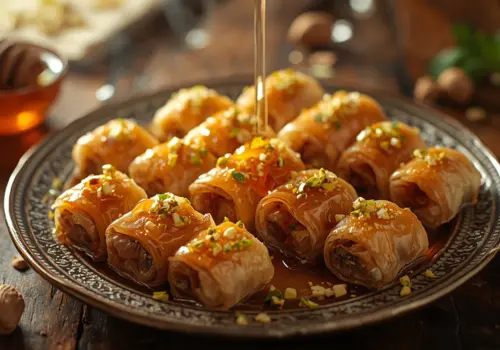
Honey Baklava Rolls represent a beautiful evolution of the timeless Middle Eastern dessert, transforming the classic layered pastry into elegant, individual rolls that are both visually stunning and delightfully crisp. Where traditional baklava is cut into diamonds or squares, these rolls offer a playful yet sophisticated presentation, making them perfect for parties, gifts, or festive tables. Each roll is a bundle of carefully spiced nuts wrapped in whisper-thin phyllo, baked until golden, and then generously soaked in a warm, aromatic honey syrup that soaks into every layer.
The magic of baklava lies in the contrast of textures and flavors: the shatteringly crisp, buttery layers of phyllo, the rich, spiced nut filling that toasts during baking, and the sweet, floral syrup that binds everything together. The syrup is not merely a topping—it is the soul of the dessert, infused with lemon and orange blossom water, which cuts through the sweetness and adds a haunting fragrance. Making baklava is a labor of love and patience, a ritual that rewards careful handling and timing. The rolls must be assembled with just the right tension—tight enough to hold their shape, but gentle enough to avoid tearing the delicate pastry. Once baked, the hot pastry eagerly drinks in the cool syrup, creating that signature moist-yet-crisp bite that defines great baklava.
This version is designed for both tradition and convenience. The rolls can be assembled ahead and frozen, ready to bake when needed. They are lighter and less messy to serve than traditional slabs, and each person gets their own perfectly syrup-soaked bundle. Whether enjoyed with a cup of strong Arabic coffee or as the grand finale to a feast, Honey Baklava Rolls carry within them centuries of culinary history, a taste of hospitality, and the simple joy of something made by hand.
About This Recipe
Baklava's origins stretch back through millennia, with threads connecting it to ancient Assyrian, Byzantine, and Ottoman empires. The earliest known ancestor of baklava appears in the 8th century BCE, when Assyrians in the Fertile Crescent layered unleavened bread with nuts and honey. As trade routes expanded, the recipe traveled westward, evolving in kitchens across empires. However, it was the Ottoman Turks who perfected baklava into the iconic dessert we know today during the height of the Ottoman Empire (15th-19th centuries). In the lavish Topkapi Palace kitchens of Istanbul, Ottoman chefs refined the technique of working phyllo dough paper-thin, creating hundreds of delicate layers that became a hallmark of imperial cuisine. The word 'baklava' itself likely derives from the Mongolian 'bayla-' (to tie, wrap) or the Turkish 'baklağı' (to pile up), reflecting both its wrapped form and layered construction. During Ottoman rule, baklava became a ceremonial food, served to the elite Janissary corps in a special procession called the 'Baklava Alayı' (Baklava Procession) each Ramadan. Trays of baklava would be carried from the palace to the barracks, covered with cloths, creating a spectacle that reinforced social hierarchies. As the empire expanded, baklava spread throughout the Mediterranean and Middle East, with each region adding its own signature: Greeks added cinnamon and cloves; Armenians favored clove and cardamom; Arabs introduced rose and orange blossom waters; Lebanese and Syrians often include pistachios. The technique of making phyllo became an art form passed from master to apprentice, with skilled dough makers able to stretch a ball of dough so thin that newspaper could be read through it. In Middle Eastern culture, baklava became more than dessert—it became a symbol of hospitality, celebration, and generosity. No wedding, Eid celebration, or important guest would be complete without a tray of baklava. The tradition of serving baklava with strong, bitter coffee or tea developed as a perfect pairing, the bitterness cutting through the sweetness. During the 20th century, baklava traveled with diaspora communities to Europe, the Americas, and beyond, becoming one of the most recognizable Middle Eastern desserts worldwide. The innovation of baklava rolls represents a modern adaptation, making the dessert more accessible for individual servings and contemporary presentation while preserving the essential flavors and techniques. Today, UNESCO recognizes the making and sharing of baklava as part of Turkey's intangible cultural heritage, acknowledging its role in social rituals, family traditions, and cultural identity. Whether shaped into traditional diamonds, rolled into cylinders, or folded into triangles, baklava remains a sweet thread connecting past to present, a testament to the enduring power of culinary tradition to adapt while retaining its soul.
Nutritional Info (per serving)
Recipe Tags
Understanding the Ingredients
Phyllo Dough (Filo Pastry)
You will need one 16-ounce package of phyllo dough, thawed according to package instructions (usually overnight in the refrigerator). Phyllo is paper-thin sheets of unleavened flour dough. Its delicate, dry nature requires you to work quickly and keep unused sheets covered with a damp towel to prevent drying and cracking. The quality of phyllo significantly affects the final texture—look for fresh or frozen brands from Middle Eastern or Greek markets for the best results. Each roll uses 2-3 sheets of phyllo, layered with butter for maximum flakiness.
Nut Filling (Walnuts & Pistachios)
The heart of the filling is a combination of walnuts and pistachios, finely chopped but not powdered. You'll need about 3 cups total. Walnuts provide a rich, slightly bitter base, while pistachios add a vibrant green color and distinctive flavor. Some traditional versions use only walnuts or a mix with almonds. The nuts must be finely chopped by hand or pulsed carefully in a food processor—you want small pieces for texture, not a paste. The filling is spiced with ground cinnamon and a pinch of cloves or cardamom for warmth.
Clarified Butter (Ghee)
Clarified butter or ghee is essential for brushing between each layer of phyllo. You will need about 1 cup (2 sticks), melted. Clarified butter has the milk solids removed, allowing it to brown beautifully without burning and giving the pastry a richer flavor and crisper texture than regular melted butter. It also keeps the phyllo layers separate and flaky. Brush it generously but not excessively—every sheet should glisten.
Honey Syrup (Atar)
The syrup, called 'atar' in Arabic, is a simple mixture of honey, sugar, water, lemon juice, and orange blossom or rose water. You need about 2 cups of syrup total. The lemon juice prevents crystallization and balances the sweetness, while the floral waters provide the classic Middle Eastern aroma. The syrup must be cooked to a thin consistency (about 10 minutes) and cooled slightly before pouring over the hot baklava. This temperature contrast is crucial for proper absorption.
Orange Blossom or Rose Water
A small amount (1-2 teaspoons) of orange blossom water (ma'zahr) or rose water (ma'ward) is added to the syrup after cooking. These floral essences are traditional and non-negotiable for authentic flavor. They provide a perfumed, sophisticated note that lifts the entire dessert. Use food-grade, pure floral water, not synthetic extract. If unavailable, a little lemon zest can provide fragrance, but the character will be different.
Ground Cinnamon & Sugar
Ground cinnamon (about 1 tablespoon) is mixed directly into the nut filling, warming it and complementing the nuts' natural flavors. A small amount of sugar (¼ cup) is also mixed into the nuts to help them caramelize slightly during baking and balance their bitterness. The sugar in the filling is separate from the syrup sugar.
Step-by-Step Cooking Guide
Prepare Ingredients & Tools
Thaw phyllo dough in the refrigerator overnight. Remove from fridge 1-2 hours before using to reach room temperature (this makes it less brittle). Clarify butter by melting 1 cup (2 sticks) of unsalted butter in a small saucepan over low heat. Skim off the white foam that rises to the top, then carefully pour the clear yellow liquid into a bowl, leaving the milk solids at the bottom. You should have about ¾ cup clarified butter. Finely chop the walnuts and pistachios by hand or pulse in a food processor until they resemble coarse crumbs—do not over-process into a paste. Mix nuts with ¼ cup sugar, 1 tablespoon cinnamon, and a pinch of salt. Prepare a clean workspace and have pastry brush, sharp knife, and baking sheet ready.
Tip: Keep phyllo covered with a damp kitchen towel at all times to prevent drying. Work efficiently but gently. Clarified butter can be made ahead and stored.
Make the Honey Syrup
In a medium saucepan, combine 1 cup honey, 1 cup sugar, 1 cup water, and 2 tablespoons fresh lemon juice. Bring to a boil over medium-high heat, stirring until sugar dissolves. Reduce heat to medium-low and simmer for about 10 minutes, without stirring, until the syrup slightly thickens but remains pourable (it will thicken more as it cools). Remove from heat and stir in 1-2 teaspoons of orange blossom or rose water. Let the syrup cool completely to room temperature or slightly warm. The syrup must be ready before the baklava comes out of the oven.
Tip: Do not overcook the syrup—it should coat the back of a spoon but not reach thread stage. Cooling is essential; pouring hot syrup over hot baklava can make it soggy.
Layer and Fill the Phyllo
Preheat oven to 350°F (175°C). Unroll the phyllo sheets and cover immediately with a damp towel. Place one sheet on a clean work surface with the long side facing you. Brush lightly but thoroughly with clarified butter. Place a second sheet on top and brush again with butter. Sprinkle about 2-3 tablespoons of the nut mixture along the bottom edge of the phyllo, leaving a 1-inch border at the bottom and sides.
Tip: Work with one roll at a time, keeping the rest covered. If a sheet tears, don't worry—just patch it with another small piece brushed with butter.
Roll the Baklava Bundles
Fold the left and right sides of the phyllo sheet inward by about 1 inch to seal the ends. Then, starting from the bottom edge (where the nuts are), carefully roll the phyllo up tightly but gently, forming a neat log. Place the roll seam-side down on a parchment-lined baking sheet. Repeat with remaining phyllo and filling, placing rolls about ½ inch apart on the sheet. You should get about 20 rolls. Brush the tops and sides of all rolls generously with the remaining clarified butter.
Tip: Roll snugly but not tightly—air inside will expand and can burst the roll. Seam-side down ensures they stay closed.
Score and Bake
Using a very sharp knife, make 3-4 diagonal shallow cuts along the top of each roll—this allows syrup to penetrate and makes serving easier. Bake in the preheated oven for 25-30 minutes, rotating the tray halfway, until the rolls are puffed and deep golden brown. The phyllo should be crisp and shiny.
Tip: Watch carefully toward the end—phyllo can go from golden to burnt quickly. The cuts should be shallow, not through the filling.
Soak with Syrup
As soon as the baklava rolls come out of the oven, immediately pour the cooled (or slightly warm) honey syrup evenly over them. You should hear a satisfying sizzle. Allow the rolls to soak and absorb the syrup at room temperature for at least 4-6 hours, or preferably overnight. Do not cover them while soaking—this keeps them crisp.
Tip: The syrup must be cool and the pastry hot for perfect absorption. Pour slowly to cover all surfaces.
Garnish and Serve
Once fully cooled and syrup is absorbed, garnish the rolls by sprinkling finely crushed pistachios over the top. You can also drizzle a little extra honey for shine. Serve at room temperature. Store leftovers in an airtight container at room temperature for up to 1 week.
Tip: For best flavor and texture, let them rest overnight. The syrup will fully permeate and the flavors will meld beautifully.
Common Mistakes to Avoid
❌ Using Hot Syrup on Hot Baklava
Solution: This is the most common error, resulting in soggy, greasy pastry. Always cool the syrup completely (or until warm) before pouring over the freshly baked, hot rolls. The temperature contrast ensures crisp absorption.
❌ Letting Phyllo Dry Out
Solution: Phyllo sheets dry out in minutes when exposed to air, becoming brittle and unworkable. Keep the stack covered with a damp (not wet) kitchen towel at all times, uncovering only one sheet at a time.
❌ Overfilling the Rolls
Solution: Too much filling will cause rolls to burst open during baking and make rolling difficult. Use about 2-3 tablespoons of nuts per roll, spread evenly along the edge.
❌ Not Brushing Enough Butter
Solution: Skipping butter between layers leads to dry, pale, and chewy phyllo. Brush each sheet lightly but thoroughly with clarified butter for golden, flaky layers.
❌ Using Raw, Unclarified Butter
Solution: Regular butter contains water and milk solids that can steam and make phyllo soggy, and burn at high heat. Always use clarified butter (ghee) for the crispiest result.
❌ Cutting After Baking
Solution: If you try to cut baklava rolls after baking, the phyllo will shatter. Always score them lightly with a sharp knife before baking for clean portions.
Ingredient Substitutions
Instead of: Phyllo Dough
Use: In a pinch, you can use spring roll wrappers, but the texture will be different—less flaky, more chewy. True phyllo is recommended.
Instead of: Walnuts & Pistachios
Use: Use all walnuts, or substitute with almonds, pecans, or hazelnuts. The classic mix is walnuts and pistachios, but regional variations exist.
Instead of: Orange Blossom Water
Use: Rose water, 1 teaspoon vanilla extract, or 1 tablespoon lemon zest can be used, but the floral note is traditional and preferred.
Instead of: Honey
Use: You can use all sugar in the syrup (increase to 2 cups sugar), but honey gives a richer flavor and color. Agave or maple syrup will change the flavor profile significantly.
Serving Suggestions
Serve at room temperature with a cup of strong Turkish or Arabic coffee, or mint tea.
Garnish with edible rose petals or gold leaf for an extra-special occasion.
Pair with a scoop of vanilla ice cream or thick clotted cream (kaymak) for a luxurious dessert.
Offer alongside other Middle Eastern sweets like ma'amoul, kanafeh, or basbousa for a dessert platter.
Package in clear cellophane with ribbon for a beautiful homemade gift.
Serve as part of a brunch spread alongside cheese, fruit, and pastries.
For a modern twist, drizzle with dark chocolate after the honey syrup has set.
Accompany with fresh pomegranate seeds for a burst of color and tartness.
Storage & Reheating Guide
Storage
Store baklava rolls in an airtight container at room temperature for up to 1 week. Do not refrigerate, as humidity will make them soggy. They can also be frozen before baking: assemble rolls, place on a baking sheet, freeze solid, then transfer to a freezer bag. Bake from frozen, adding 5–10 minutes to baking time.
Reheating
Baklava is best served at room temperature. If they become slightly soft, you can crisp them in a 300°F oven for 5–8 minutes, then let cool before serving. Do not microwave.
Tips: The flavor improves after 1–2 days as the syrup fully permeates. Always store in a single layer or with parchment between layers to prevent sticking.
Frequently Asked Questions
Recipe by

Similar Recipes


Our Recipe Ebooks
Discover our collection of authentic Moroccan recipe ebooks. Learn traditional cooking methods and create delicious meals at home.
The Moroccan Vegen
The Royal Moroccan Table -Part1
The Royal Moroccan Table -Part2
YouTube Channel
Watch step-by-step cooking videos, learn professional techniques, and get inspired by traditional and modern recipes from around the world.
Latest Video
"Traditional Moroccan Tagine Masterclass"