
Introduction
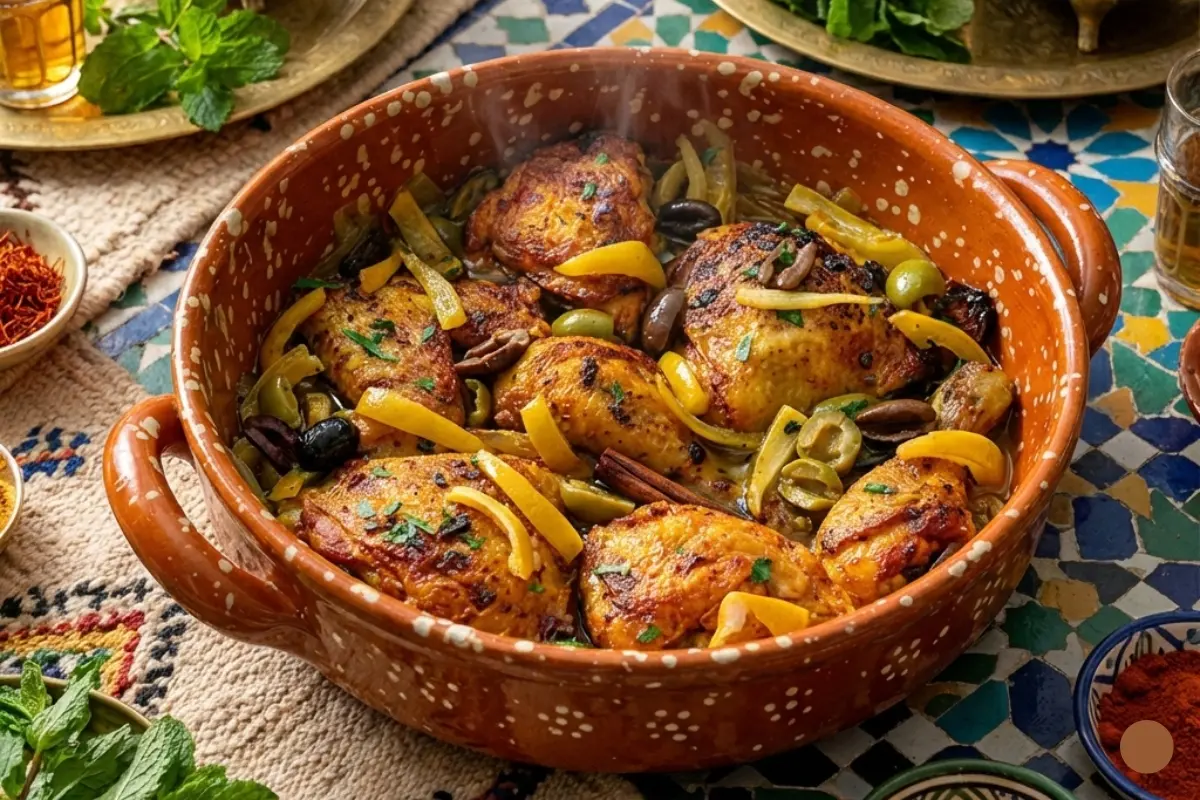
Djaj mqualli (also spelled djej mquali, dajaj maqli, or simply chicken with preserved lemon and olives) stands as one of Morocco's most iconic, elegant, and internationally recognized tagines - a dish that exemplifies the sophisticated simplicity at the heart of Moroccan cuisine. Unlike elaborate tagines featuring multiple vegetables, dried fruits, and complex spice blends, djaj mqualli achieves extraordinary flavor through restraint and the perfect marriage of just a few exceptional ingredients: tender chicken, the incomparable tangy-salty brightness of preserved lemons, the briny depth of green or purple Moroccan olives, the golden luxury of saffron, and warming ginger. The result is a dish of remarkable elegance - silky, golden sauce coating fall-apart tender chicken, punctuated by soft, intensely flavored preserved lemon quarters and plump olives, perfumed with saffron's distinctive aroma.
What makes djaj mqualli so special is how it showcases preserved lemon - Morocco's signature condiment and one of the country's most important culinary contributions to world cuisine. Preserved lemons are fresh lemons packed in salt and their own juices, then fermented for weeks or months until the rind becomes soft, mellow, and intensely flavored - losing the fresh lemon's sharp acidity and developing a complex, almost floral, deeply savory-citrus character unlike anything else. In djaj mqualli, the preserved lemon transforms from a condiment into a central ingredient, providing the dish's defining flavor. The olives add briny, savory depth that balances the lemon's brightness, while saffron provides golden color and its incomparable floral aroma. Ginger adds warming spice without the heat of pepper. The sauce - reduced cooking liquid enriched with olive oil - achieves a silky, emulsified consistency that coats the chicken luxuriously.
Djaj mqualli holds a special place in Moroccan culinary culture as an elegant yet unpretentious dish suitable for both everyday family dinners and important occasions. It's sophisticated enough to serve at dinner parties and weddings, yet simple enough for weeknight cooking. The dish represents Moroccan cooking at its finest - maximum flavor from minimal ingredients through perfect technique and patience. It's often the tagine Moroccan cooks prepare when they want to impress guests while showcasing the essential flavors of Moroccan cuisine. The combination of preserved lemon, olives, and saffron has become so iconic that it defines an entire category of Moroccan cooking, appearing in variations with fish, lamb, and vegetables.
About This Recipe
Djaj mqualli represents one of Morocco's most iconic and internationally recognized tagines - a dish that has become synonymous with Moroccan cuisine in the global culinary imagination and exemplifies the sophisticated simplicity that characterizes the country's finest cooking. The name 'mqualli' (also spelled maqli) derives from the Arabic root meaning 'to fry' or 'to sauté,' referring to the initial cooking of the onions and aromatics, though the dish itself is a braised tagine rather than a fried preparation. This naming convention reflects the importance of the foundational sautéing step in building the sauce's flavor. The dish showcases preserved lemon - Morocco's most significant culinary contribution to world cuisine and a condiment so essential to Moroccan cooking that it's difficult to imagine the cuisine without it. The technique of preserving lemons in salt dates back centuries in North Africa, developed as a method to preserve the harvest and have lemons available year-round in the days before refrigeration. The fermentation process transforms fresh lemons from sharp and acidic to mellow, complex, and almost savory-sweet, creating a flavor profile unlike anything else in world cuisine. Djaj mqualli elevates preserved lemon from condiment to central ingredient, making it the star alongside chicken rather than merely an accent. The combination of preserved lemon with olives - another ancient preserved food central to Mediterranean and North African cuisine - creates the signature flavor profile that defines not just this dish but an entire category of Moroccan cooking. Variations of this preserved lemon and olive combination appear with fish, lamb, vegetables, and other proteins throughout Moroccan cuisine. The dish exemplifies Moroccan palace cuisine's philosophy of achieving extraordinary flavor through restraint and the perfect marriage of a few exceptional ingredients rather than through complexity or abundance. Unlike elaborate mrouzia with its honey and raisins, or bisteeya with its layers of pastry and multiple preparations, djaj mqualli achieves elegance through simplicity - the focus on a few perfect ingredients cooked with precision and patience. The addition of saffron - Morocco's liquid gold from the Taliouine region - elevates the dish further, providing golden color and incomparable floral aroma that distinguishes this as special-occasion food despite its straightforward preparation. Historically, djaj mqualli was celebration food and honored-guest food - the preserved lemons, quality olives, and precious saffron marked it as something beyond everyday sustenance. Today, the dish occupies a unique place in Moroccan cuisine as simultaneously elegant and accessible - impressive enough for dinner parties and weddings, yet simple enough for weeknight family dinners. It's often the tagine Moroccan restaurants serve to introduce international diners to Moroccan cuisine because it's approachable (everyone understands chicken), sophisticated (the preserved lemon and olive combination is distinctive and memorable), and definitively Moroccan in character. The dish has been featured in countless cookbooks, cooking shows, and food articles as the quintessential Moroccan tagine, spreading knowledge of preserved lemons and Moroccan cooking techniques globally. Regional variations exist but are subtle - some areas prefer more ginger, others emphasize saffron more heavily, coastal regions might add preserved lemon to fish versions while inland areas favor lamb. Yet the essential character remains constant - tender protein, silky golden sauce, the incomparable preserved lemon, briny olives, and aromatic saffron creating a dish that is unmistakably and beautifully Moroccan.
Nutritional Info (per serving)
Recipe Tags
Understanding the Ingredients
Chicken
The choice of chicken is important for achieving the tender, fall-apart texture that defines great djaj mqualli. A whole chicken (three to four pounds) cut into serving pieces is traditional - the combination of dark and white meat provides variety and the bones add flavor to the sauce. Alternatively, use bone-in, skin-on chicken pieces - thighs and drumsticks provide the most flavor and stay juiciest during the slow cooking, while chicken breasts work but require careful monitoring to prevent drying. You'll need about three and a half to four pounds of chicken pieces for six servings. The skin can be left on for richer sauce or removed for a lighter result - both approaches are authentic. The chicken should be at room temperature before cooking for even heat distribution.
Preserved Lemons
Preserved lemons are the heart and soul of djaj mqualli and absolutely non-negotiable for authentic results. You'll need two to three preserved lemons depending on size - they should be soft, with the rind completely tender and the pulp broken down into a jammy consistency. To use preserved lemons: rinse them under cold water to remove excess salt, then cut in half or quarters. Scoop out and discard the pulp (which is very salty and intense) - only the rind is used in cooking. The rind should be soft enough to cut easily with a knife or even tear with your fingers. Some recipes call for slicing the rind into strips, while others leave it in large pieces. Homemade preserved lemons are ideal if you have them, or purchase quality preserved lemons from Moroccan or Middle Eastern markets. If absolutely unavailable, see substitution notes, though the dish will fundamentally differ without authentic preserved lemon.
Olives
Moroccan olives provide essential briny, savory depth that balances the preserved lemon's brightness. You'll need one to one and a half cups of olives. Green cracked olives are most traditional - these are large green olives that have been cracked and cured in brine, resulting in meaty texture and complex flavor. Purple olives (actually ripe olives with dark purple-brown color) are equally traditional and provide slightly earthier, more mellow flavor. A mixture of both creates beautiful visual appeal. The olives should be unpitted for best flavor (though pitted work for convenience). Moroccan olives specifically are ideal, but any good quality brine-cured Mediterranean olives work - avoid canned black olives which have completely different character. Rinse the olives if very salty, or blanch briefly in boiling water to mellow the saltiness.
Saffron
Saffron is essential for authentic djaj mqualli - it provides the characteristic golden color and incomparable floral aroma that distinguish this dish. Use a generous pinch (about half a teaspoon) of saffron threads, crushed between your fingers and dissolved in two tablespoons of warm water before adding to the dish. This blooming process releases the saffron's color and flavor more effectively than adding threads directly. Moroccan saffron from Taliouine is among the world's finest and most aromatic. While saffron is expensive, it transforms the entire dish and is worth the investment for this special recipe. If saffron is unavailable, the dish can be made without it but will lack the authentic appearance and that distinctive floral note.
Ginger
Ground ginger (one and a half to two teaspoons) provides warming spice without heat - it adds depth and aromatic complexity without overwhelming the delicate preserved lemon and olive flavors. Some traditional recipes also include fresh ginger (one tablespoon grated) in addition to or instead of ground ginger for a brighter, more pronounced ginger flavor. The ginger should be fresh and aromatic - old, stale ground ginger creates flat flavor. Ginger is traditional in djaj mqualli and should not be omitted.
Onions and Garlic
The aromatic base requires onions (two medium, finely chopped or grated) and garlic (four to five cloves, minced or crushed). The onions provide sweetness and body to the sauce, cooking down until they virtually disappear into the liquid. Some traditional recipes grate the onions on a box grater rather than chopping, which creates a pulpy consistency that dissolves more completely into the sauce. The garlic adds pungent depth. These aromatics create the foundation that supports the preserved lemon and olive flavors.
Fresh Herbs
Fresh herbs provide essential brightness and authentic Moroccan character. Fresh cilantro (half to three-quarters cup, chopped) is traditional and important. Fresh parsley (half cup, chopped) adds complementary freshness. The herbs are used in two ways: a generous bundle of whole stems tied with string simmers in the tagine during cooking to infuse flavor, then is removed before serving. Freshly chopped herbs are stirred in at the end or used as garnish for maximum fresh impact. Never substitute dried herbs - the bright, fresh flavor is essential.
Oil and Butter
The sauce base requires generous fat to create the characteristic silky, emulsified consistency. Use half a cup of olive oil, or a combination of olive oil and butter (quarter cup each) for even richer results. Some traditional recipes use smen (Moroccan preserved fermented butter) which adds distinctive tangy, nutty complexity. The fat carries the spices, prevents sticking, and creates the glossy sauce that coats the chicken. The oil also helps extract and carry the fat-soluble aromatic compounds from saffron and ginger. Don't reduce the fat quantity significantly - it's essential for proper sauce development and authentic texture.
Step-by-Step Cooking Guide
Prepare the Chicken and Aromatics
If using whole chicken, cut it into serving pieces (two breasts cut in half, two thighs, two drumsticks, two wings) - or use pre-cut bone-in, skin-on chicken pieces (about three and a half to four pounds total). Rinse the chicken pieces under cold water and pat completely dry with paper towels - this is important for proper browning if you choose to brown the chicken. Season the chicken pieces generously all over with one teaspoon of salt and half a teaspoon of black pepper. Prepare your aromatics: finely chop or grate two medium onions, mince or crush four to five garlic cloves, and chop your fresh herbs (half to three-quarters cup cilantro, half cup parsley). Make a large herb bundle by tying generous amounts of cilantro and parsley stems together with kitchen string. Crush half a teaspoon of saffron threads between your fingers and dissolve in two tablespoons of warm water - set aside to bloom.
Tip: Pat chicken completely dry for better browning. Room temperature chicken cooks more evenly. Season generously with salt and pepper. Crush saffron and dissolve in warm water to release color and flavor. Prepare herb bundle for simmering.
Brown the Chicken (Optional but Recommended)
This browning step is optional but highly recommended for deeper flavor and more attractive appearance. Heat three tablespoons of olive oil in a large tagine or heavy-bottomed pot (at least six-quart capacity) over medium-high heat. Working in batches to avoid crowding, add the chicken pieces skin-side down and brown for three to four minutes per side until golden. The chicken doesn't need to be deeply caramelized - just lightly colored to add flavor and seal the surface. Transfer browned chicken to a plate. If skipping the browning step (which is also traditional), proceed directly to the next step. Some Moroccan cooks never brown the chicken for this dish, allowing it to cook entirely in the sauce - both approaches are authentic.
Tip: Browning is optional but adds flavor and color. Don't crowd pan - work in batches. Light browning is sufficient - 3-4 minutes per side. Can skip entirely and cook chicken directly in sauce - both methods authentic.
Build the Aromatic Base
In the same tagine or pot (with any browned bits remaining if you browned the chicken), heat half a cup of olive oil (or quarter cup olive oil plus quarter cup butter) over medium heat. Add the chopped or grated onions and cook, stirring occasionally, for five to six minutes until very soft and beginning to turn golden. Don't let them brown deeply - they should become translucent and sweet. Add the minced garlic and cook for one minute, stirring constantly, until fragrant but not browned. Add your spice blend: one and a half to two teaspoons of ground ginger, one teaspoon of black pepper, and one teaspoon of salt. Stir for thirty seconds until the spices are fragrant and coat the onions evenly. Add the dissolved saffron water and stir well - the mixture should turn a beautiful golden color. This aromatic base is the foundation of the sauce.
Tip: Cook onions until very soft and sweet - don't brown deeply. Add garlic last - burns easily. Bloom spices briefly in the oil until fragrant. Saffron should turn mixture golden. This aromatic base is essential for sauce flavor.
Add Chicken and Initial Cooking
Nestle all the chicken pieces into the aromatic onion mixture in the tagine or pot, turning to coat them with the spiced oil. The pieces can overlap slightly but try to arrange them in a relatively single layer. Add the large herb bundle (tied cilantro and parsley stems), pushing it down into the liquid. Pour in one and a half to two cups of water or chicken stock - enough to come about halfway up the chicken pieces but not cover them completely. Bring to a boil over medium-high heat, then immediately reduce heat to maintain a gentle simmer. Cover with the tagine lid or a tight-fitting pot lid. Simmer gently for thirty to forty minutes, turning the chicken pieces once halfway through. During this stage, the chicken should become tender and the sauce should reduce and concentrate. The liquid should barely bubble - gentle simmering keeps the chicken tender while vigorous boiling can toughen it.
Tip: Coat chicken pieces with aromatic mixture. Liquid should come halfway up chicken, not cover. Herb bundle infuses flavor during cooking. Maintain gentle simmer - vigorous boiling toughens chicken. Cover tightly throughout. Turn chicken once halfway through.
Prepare and Add Preserved Lemons
While the chicken is cooking, prepare the preserved lemons. Rinse two to three preserved lemons under cold running water to remove excess salt. Cut each lemon in half or into quarters. Using a spoon, scoop out and discard the pulp (the interior jammy part) - it's very salty and intense and isn't used in the cooking. You want only the soft, tender rind. Depending on preference, leave the rind in large pieces or slice into strips. After the chicken has simmered for thirty to forty minutes and is becoming very tender, add the prepared preserved lemon rinds to the tagine, distributing them around and over the chicken pieces. The preserved lemon will infuse its distinctive flavor into the sauce during the remaining cooking time.
Tip: Rinse preserved lemons to remove excess salt. Discard pulp - use only the soft rind. Cut into halves, quarters, or strips as preferred. Add after initial chicken cooking - they need less time. Preserved lemon flavor will infuse during final cooking.
Add Olives and Final Cooking
Add one to one and a half cups of olives (green, purple, or a mixture) to the tagine. If your olives are very salty, rinse them first or blanch briefly in boiling water to mellow the saltiness. Distribute the olives throughout the dish. Continue simmering gently, covered, for another ten to fifteen minutes. During this final stage, the preserved lemon and olives will heat through and infuse their flavors into the sauce, and the sauce will continue reducing and concentrating. The chicken should be very tender at this point - nearly falling off the bone when tested with a fork. Check the liquid level - if it seems too much and the sauce is thin, uncover and increase heat to medium for the last few minutes to reduce it to a thick, coating consistency. If the sauce is too thick or threatening to dry out, add a few tablespoons of water.
Tip: Rinse very salty olives before adding. Add olives in final stage - they just need to heat through. Continue gentle simmering covered 10-15 min. Chicken should be very tender, nearly falling off bone. Adjust sauce consistency - should be thick and coat chicken, not watery.
Final Seasoning and Finish
Remove and discard the herb bundle. Taste the sauce and adjust seasoning - you may need to add more salt, though the preserved lemons and olives have already contributed significant saltiness. The sauce should be well-balanced between the tangy brightness of preserved lemon, the briny depth of olives, the warming ginger, and the floral saffron. If desired, stir in half of your freshly chopped cilantro and parsley (reserve the rest for garnish). Some traditional cooks add a knob of butter (one to two tablespoons) at the very end, swirling it into the sauce for additional richness and shine. Let the tagine rest off the heat for five to ten minutes - this brief rest allows the sauce to thicken slightly more and the flavors to settle and meld together.
Tip: Remove herb bundle before serving. Taste and adjust salt carefully - preserved lemons and olives are already salty. Stir in half the fresh herbs, reserve rest for garnish. Optional: swirl in butter at end for richness. Rest 5-10 minutes for flavors to meld.
Serve
Transfer the chicken pieces to a large serving platter or serve directly from the beautiful tagine if you have one. Arrange the chicken attractively and distribute the preserved lemon quarters and olives over and around the chicken pieces - they should be prominently visible as they're essential elements of the dish. Spoon the golden, silky sauce generously over everything. The sauce should be thick enough to coat the chicken beautifully but fluid enough to pool slightly around the edges. Garnish generously with the reserved fresh cilantro and parsley. Serve immediately while hot with warm Moroccan bread (khobz), crusty baguette, or over fluffy couscous. Traditionally, djaj mqualli is eaten with bread, using pieces to scoop up the tender chicken and mop up the extraordinary sauce. The preserved lemon and olives are eaten along with the chicken - they're not just flavoring but integral components of each bite.
Tip: Arrange chicken attractively with preserved lemons and olives prominently visible. Sauce should coat chicken beautifully - thick, glossy, golden. Garnish generously with fresh herbs. Serve hot with bread or couscous. Preserved lemons and olives are eaten with the chicken - essential to each bite.
Common Mistakes to Avoid
❌ Using Fresh Lemon Instead of Preserved
Solution: Fresh lemons cannot substitute for preserved lemons - the flavor is completely different. Preserved lemons have undergone fermentation that transforms their character from sharp and acidic to mellow, complex, and almost floral. Fresh lemon creates a different, inferior dish. Always use authentic preserved lemons for djaj mqualli.
❌ Not Removing Preserved Lemon Pulp
Solution: The interior pulp of preserved lemons is extremely salty and intensely flavored - it should be scooped out and discarded, using only the soft rind. Leaving the pulp in makes the dish unbearably salty and overwhelmingly lemony. Always scoop out and discard the pulp, using only the tender rind.
❌ Adding Preserved Lemons Too Early
Solution: Preserved lemons should be added in the final twenty to twenty-five minutes of cooking, not at the beginning. Adding them too early can make them break down excessively and create overpowering lemon flavor. Add them after the chicken has cooked for thirty to forty minutes and is becoming tender.
❌ Too Much or Too Little Liquid
Solution: The sauce should be thick, silky, and coat the chicken beautifully - neither watery nor dry. Start with liquid coming halfway up the chicken, then adjust at the end. If too thin, simmer uncovered to reduce. If too thick, add water. The final consistency is crucial for the dish's character.
❌ Overcooking the Chicken
Solution: While the chicken should be very tender, overcooking can make it fall apart into shreds rather than holding together in attractive pieces. Monitor carefully, especially if using chicken breasts which dry out quickly. The chicken is done when nearly falling off the bone but still holding its shape - usually fifty to sixty minutes total cooking time.
❌ Skipping the Fresh Herb Finish
Solution: The fresh cilantro and parsley stirred in at the end or used as garnish are essential for brightness and authentic Moroccan character. The dish tastes flat and one-dimensional without them. Always finish with generous amounts of fresh herbs - they're not optional garnish but essential flavor components.
Ingredient Substitutions
Instead of: Preserved Lemons
Use: If absolutely unavailable, make a quick substitute: use strips of fresh lemon zest (from 3 lemons, no white pith) simmered in salted water for 10 minutes, then added to the dish. Or use 1/3 cup fresh lemon juice plus thin strips of lemon zest. Neither replicates authentic preserved lemon but provides some lemon character. Ideally, make preserved lemons in advance.
Instead of: Whole Chicken Pieces
Use: Bone-in, skin-on chicken thighs alone create the most forgiving, flavorful version. Chicken breasts work but require careful monitoring to prevent drying - reduce cooking time to 35-40 minutes. Boneless chicken is not recommended - bones add essential flavor. Skin can be removed for lighter version.
Instead of: Moroccan Olives
Use: Greek green olives (cracked or whole) work well. Kalamata olives provide different but good flavor. Nicoise olives are closer to Moroccan purple olives. Any quality brine-cured Mediterranean olives work. Avoid canned black olives - completely different character.
Instead of: Saffron
Use: While saffron is traditional and ideal, the dish can be made without it - increase turmeric to one teaspoon for golden color without the floral aroma. The character will be different but still delicious. Saffron is worth the investment when possible.
Instead of: Chicken
Use: Bone-in lamb shoulder or leg cut into chunks works beautifully with this same preparation (increase cooking time to 75-90 minutes). Fish fillets or steaks create a lighter version (reduce cooking time to 15-20 minutes). The preserved lemon and olive combination works with many proteins.
Serving Suggestions
Serve djaj mqualli as elegant main course for dinner parties - sophisticated yet approachable.
Present in traditional tagine dish for beautiful, authentic presentation that impresses guests.
Serve with warm Moroccan khobz bread, baguette, or pita for traditional eating - scooping chicken and sauce with bread.
Alternatively, serve over fluffy steamed couscous for more substantial, complete meal.
Accompany with simple Moroccan salads as starters - zaalouk, taktouka, tomato-cucumber salad for fresh contrast.
Include as part of Moroccan feast menu alongside other tagines, couscous, and salads for variety.
For family dinner, serve family-style in the tagine at table center for communal eating.
Pair with Moroccan mint tea after the meal for traditional experience.
Garnish table with lemon wedges and fresh herbs for additional brightness and color.
Storage & Reheating Guide
Storage
Djaj mqualli stores excellently and actually improves in flavor after a day as the preserved lemon and olive flavors continue to permeate the chicken. Allow to cool to room temperature within two hours, then transfer to airtight containers and refrigerate for up to four days. The sauce will thicken considerably during refrigeration as the fats solidify - this is normal. The dish can also be frozen for up to three months - freeze in portion-sized containers for convenience. Thaw overnight in refrigerator before reheating. Store preserved lemons and olives with the chicken - they're integral components, not garnish.
Reheating
To reheat refrigerated djaj mqualli, place in a pot over low heat and warm gently, stirring occasionally, for fifteen to twenty minutes until heated through. Add a few tablespoons of water or stock to thin the sauce which will have thickened during storage. The sauce should return to its silky, coating consistency as it warms and the fats melt. Reheat until the chicken is warmed throughout and the sauce is fluid and glossy. Can also reheat covered in a 325°F oven for twenty-five to thirty minutes. Microwave reheating works for individual portions but can make chicken slightly rubbery. Always stir in fresh herbs after reheating to restore brightness.
Tips: Flavor improves after 1-2 days - make ahead for best results. Sauce thickens dramatically during storage - add water when reheating. Always add fresh herbs after reheating for brightness. Stores well for 4 days refrigerated. Freezes successfully for 3 months.
Frequently Asked Questions
Recipe by

Similar Recipes


Our Recipe Ebooks
Discover our collection of authentic Moroccan recipe ebooks. Learn traditional cooking methods and create delicious meals at home.
The Moroccan Vegen
The Royal Moroccan Table -Part1
The Royal Moroccan Table -Part2
YouTube Channel
Watch step-by-step cooking videos, learn professional techniques, and get inspired by traditional and modern recipes from around the world.
Latest Video
"Traditional Moroccan Tagine Masterclass"