
60
Prep (min)
120
Cook (min)
8
Servings
High
Level
Introduction
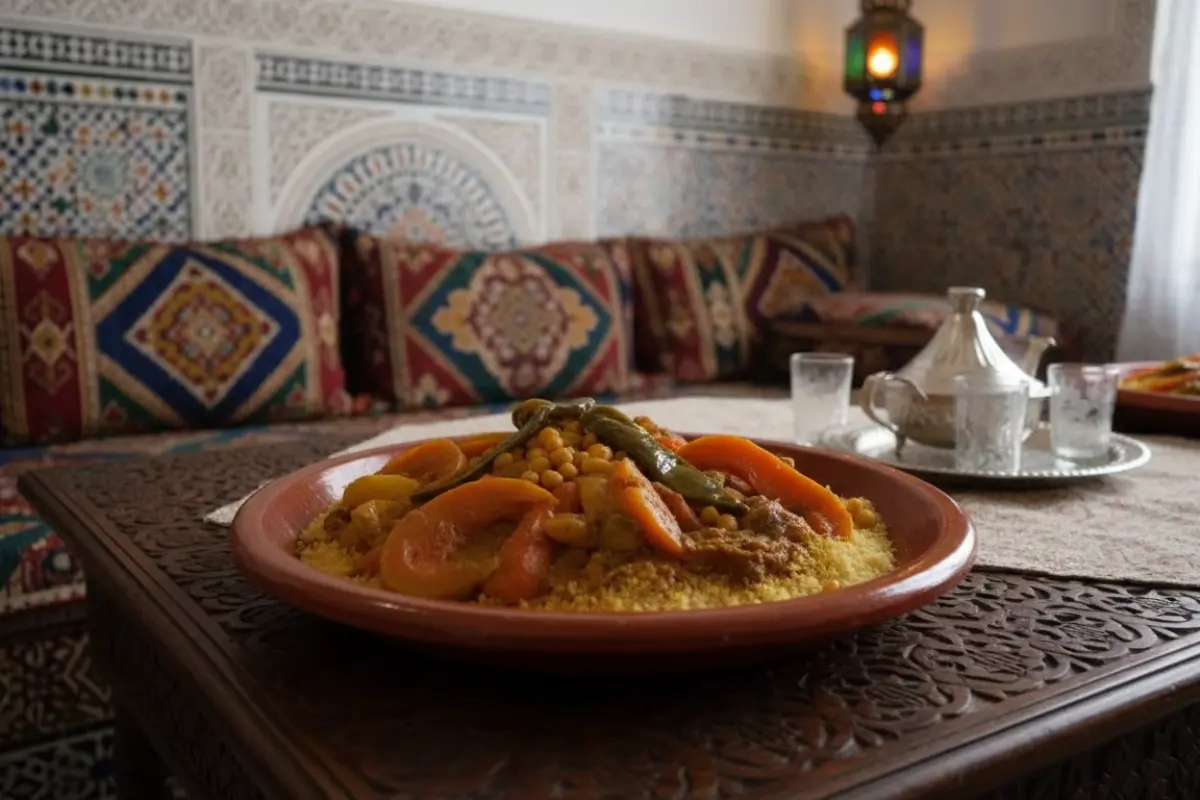
Couscous with Seven Vegetables—known in Morocco as 'Seksu b'Se'b Khodra' or simply 'Seksu l-Jem'a' (Friday Couscous)—is more than a dish; it is a sacred culinary ritual, a weekly celebration of family, community, and Moroccan identity. Every Friday, following the midday prayer, the scent of steaming couscous and slow-simmered broth wafts through homes from Tangier to Lagouira, announcing the arrival of the family gathering that defines the Moroccan weekend.
Contrary to what its name suggests, the 'seven vegetables' are not a rigid prescription but a symbolic representation of abundance and blessing (baraka). Depending on the season and region, the vegetables change, but the principle remains constant: a harmonious layering of flavors achieved through patient, sequential cooking. The meat—lamb shoulder or beef chuck—is browned and simmered first, then vegetables are added in precise order based on their cooking times: first the densest (turnips, carrots), then the more delicate (zucchini, cabbage), and finally the quick-cooking vegetables (tomatoes, bell peppers).
This sequential method, passed down through generations of Moroccan cooks, is the soul of authentic couscous. It ensures each vegetable retains its integrity while contributing to a broth that is simultaneously deep, sweet, savory, and aromatic. Meanwhile, the couscous itself undergoes a separate ritual: three rounds of steaming and fluffing, absorbing only water and salt, never oil—a technique that yields grains so light and separate they seem to dance on the tongue.
Served on a vast communal platter, with meat crowned at the center and vegetables arranged like jewels, couscous is eaten with the right hand, each diner shaping their portion from the edge of the platter. It is a dish of profound generosity and patience, requiring three hours of loving attention—time that Moroccan cooks consider not a burden but a gift to their families. This recipe, distilled from the expertise of Chef Karim Ben Baba of Royal Mansour Casablanca and generations of home cooks, captures the authentic, unshortcuttable essence of Morocco's most cherished dish.
About This Recipe
Couscous with Seven Vegetables is the undisputed king of Moroccan cuisine, a dish whose origins trace back to the Berber (Amazigh) communities of North Africa, predating the Arab arrival in the 7th century. Archaeological evidence suggests couscous-making techniques—crushing durum wheat, rolling it into tiny grains, steaming over stew—existed in the Maghreb as early as the 3rd century BCE. The word 'seksu' is Amazigh, and the cooking method (steaming grains over meat broth) is uniquely North African, distinct from other grain preparations worldwide. The Friday tradition emerged with the spread of Islam. Following communal midday prayer, families gather for the week's most elaborate meal, symbolizing both religious observance and family unity. The seven vegetables represent the abundance of the earth and divine blessing (baraka). Historically, the specific vegetables varied by region and season—coastal areas added fish, mountain regions used wild greens, desert oases emphasized squash and dried fruits. Couscous traveled beyond Morocco with Andalusi refugees in the 15th century, influencing Spanish and Sicilian cuisines. In the 20th century, UNESCO recognized couscous as part of the intangible cultural heritage of the Maghreb. Yet in Morocco, it remains fundamentally domestic—every family's couscous is distinct, each grandmother's technique slightly different, each region's vegetable selection unique. This recipe captures the Fassi (Fez) tradition, considered the classical standard, while acknowledging that authentic couscous is always, ultimately, the couscous of one's mother.
Nutrition / serving
Recipe Tags
Understanding the Ingredients
Meat: Lamb Shoulder or Beef Chuck
Choose lamb shoulder (2-2.5 kg) with some fat, or beef chuck—collagen-rich cuts that become meltingly tender after long, gentle cooking. The bones are essential: they enrich the broth with gelatin and depth. For lamb, the shoulder blade or neck pieces are ideal. For beef, marrow bones add luxury. Meat should be cut into large pieces (100-120g each) to withstand 2 hours of simmering without shredding. Freeze the meat for 20 minutes before cutting for cleaner slices.
The Seven Vegetables (Seasonal)
The 'seven' are symbolic of abundance, not a fixed rule. Classic composition: carrots (sweetness), turnips (earthy), zucchini (delicate), pumpkin/squash (sweet), cabbage (hearty), tomatoes (acidity), bell peppers (aromatic). Optional: potatoes, chickpeas, fava beans, celery, green beans. Each vegetable is peeled and cut uniformly—carrots and turnips in thick batons, zucchini in halves, cabbage in wedges, pumpkin in large pieces. The peels are never discarded; they're tied in cheesecloth and simmered to extract flavor without clouding the broth. This layering technique—adding vegetables in stages based on density—is non-negotiable for authentic texture.
Couscous Grains (Medium or Extra-Fine)
Moroccan couscous is not 'quick-cook' boxed couscous. Authentic couscous requires traditional Berber grains made from crushed durum wheat semolina. The quality is determined by hand-rolling technique; for home cooks, purchasing high-quality medium-grain couscous from a trusted Moroccan brand is essential. The grains must be moistened, fluffed, and steamed three times—never boiled. Each steaming builds layers of separation until the grains are ethereally light. The couscous absorbs only water and salt; oil is added only at the very end. A traditional couscoussier (bottom pot for broth, top steamer for grains) is ideal, but a colander over a large pot can work.
Onions and Aromatics
Two large onions, finely chopped, form the flavor base. They are cooked slowly in oil and smen (Moroccan aged butter) until translucent and sweet—never browned. Smen provides the signature fermented depth; if unavailable, use unsalted butter plus a pinch of fenugreek powder for approximation. Fresh garlic (4-6 cloves) is crushed and added with the meat. Saffron threads (1/4 tsp) are essential—they soak in warm water and are added with their golden infusion. Fresh cilantro and parsley are tied in a bouquet garni, simmered then discarded, imparting freshness without vegetal intrusion.
Spices: Ras el Hanout & Saffron
Authentic couscous uses a subtle, balanced spice blend—never heavy or pungent. Ras el hanout (2 tsp) is ideal; its name means 'head of the shop'—the spice seller's best blend. If unavailable, mix: 1 tsp ginger, 1/2 tsp white pepper, 1/2 tsp turmeric, 1/4 tsp cinnamon, pinch of nutmeg. Saffron is non-negotiable; it provides the characteristic golden color and floral aroma. Black pepper and salt are added at the end after tasting. Cayenne is optional and regional—some families add a small dried chili for gentle heat.
Chickpeas and Raisins (Optional)
Chickpeas are traditional in some regions (particularly Fez), added for substance and sweetness. Dried chickpeas must be soaked overnight, then simmered with the meat. Canned chickpeas can be added in the last 30 minutes. Raisins are controversial—some families add them for sweetness, others consider them an intrusion. If used, they're added during final 15 minutes to plump without bursting. Neither is mandatory; the seven vegetables are sufficient.
Step-by-Step Cooking Guide
Prepare the Couscous Grains (First Steaming)
30 minPlace 1 kg of medium-grain couscous in an extra-wide shallow dish (traditionally a gsaa). Sprinkle with 1 cup cold water mixed with 1 tbsp salt, drizzling gradually with your fingertips. Immediately begin rolling and lifting the grains with your palms to distribute moisture evenly—do not press or knead. Let rest 10 minutes, then break apart any clumps with your fingers. Transfer to the top of the couscoussier (steamer basket) without packing down. Place over boiling broth (not touching water), seal seam with cloth to trap steam, and steam 20 minutes from first sight of steam.
Tip: This first steam opens the grains. The couscous should feel warm and slightly moist, not wet. Do not skip the cloth seal—it prevents steam escape and ensures light grains.
First Fluffing and Resting
15 minEmpty the steamed couscous back into the gsaa. Spread evenly with a wooden spatula to cool slightly. Sprinkle with 1 cup cold water mixed with 1 tsp salt, drizzling gradually while fluffing vigorously with your fingers to break all clumps. The grains will swell. Let rest 10-15 minutes. Meanwhile, prepare the broth base.
Tip: This resting period is crucial—it allows moisture to penetrate the grain centers. The couscous should look uniform, each grain distinct. Cover with clean towel if resting longer.
Build the Broth Base: Meat and Aromatics
40 minIn the bottom pot of couscoussier, heat 3 tbsp olive oil and 1 tbsp smen over medium. Add 2 finely chopped onions, cook 5-7 minutes until translucent (not brown). Add meat pieces in single layer, turning to coat. Add crushed garlic, 2 tsp ras el hanout, 1/2 tsp white pepper, saffron with its soaking water, and a bouquet of fresh cilantro/parsley tied with string. Add 2 tbsp tomato paste dissolved in 1 cup water. Cover with 4 liters water. Bring to boil, reduce to gentle simmer, skim foam. Cook uncovered 30 minutes.
Tip: The broth should be golden, not brown. Skimming ensures clear broth. Do not salt yet—it toughens meat and vegetables if added too early.
Second Couscous Steaming
25 minReturn the rested, moistened couscous to the steamer basket. Place over the simmering meat broth. Seal seam with cloth. Steam 20 minutes after steam appears. The couscous will absorb aromatic steam from the broth below.
Tip: The second steam builds flavor. The grains should be visibly plumper and separate easily. Do not peek unnecessarily.
Add Dense Vegetables (First Layer)
35 minAfter meat has simmered 30 minutes, add chickpeas if using dried (soaked overnight). Add carrots and turnips (peeled, cut into thick batons). Season broth with 1 tbsp salt and 1 tsp black pepper. Continue simmering uncovered. These dense vegetables need 30-35 minutes to become tender.
Tip: Vegetables are added in precise order by density. Carrots and turnips go first. Keep vegetables submerged; add hot water if needed.
Third Couscous Steaming (Final)
25 minTransfer couscous to gsaa. Sprinkle with 1/2 cup cold water mixed with 1/2 tsp salt, fluff vigorously with fingertips, breaking all remaining clumps. Let rest 5 minutes. Return to steamer basket, place over broth, seal with cloth. Steam 20 minutes. The couscous is now fully cooked—each grain should be separate, tender, and light.
Tip: This final steam completes the couscous. After this, it will be kept warm and fluffed with butter. Taste a grain—it should be tender with no hard center.
Add Medium Vegetables (Second Layer)
15 minAfter carrots and turnips have cooked 20 minutes, add zucchini (halved lengthwise), cabbage wedges, and celery if using. Simmer 15 minutes. These vegetables cook faster and would disintegrate if added earlier.
Tip: Zucchini should be just tender, not falling apart. Cabbage should retain some bite. Pierce with knife to test.
Add Quick-Cooking Vegetables (Final Layer)
20 minAdd pumpkin/squash (large pieces), tomatoes (quartered, seeded), bell peppers (halved or quartered), and potatoes if using. Simmer 15-20 minutes until all vegetables are tender but intact. Taste broth and adjust salt/pepper. If using raisins, add now. If using canned chickpeas, add now to warm through.
Tip: Pumpkin cooks quickly and becomes fragile. Handle gently. The broth should be richly flavored, slightly thickened by vegetable starches.
Finish the Couscous
10 minTurn the finished couscous into a large warm gsaa or platter. Drizzle with 1/2 cup of the hot broth, then add 2 tbsp smen or butter in small pieces. Fluff with fingertips—the fat should coat each grain, making them glossy and separate. Taste and adjust salt. Cover with clean towel to keep warm.
Tip: The broth addition keeps couscous moist. The butter gives richness and sheen. Fluffing with fingertips (not spoon) is traditional and prevents crushing grains.
Assemble and Serve
10 minMound the couscous on a vast, round platter (traditional Moroccan couscous dish). Create a well in the center. Place meat pieces in the well. Arrange vegetables artistically around: carrots and turnips in separate piles, zucchini crossed, pumpkin wedges, cabbage, peppers. Ladle 2-3 cups of hot broth over the couscous—it should moisten but not pool. Serve immediately, with extra hot broth on the side. Eat with the right hand, shaping portions from the edge.
Tip: The presentation is part of the tradition—vegetables arranged by color, meat crowned. The broth is added just before serving to prevent sogginess. Each diner shapes their couscous portion into a ball with their fingers.
Common Mistakes to Avoid
✗ Using Quick-Cook Couscous
Fix: Authentic Moroccan couscous requires traditional grains that are steamed, not boiled. Quick-cook varieties turn to paste. Seek out medium-grain couscous from Moroccan brands. The three-steam method is essential and cannot be shortcut.
✗ Adding All Vegetables at Once
Fix: This cardinal error turns vegetables to mush. Dense vegetables (carrots, turnips) need 30+ minutes; zucchini and cabbage need 15-20; pumpkin and tomatoes need 10-15. Layer them sequentially. The peels can be simmered in a sachet for flavor, then discarded.
✗ Skipping the Cloth Seal on Couscoussier
Fix: Steam escapes if the seam between pot and steamer is not sealed. Wrap a clean cotton cloth dipped in flour-water paste around the joint. This traps steam, ensuring light, separate grains.
✗ Salting Too Early
Fix: Salt added at the beginning toughens meat and prevents vegetables from softening properly. Season the broth only after meat has cooked 30 minutes, then adjust at the end.
✗ Overcrowding the Steamer Basket
Fix: Couscous needs space to expand and steam. Fill the steamer basket no more than ⅔ full. Overpacking produces dense, sticky grains. Steam in batches if necessary.
Ingredient Substitutions
Instead of: Lamb Shoulder
Use: Beef chuck (same cooking time) or chicken thighs (reduce meat cooking time to 45 minutes, add vegetables accordingly). For vegetarian version, use rich vegetable broth and add chickpeas, fava beans, and extra root vegetables.
Instead of: Smen (Moroccan Aged Butter)
Use: Unsalted butter + 1/4 tsp fenugreek powder. Ghee works but lacks the fermented note. For dairy-free, use olive oil.
Instead of: Couscoussier
Use: Large pot with tight-fitting lid + metal colander or steamer basket that fits snugly, lined with cheesecloth. Seal seam with foil and damp kitchen towel.
Instead of: Fresh Saffron
Use: 1/2 tsp turmeric provides color but not flavor. Achiote powder (annatto) also colors. Safflower is not a substitute.
Instead of: Ras el Hanout
Use: Homemade blend: 1 tsp ginger, 1/2 tsp white pepper, 1/2 tsp turmeric, 1/4 tsp cinnamon, 1/4 tsp cardamom, pinch nutmeg.
Serving Suggestions
Serve on a large communal platter with the meat crowned in the center and vegetables arranged by color around the edge.
Accompany with bowls of extra hot broth (merqa) on the side for diners to add as desired.
Traditional beverages: buttermilk (lben) or fresh mint tea. Water with orange blossom water is also served.
Offer harissa and cumin on the side for those who wish to add heat to their broth.
For Friday couscous, start with a small bowl of the broth with chickpeas as an appetizer.
Finish the meal with fresh fruit, dates, and mint tea—never heavy dessert.
Storage & Reheating
Storage
Store couscous, vegetables, and broth separately in airtight containers in refrigerator up to 3 days. Couscous absorbs liquid and becomes dense; it's best enjoyed fresh but can be revived. Freeze broth and vegetables up to 2 months; couscous freezes poorly (texture suffers).
Reheating
To revive couscous: sprinkle with water, steam in couscoussier or covered colander over boiling water 10-15 minutes until hot and separate. Reheat broth and vegetables gently on stovetop. Never microwave couscous—it becomes rubbery.
Leftover couscous can be transformed: pan-fry with onions, eggs, and spices for 'couscous bel-kedra' (fried couscous). This is a traditional Monday dish using Friday's leftovers.
Frequently Asked Questions
Recipe by

Fatima El Amrani
فاطمة العمراني
Master Chef
View all recipes by Fatima →
You May Also Like
Our Ebooks

The Moroccan Vegan
$12.56

Tables of Fez: A Royal Palace Legacy
$22.99

The Soul of Morocco
$20.00
YouTube
Watch step-by-step cooking videos and learn traditional Moroccan techniques.
450+
Subscribers
150+
Videos