
Introduction
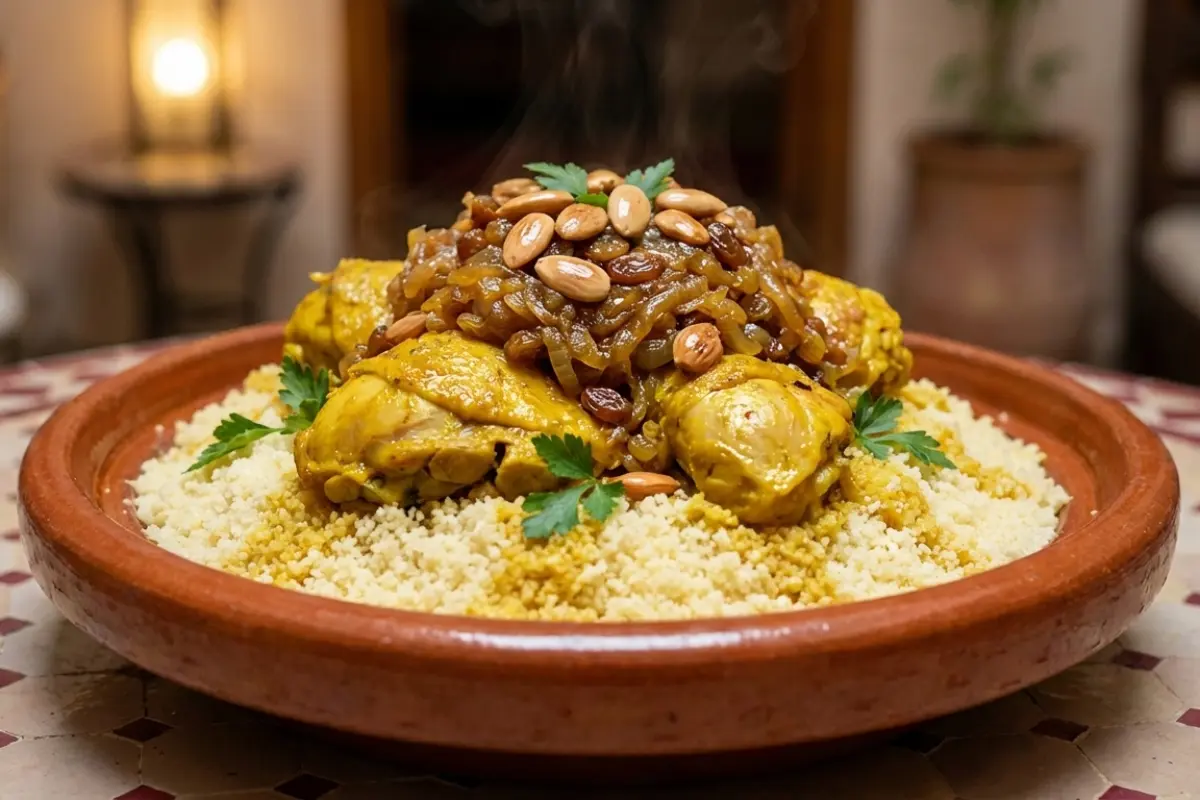
Couscous with Chicken Tfaya is the jewel of Fassi (Fez) cuisine—a dish of such perfect balance between savory and sweet, tender and crisp, simple and profound that it has been celebrated for centuries. Unlike the vegetable couscous of Friday gatherings, this version centers on tfaya: a slow-caramelized onion and raisin confit perfumed with honey, cinnamon, and saffron, which transforms humble ingredients into a topping of almost confit-like luxury.
Historical records confirm that this dish is not merely traditional but ancient. The first written reference to couscous cooked with chicken appears in the anonymous thirteenth-century Hispano-Muslim cookbook *Kitāb al-tabīkh fī al-Maghrib wa'l-Āndalus* (Cookbook of the Maghrib and Andalusia), making this one of the earliest documented Moroccan dishes in existence [citation:7]. For over 800 years, this preparation has been perfected in the kitchens of Fez, passed from mother to daughter, from the royal palaces to the humble homes of the medina.
The magic of this couscous lies in its three distinct yet harmonious components: chicken braised until butter-tender in a golden saffron-ginger broth; couscous steamed to ethereal lightness, each grain separate and dancing; and the tfaya itself—onions cooked so slowly they become sweet as jam, plumped raisins bursting with honey, and the warm embrace of cinnamon. Together, they create a dish that is simultaneously comforting and elegant, humble and celebratory [citation:3][citation:6][citation:8].
In Fez, this couscous is served for joyous occasions—family reunions, Eid celebrations, or simply when a cook wishes to express love through labor. The preparation requires patience, but the reward is profound: a taste of Moroccan culinary heritage that connects the modern table to the thirteenth-century kitchens where this dish first earned its enduring place in the hearts of the Moroccan people.
About This Recipe
Couscous with Chicken Tfaya holds a singular place in Moroccan culinary history as the earliest documented couscous dish. The anonymous thirteenth-century Hispano-Muslim cookbook Kitāb al-tabīkh fī al-Maghrib wa'l-Āndalus (Cookbook of the Maghrib and Andalusia) contains the first known written recipe for couscous cooked with chicken, establishing this preparation as one of the oldest continuously prepared dishes in the Moroccan repertoire [citation:7]. The dish originates in Fez, the imperial city that has served as Morocco's cultural and spiritual capital for over twelve centuries. Fassi cuisine is renowned for its refinement, its subtle balance of sweet and savory, and its insistence on patience and precision. Tfaya—the slow-caramelized onion and raisin confit—is quintessentially Fassi, a testament to the city's genius for transforming humble ingredients into luxurious preparations through the alchemy of time and gentle heat. For generations, this couscous was prepared for celebrations, family gatherings, and the welcoming of honored guests. The preparation itself was a ritual, often involving multiple generations of women working together—steaming the couscous three times, coaxing the onions to sweetness, toasting almonds until golden. In Sefrou, near Fez, agronomist Allal Chibane shared with visiting cooks the 'secret intricacies' of couscous making, knowledge passed from mother to daughter for centuries [citation:7]. Today, this dish remains a pillar of Fassi identity. Nargisse Benkabbou, a London-based chef of Moroccan heritage, writes that this couscous was her favorite as a child, recalling holidays spent in Fez watching her grandmother and aunts prepare 'gigantic feasts' in the old medina [citation:8]. The dish thus connects contemporary Moroccans—whether in Fez, Casablanca, or the diaspora—directly to their thirteenth-century ancestors, a living culinary tradition that has survived empires, colonialism, and modernization. It is, quite simply, the taste of Fez.
Nutritional Info (per serving)
Recipe Tags
Understanding the Ingredients
Chicken: Legs and Thighs
Authentic Moroccan chicken couscous demands bone-in, skin-on dark meat. Chicken legs and thighs (6-8 pieces) provide the fat and connective tissue necessary for a rich, silky broth. The bones add depth, the skin adds richness. Breasts, while leaner, cannot withstand 60-75 minutes of simmering without drying. For special occasions, a whole chicken cut into eighths is traditional. Seek free-range or organic poultry for superior flavor [citation:3][citation:6][citation:8].
Tfaya: The Caramelized Onion Crown
Tfaya is not merely a garnish; it is the soul of this dish. Four to six large onions are sliced into thin half-rings and cooked with near-religious patience over low heat until they transform into a golden, sweet confit—a process requiring 30-40 minutes of gentle coaxing. The onions should soften completely but never brown. Golden raisins (sultanas) are soaked until plump, then added with honey, cinnamon, and saffron. The honey caramelizes slightly, the raisins burst with sweetness, and the result is a topping of such luxurious simplicity that it elevates the entire dish. Some Fassi families add a drop of orange blossom water for ethereal fragrance [citation:3][citation:6][citation:8].
Saffron-Ginger Broth
Unlike the vegetable couscous of other regions, chicken tfaya couscous relies on a broth that is pure essence of chicken and aromatics. Saffron is non-negotiable—it provides the golden color and floral notes that define Fassi cooking. Fresh ginger (or high-quality ground ginger) adds warmth without heat. Turmeric deepens the color. Garlic, cilantro, and parsley are simmered and discarded. The broth is never thickened; its beauty lies in clarity and depth [citation:7][citation:8][citation:9].
Chickpeas and Almonds
Cooked chickpeas are stirred into the broth at the end, absorbing the saffron-ginger essence. They add substance and textural contrast. Toasted blanched almonds—whole or slivered—provide essential crunch against the softness of the chicken and tfaya. The almonds are toasted separately in butter or smen until golden, then scattered over the finished dish. Some families also include hard-boiled eggs, halved, as a traditional garnish [citation:7][citation:8][citation:9].
Moroccan Couscous Grains
This dish demands authentic Moroccan couscous, not the quick-cook variety. The grains are medium-sized, hand-rolled from durum wheat semolina. They require three rounds of steaming and fluffing to achieve the characteristic lightness—each grain separate, never sticky. The couscous is traditionally steamed over the chicken broth, absorbing its fragrance. At the end, it is moistened with a ladle of broth and enriched with butter or smen. Pearl couscous (Israeli couscous) is never used in authentic preparation [citation:7].
Step-by-Step Cooking Guide
Prepare and Steam Couscous (First Steaming)
Place 600g medium-grain Moroccan couscous in a large, shallow dish (gsaa). Gradually sprinkle 1 cup warm water mixed with 1 tsp salt over the grains, using your fingertips to moisten evenly. Immediately begin raking and rolling the couscous with circular motions, breaking any clumps between your palms. The goal is even moisture, not saturation. Let rest 10 minutes, then fluff again. Transfer to the top of a couscoussier lined with cheesecloth. Place over boiling water (not touching), seal seam with a flour-water paste or damp cloth, and steam 20 minutes after steam appears [citation:7].
Tip: The cheesecloth facilitates transferring the couscous between steamings. Do not skip the seal—trapped steam is essential for light grains. The couscous should swell but remain firm.
First Fluffing and Rest
Empty the steamed couscous back into the gsaa. Spread evenly with a wooden spatula to cool slightly. Sprinkle with 1/2 cup warm salted water while fluffing vigorously with your fingertips, breaking all clumps. The grains will expand further. Let rest 15-20 minutes, covered with a clean towel. Meanwhile, begin the chicken and broth [citation:7].
Tip: This resting period allows moisture to penetrate the grain centers. The couscous should look uniform, each grain distinct and separate.
Brown Chicken and Build Broth
In the bottom pot of the couscoussier or a large Dutch oven, heat 2 tbsp olive oil over medium. Pat chicken pieces completely dry, then place skin-side down in a single layer. Cook 5-7 minutes until golden, turn, cook 3 minutes more. Remove chicken. To the same pot, add 2 sliced onions, 4 crushed garlic cloves, 1 tsp ground ginger, 1 tsp turmeric, 1/2 tsp black pepper, 1/4 tsp saffron threads (crumbled and soaked in 1/4 cup warm water). Sauté 3 minutes. Return chicken to pot, add tied bouquet of cilantro and parsley, 1 cinnamon stick, and 1 liter water. Bring to boil, reduce to gentle simmer, cover. Cook 45 minutes [citation:8][citation:9].
Tip: Do not crowd the pan during browning—work in batches if necessary. The broth should remain at a bare simmer, not a rolling boil. Skim any foam that rises.
Second Couscous Steaming
Return the rested couscous to the steamer basket. Place over the simmering chicken broth. Reseal the seam with fresh flour-water paste or a clean damp cloth. Steam 20 minutes after steam appears. The couscous will absorb aromatic steam from the broth below [citation:7].
Tip: This second steam builds flavor. The grains should be visibly plumper and separate easily when fluffed.
Prepare Tfaya: Caramelize Onions
While chicken simmers, begin the tfaya. In a large, wide skillet, heat 2 tbsp olive oil and 1 tbsp butter over medium-low. Add 4 large onions, thinly sliced into half-rings. Cook slowly, stirring occasionally, for 20-25 minutes until the onions are completely soft, translucent, and beginning to turn golden. Do not rush—low heat is essential. Meanwhile, soak 150g golden raisins in hot water with 1 tsp orange blossom water for 15 minutes, then drain [citation:3][citation:6][citation:8].
Tip: Patience is the only secret to perfect tfaya. The onions should melt, not fry. If they begin to brown, reduce heat immediately.
Finish Tfaya: Honey, Raisins, Spices
When onions are soft and golden, add the drained raisins, 3 tbsp honey, 1 tsp ground cinnamon, 1/2 tsp ground ginger, 1/4 tsp turmeric, and a pinch of saffron threads. Stir well. Ladle in 1 cup of the hot chicken broth from the simmering pot. Simmer gently, uncovered, for 15-20 minutes until most liquid evaporates and the mixture becomes thick, glossy, and deeply golden. The raisins should be plump and bursting. Taste and adjust salt [citation:3][citation:6][citation:8].
Tip: The tfaya should be jammy, not watery. If it seems too wet, increase heat slightly to evaporate excess liquid. The honey will caramelize and create a beautiful sheen.
Third Couscous Steaming (Final)
Transfer couscous to gsaa. Sprinkle with 1/4 cup warm water mixed with 1/2 tsp salt. Fluff vigorously with fingertips, breaking all remaining clumps. Let rest 5 minutes. Return to steamer basket, place over chicken broth, seal, steam 20 minutes. The couscous is now fully cooked—taste a grain; it should be tender with no hard center [citation:7].
Tip: This final steam completes the couscous. Do not skip the resting period before steaming. The grains should be ethereally light.
Finish Chicken: Add Chickpeas
After chicken has simmered 45 minutes, add 1 can (400g) chickpeas, rinsed and drained. Continue simmering uncovered 15 minutes. The broth will reduce slightly and concentrate in flavor. The chicken should be extremely tender—almost falling from the bone. Taste broth and adjust salt and pepper. Remove cilantro/parsley bouquet and cinnamon stick. Keep warm [citation:8].
Tip: If using dried chickpeas, soak overnight and simmer with the chicken from the beginning. Canned chickpeas are added at the end to warm through without disintegrating.
Finish Couscous and Toast Almonds
Turn the finished couscous into a large, warm platter. Drizzle with 1/2 cup of the hot chicken broth, then add 2 tbsp butter or smen in small pieces. Fluff with fingertips until each grain is glossy and separate. Cover with clean towel. In a small skillet, melt 1 tbsp butter over medium heat. Add 1/2 cup blanched whole or slivered almonds. Cook, stirring constantly, 2-3 minutes until golden and fragrant. Drain on paper towel [citation:7][citation:8][citation:9].
Tip: The broth addition keeps couscous moist. The butter gives richness and sheen. Watch almonds carefully—they burn in seconds.
Assemble and Serve
Mound the couscous on an enormous, round platter, shaping a slight well in the center. Arrange the chicken pieces in the well. Ladle some of the remaining hot broth over the chicken and couscous—enough to moisten but not pool. Spoon the tfaya generously over the chicken and around the edges. Scatter toasted almonds over everything. For traditional Fassi presentation, add halved hard-boiled eggs as garnish. Serve immediately, with extra hot broth on the side [citation:7][citation:8][citation:9].
Tip: The contrast of colors—golden couscous, amber tfaya, brown chicken, white almonds—is part of the dish's beauty. Serve family-style, inviting guests to eat with their right hands, shaping the couscous into small balls.
Common Mistakes to Avoid
❌ Using Quick-Cook or Pearl Couscous
Solution: Authentic Moroccan couscous requires traditional grains that are steamed, not boiled. Pearl couscous (Israeli couscous) is a completely different product and will not yield the correct texture. Seek out medium-grain Moroccan couscous from a North African grocer. The three-steam method is essential and cannot be shortcut [citation:7].
❌ Rushing the Tfaya
Solution: Onions cooked over high heat brown and burn; they do not caramelize properly. Tfaya requires patience—20-25 minutes over medium-low heat, stirring occasionally. The onions should be soft, sweet, and pale golden, never crispy or dark brown. Rushing this step is the most common error [citation:3][citation:6][citation:8].
❌ Adding Tfaya Too Early
Solution: Tfaya is a topping, not a cooking component. It should be prepared separately and spooned over the finished dish just before serving. Adding it to the simmering broth dilutes its concentrated flavor and turns the raisins to mush [citation:8].
❌ Using Chicken Breast
Solution: Boneless, skinless chicken breast cannot withstand 60+ minutes of simmering; it becomes dry and stringy. Traditional couscous uses bone-in, skin-on thighs and legs. The bones enrich the broth, and the dark meat remains succulent. Reserve breasts for quicker preparations [citation:8][citation:9].
❌ Skipping the Couscous Steaming Ritual
Solution: Three steamings are not mere tradition—they are culinary science. Each steaming and resting period allows the grains to absorb moisture gradually, resulting in couscous that is light, separate, and tender. A single steam produces dense, sticky grains. Do not attempt to shortcut this process [citation:7].
Ingredient Substitutions
Instead of: Moroccan couscous grains
Use: If authentic couscous is absolutely unavailable, use high-quality medium-grain couscous labeled 'for steaming' (not 'instant'). Follow the three-steam method. Do not substitute pearl couscous, quinoa, or rice—the dish fundamentally changes.
Instead of: Smen (Moroccan aged butter)
Use: Unsalted butter plus a tiny pinch of fenugreek powder. Ghee also works. For the couscous finish, good-quality European-style butter is preferable to smen if the latter is unavailable.
Instead of: Fresh saffron
Use: 1/4 teaspoon ground turmeric provides golden color but lacks saffron's floral notes. There is no true substitute. The dish is vastly superior with even a small pinch of real saffron.
Instead of: Golden raisins
Use: Dark raisins, sultanas, or chopped dried apricots. Each will shift the flavor profile. Apricots are traditional in some regions and provide pleasing tartness.
Instead of: Chicken legs/thighs
Use: A whole 5-pound chicken, cut into 8 pieces, is traditional and provides both white and dark meat. Remove breasts after 30 minutes if using a whole chicken to prevent overcooking [citation:7].
Serving Suggestions
Serve on a vast, round Moroccan platter with the couscous mounded in a dome, chicken nestled in the center, and tfaya spooned lavishly over the top and cascading down the sides.
Offer extra hot broth (merqa) in a separate bowl for guests to ladle over their couscous as desired.
Traditional accompaniments: buttermilk (lben), fresh mint tea, and a bowl of dates or fresh fruit to follow.
For authentic Fassi presentation, garnish with halved hard-boiled eggs and additional toasted almonds.
The meal is eaten with the right hand; each diner shapes a portion of couscous into a ball using their fingers. Provide spoons for those who prefer them, though tradition favors the hand.
After the meal, mint tea is essential—it aids digestion and provides a sweet, fragrant conclusion.
Storage & Reheating Guide
Storage
Store couscous, chicken/broth, and tfaya in separate airtight containers in the refrigerator up to 3 days. The tfaya actually improves overnight as flavors meld. Freeze chicken and broth up to 2 months; couscous freezes poorly (texture suffers).
Reheating
To revive couscous: sprinkle with water, steam in couscoussier or covered colander over boiling water 10-15 minutes. Reheat chicken gently in its broth. Reheat tfaya separately in a small skillet. Never microwave couscous—it becomes rubbery and dense.
Tips: Leftover couscous can be transformed into bel-kedra: pan-fry with onions, eggs, and spices for a quick breakfast or lunch. This is a traditional Monday dish using Friday's leftovers.
Frequently Asked Questions
Recipe by

Similar Recipes


Our Recipe Ebooks
Discover our collection of authentic Moroccan recipe ebooks. Learn traditional cooking methods and create delicious meals at home.
The Moroccan Vegen
The Royal Moroccan Table -Part1
The Royal Moroccan Table -Part2
YouTube Channel
Watch step-by-step cooking videos, learn professional techniques, and get inspired by traditional and modern recipes from around the world.
Latest Video
"Traditional Moroccan Tagine Masterclass"