Part · Tables of Fez: A Royal Palace LegacyThe Warqa Legacy: Pastry as Palace Art
10 min
100%
/Part /Ch. 1
Chapter 1 of 6
The Warqa Legacy: Pastry as Palace Art
ورقة الأجداد: فن العجين الملكي
⏱ 10 min readOthmane DriouchMaCooking
ورقة الأجداد: فن العجين الملكي
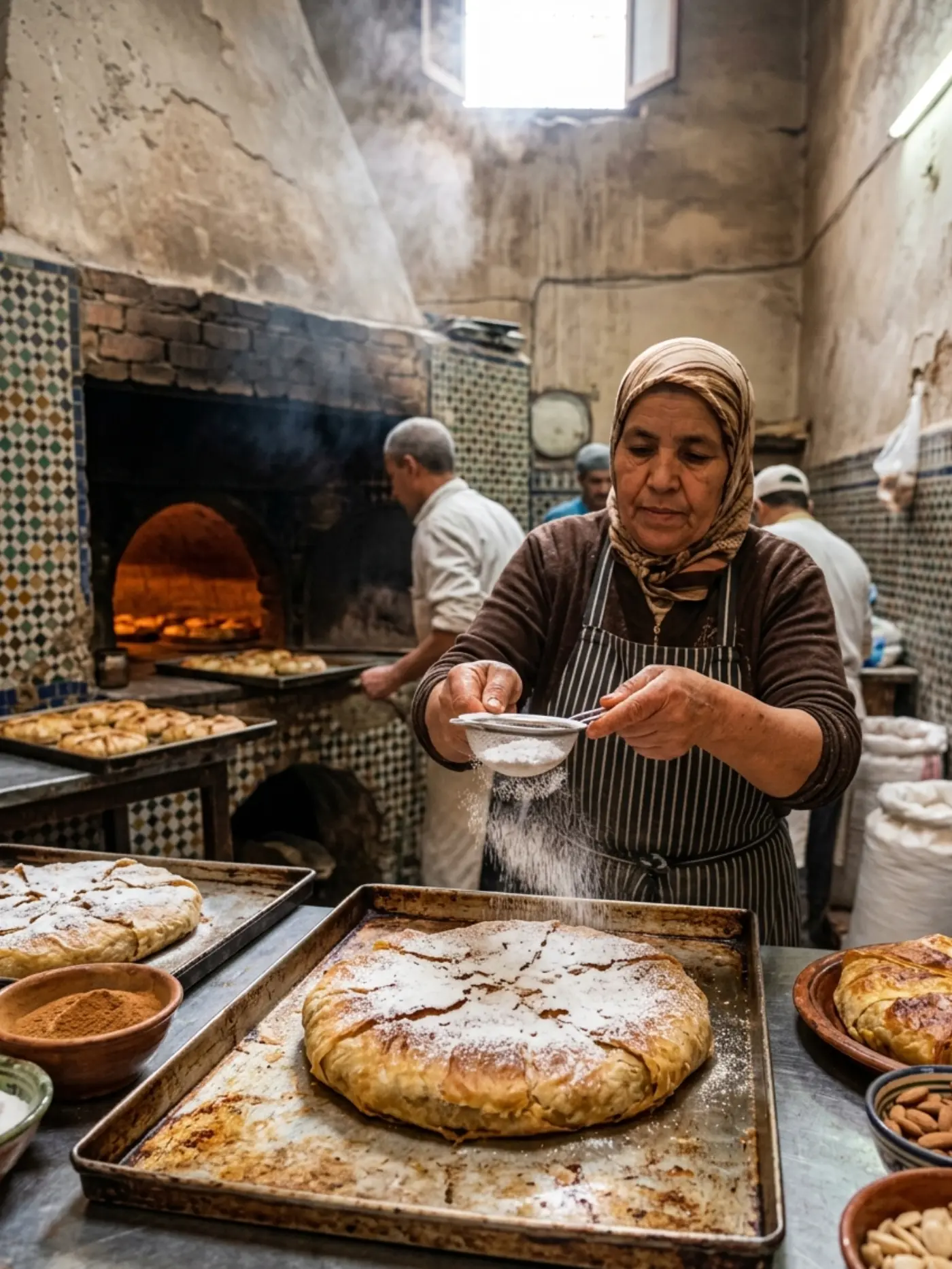
Bastilla fresh from the oven in the medina of Fes — the powdered sugar hits the crust before the dish reaches the table.
There is a moment, roughly forty seconds into the process, when you understand that warqa will not be rushed. You press the wet dough ball — the tbikha — flat against a hot copper tray in a fast circular motion, peel it back immediately, and watch a translucent disc form and dry before your eyes. Too slow and it tears. Too fast and it bunches. The dough teaches you its pace, not the other way around.
Warqa — literally 'a leaf' or 'a sheet of paper' in Darija — is the foundation of the most celebrated pastry tradition in Morocco. Food historians trace its refinement to the royal kitchens of Fes during the Marinid dynasty, when the city functioned as the intellectual and culinary capital of the Arab world. The technique shares ancestry with the warkha of Andalusia and the brick pastry of Tunisia, each descended from a common thread of thin-dough craft that stretched across the medieval Mediterranean. But the Fassi version became its own thing: finer, more precise, pressed by hand rather than rolled, built for the layered grandeur of bastilla.
Warqa does not forgive impatience. It rewards presence.
The making of warqa was first documented here in the autumn of 2014, in the kitchen of Lalla Khadija Bensouda — a maâlema, a master home cook, who had been feeding wedding parties in the Seffarine quarter of Fes for over thirty years. She made warqa every Thursday afternoon on a low round table, the tbikha in a clay bowl beside her, a copper tray balanced over a charcoal brazier. She never looked at the tray while she worked. She was listening. The sound of the dough leaving the copper cleanly — a faint, papery release — told her more than her eyes could. Eleven batches were documented that day. The first four were what Lalla Khadija called 'encouragements.' The fifth was acceptable.
📜
Why Fes Claims Bastilla
The bastilla as Fassis know it is an Andalusian inheritance — one of hundreds of culinary traditions that arrived with the Moorish refugees who poured into northern Morocco after 1492. Fes absorbed them and made the dish its own, layering pigeon, spiced eggs, and ground almonds between sheets of warqa. The name itself likely derives from the Spanish 'pastela,' though Fassis will politely dispute this etymology over tea.
Making Warqa at Home — A Practical Note
Commercial warqa, sold frozen in Moroccan supermarkets and in some specialty stores abroad, is adequate for weeknight cooking. But for any of the following recipes intended for a celebratory table, attempting the fresh version at least once is worthwhile. The difference is not subtle: fresh warqa is thinner, more pliable, and carries a faint baked-grain aroma that dried commercial sheets cannot replicate. The recipe below produces enough for one bastilla. Scale up only after practicing — the tbikha deteriorates if left too long.
Recipe 1 — Fassi Chicken Bastilla with Toasted Almonds, Cinnamon, and Orange Blossom
Recipe
Fassi Chicken Bastilla with Toasted Almonds, Cinnamon, and Orange Blossom
Serves
Serves 6–8
Prep
45 min (plus 30 min resting)
Cook
1 hour 40 min
Level
Advanced
Ingredients
1.4kg whole chicken, jointed into 8 pieces
180g white onion, grated on a box grater
60ml olive oil
1g saffron threads, bloomed in 3 tbsp warm water for 15 min
1 tsp ground ginger
1 tsp ground white pepper
1½ tsp ground cinnamon (divided: 1 tsp for filling, ½ tsp for topping)
1 tsp fine sea salt
Small bunch flat-leaf parsley (about 20g), finely chopped
Small bunch fresh coriander (about 20g), finely chopped
6 large eggs, beaten
240g blanched almonds
30ml vegetable oil (for frying almonds)
60g icing sugar (divided: 40g for filling, 20g for topping)
2 tbsp orange blossom water
14 sheets warqa or brick pastry (each approx. 30cm diameter)
60g unsalted butter, melted
1 egg yolk, beaten (for sealing)
Extra icing sugar and cinnamon for finishing dust
Method
01
STEP 1 — In a wide, heavy-bottomed pot, combine the chicken pieces, grated onion, olive oil, bloomed saffron with its water, ginger, white pepper, 1 tsp cinnamon, and salt. Set over medium heat and cook uncovered for 10 minutes, turning the chicken to coat it fully. The onion will release its water and the pan will fill with a pale, sharp steam — this is normal.
02
STEP 2 — Add 120ml of water, reduce heat to medium-low, cover, and braise for 45 minutes until the chicken is fully cooked and falling from the bone. Remove the chicken pieces and set aside to cool. Continue reducing the braising liquid over medium heat, uncovered, for 8–10 minutes until it thickens to a coating consistency.
03
STEP 3 — Add the beaten eggs to the reduced braising liquid over low heat. Stir continuously with a wooden spoon for 4–5 minutes until the eggs scramble softly and absorb the liquid — you want moist, barely-set curds, not dry scrambled eggs. Remove from heat immediately, stir in the chopped parsley and coriander, and set aside to cool.
04
STEP 4 — Fry the blanched almonds in the vegetable oil over medium heat, stirring constantly, for 3–4 minutes until golden. The moment they turn the color of pale honey, remove them with a slotted spoon — they continue cooking off the heat. Drain on paper towel, cool completely, then pulse in a food processor 6–8 times until coarsely crushed (not powdered). Mix with 40g icing sugar, the remaining ½ tsp cinnamon, and orange blossom water.
05
STEP 5 — When the chicken is cool enough to handle, pull the meat from the bones in medium shreds — not too fine. Discard all bones and skin.
06
STEP 6 — Preheat your oven to 200°C (fan 180°C). Brush a 28cm round baking tin or oven-safe skillet generously with melted butter.
07
STEP 7 — Lay 6 sheets of warqa into the tin, overlapping them so they cover the base and hang over the edge by about 10cm all around. Brush each sheet lightly with melted butter as you lay it. The overlapping sheets will form a rough circular base.
08
STEP 8 — Spread the almond mixture evenly across the warqa base. Layer the shredded chicken over the almonds. Spoon the egg and herb mixture evenly over the chicken.
09
STEP 9 — Fold the overhanging warqa sheets up and over the filling to enclose it. Lay 4 more sheets across the top, tucking their edges under the parcel. Brush with beaten egg yolk. Add a final 4 sheets on top, brush again with egg yolk, and tuck all edges neatly underneath.
10
STEP 10 — Bake for 25–30 minutes until the top is deep golden and the pastry sounds hollow when you tap it lightly with your knuckle. Allow to rest in the tin for 5 minutes before inverting onto a serving platter. Dust immediately with icing sugar, then draw crisscross lines of cinnamon across the surface using a small sieve. Serve within 10 minutes.
Chef's Notes
→
If the egg and braising liquid mixture seizes or turns rubbery in STEP 3: you cooked it on too high a heat. Remove from heat immediately, add 2 tbsp of cold water, and stir vigorously — it will loosen slightly. The texture should be just set when it comes off the stove; residual heat will firm it further.
→
If the bastilla top browns too quickly before the center sets: cover loosely with foil after 15 minutes of baking and remove for the final 5 minutes to restore the crust.
→
Warqa substitution: If using commercial frozen brick pastry, note that it is thicker and less pliable than fresh warqa. Reduce the number of base layers to 4 and top layers to 3, otherwise the pastry-to-filling ratio will be too heavy.
Recipe 2 — Pigeon Bastilla in the Palace Style (Bastilla bel Hmam)
The pigeon bastilla is the oldest form of the dish — the one that palace cooks in Fes made for sultans and foreign dignitaries. Squab pigeon (hmam in Darija) has a deeper, more mineral flavor than chicken, and the braising liquid it produces is richer and darker. Where the chicken version is approachable and celebratory, this version is serious.
Recipe
Pigeon Bastilla in the Palace Style (Bastilla bel Hmam)
1.5g saffron threads, bloomed in 4 tbsp warm water
1½ tsp ground ginger
1 tsp ground cinnamon
1 tsp ground white pepper
1½ tsp fine sea salt
½ tsp ground turmeric
1 cinnamon stick
30g flat-leaf parsley, finely chopped
20g fresh coriander, finely chopped
8 large eggs, beaten
250g blanched almonds, toasted and coarsely crushed
50g icing sugar, plus extra for finishing
1½ tbsp ground cinnamon (for almond layer and topping)
14 sheets warqa or brick pastry
70g unsalted butter, melted
1 egg yolk, beaten
Method
01
STEP 1 — In a large, wide pot, combine the pigeons, grated onion, olive oil, bloomed saffron, ginger, 1 tsp cinnamon, white pepper, salt, turmeric, and cinnamon stick. Turn the pigeons to coat. Set over medium heat and cook uncovered for 8 minutes. The onion will stick slightly to the bottom — this is where much of the flavor lives.
02
STEP 2 — Add 180ml of water, cover, and reduce heat to low. Braise for 1 hour to 1 hour 15 minutes, turning the pigeons every 20 minutes, until the meat pulls easily from the carcass. The braising liquid should be dark amber and intensely aromatic at this point — the saffron, ginger, and rendered pigeon fat will have merged into something close to a fortified stock.
03
STEP 3 — Remove the pigeons and cool for at least 15 minutes until handleable. Pull all meat from the bones in medium pieces — include the thigh and breast dark meat. Discard carcasses, skin, and cinnamon stick.
04
STEP 4 — Skim the excess fat from the braising liquid. Reduce over medium heat for 6 minutes until syrupy. Add beaten eggs and cook over low heat, stirring steadily for 5–6 minutes, until soft curds form. Fold in parsley and coriander off the heat.
05
STEP 5 — Mix crushed almonds with 50g icing sugar and 1 tbsp ground cinnamon.
06
STEP 6 — Preheat oven to 200°C (fan 180°C). Butter a 30cm round tin generously. Assemble exactly as in the chicken bastilla method (Recipe 1, Steps 7–9), layering almonds first, then pigeon, then egg mixture. Seal, brush with egg yolk, and bake 28–32 minutes until deeply golden.
07
STEP 7 — Invert onto a platter. Dust with icing sugar and trace a geometric pattern in cinnamon across the surface — palace presentations traditionally used a star or diamond grid. Serve within 10 minutes of inverting.
Chef's Notes
→
Squab availability: Fresh squab can be ordered from specialist butchers. If unavailable, use poussin (baby chicken) — the flavor is less complex but the technique is identical. Do not use mature pigeon; the braising time above is calibrated for squab.
→
The darker color of pigeon braising liquid means the egg layer will be much darker than in the chicken version — this is correct. Do not add extra liquid trying to lighten it.
→
If the pigeon meat is still firm after 1 hour 15 minutes of braising: add 60ml more water, re-cover, and continue at low heat in 10-minute increments. Squab from different suppliers vary in age and density; the pull-from-bone test is more reliable than the clock.
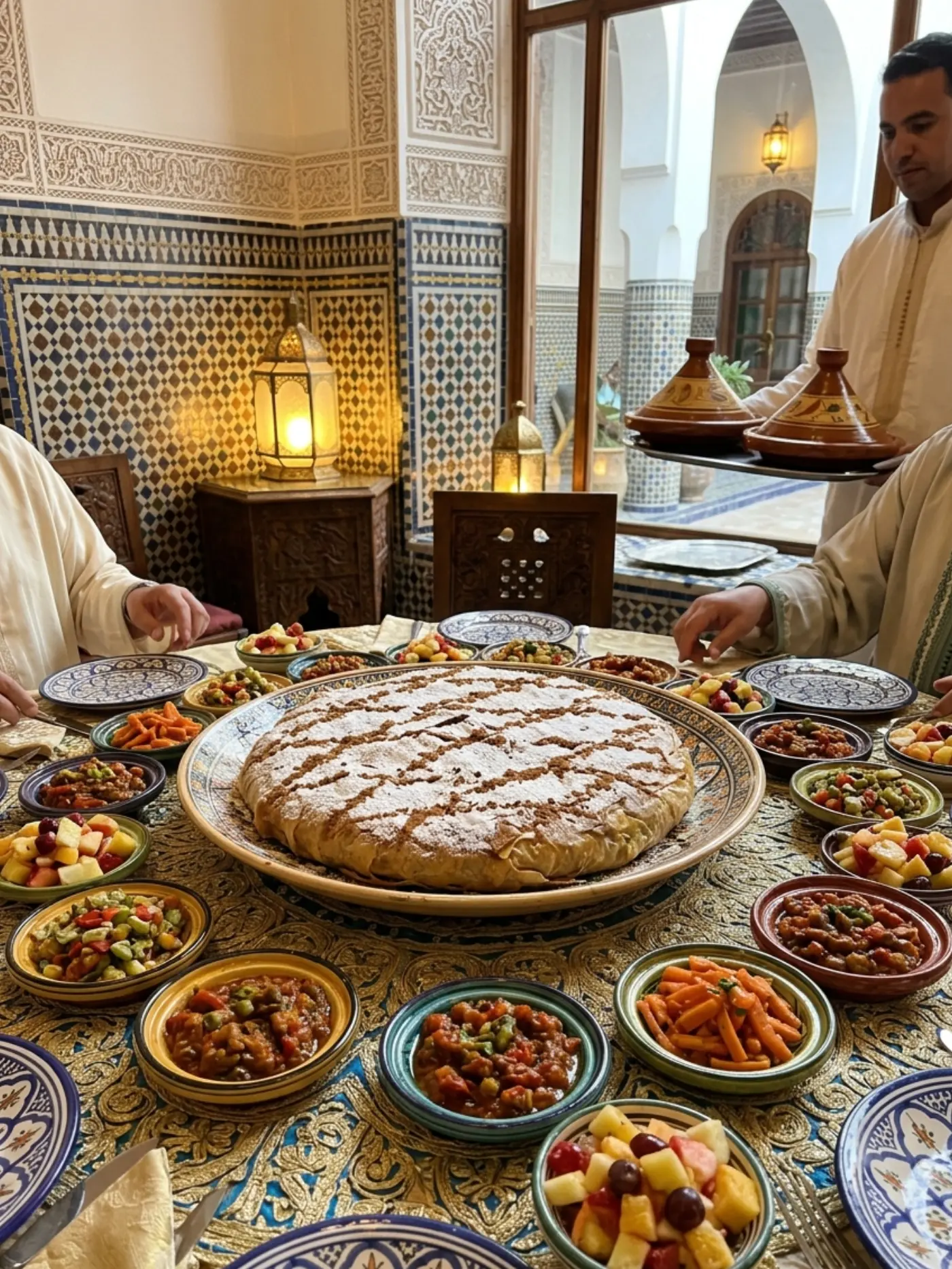
Bastilla occupies the center of the table at any serious Fassi celebration — it arrives before the tagines and after the salads.
Recipe 3 — Seafood Bastilla with Vermicelli, Chermoula, and Saffron Cream
This version is a coastal adaptation — Casablanca and Essaouira both claim it, and both have a reasonable argument. What distinguishes it from the palace versions above is the presence of saffron cream, which binds the seafood and keeps the interior moist through the baking. The vermicelli layer prevents the cream from soaking through the bottom warqa. Note that the chermoula here is used purely as a marinade component; for a full treatment of chermoula as a sauce, see the dedicated chapter in this series.
Recipe
Seafood Bastilla with Vermicelli, Chermoula, and Saffron Cream
Serves
Serves 6
Prep
40 min (plus 30 min marinating)
Cook
50 min
Level
Intermediate
Ingredients
300g raw tiger prawns, peeled and deveined
300g firm white fish fillet (monkfish or sea bass), cut into 3cm pieces
STEP 1 — Toss the prawns, fish, and squid with the chermoula. Cover and marinate in the refrigerator for 30 minutes.
02
STEP 2 — Cook the vermicelli in boiling salted water for 3 minutes. Drain, rinse under cold water, and set aside.
03
STEP 3 — In a wide pan, melt 30g butter over medium-high heat until it foams. Add the marinated seafood in a single layer and cook for 2 minutes without stirring — you want color on the prawns, not steam. Turn and cook 1 minute more. Remove from heat immediately; the seafood should be about 80% cooked at this stage. It will finish in the oven.
04
STEP 4 — In a small saucepan, combine the bloomed saffron and cream over medium heat. Bring to a gentle simmer and reduce for 4 minutes until the cream coats the back of a spoon and turns pale gold. Season with lemon juice, salt, and white pepper.
05
STEP 5 — Preheat oven to 195°C (fan 175°C). Butter a 28cm round tin. Lay 6 warqa sheets into the base, overlapping and draping over the edge, brushing each with melted butter.
06
STEP 6 — Spread the cooked vermicelli across the warqa base. Arrange the partially cooked seafood evenly over the noodles. Pour the saffron cream slowly over everything — it will settle into the layers.
07
STEP 7 — Fold the draped edges over the filling and seal with 4 more warqa sheets on top, brushing with egg yolk between each. Brush the final surface with egg yolk.
08
STEP 8 — Bake for 22–25 minutes until the top is crisp and golden. Rest 4 minutes. Invert onto a platter, dust with icing sugar and a light trace of cinnamon. Serve immediately.
Chef's Notes
→
The saffron cream must be reduced enough before pouring — if it is too liquid, it will steam the warqa from inside and produce a soggy bottom layer. Test it by running your finger across the back of the spoon; the line should hold for 3 seconds.
→
Do not overcook the seafood in STEP 3. Because it finishes in the oven, starting from 80% cooked means it arrives at 100% when the bastilla is done. Fully cooked seafood at the pan stage will be rubbery by the time it comes out of the oven.
Recipe 4 — Warqa Briouat Stuffed with Spiced Ground Lamb and Fresh Herbs
Briouat (singular: briouate) are the everyday expression of warqa — smaller, faster, and fried rather than baked. They appear at every Moroccan table during Ramadan, at family gatherings, and alongside tea. The lamb filling below is the version documented most often in the Fes medina: boldly spiced, cut through with fresh herbs, sealed in a triangle fold that keeps the hot oil out of the filling.
Recipe
Warqa Briouat Stuffed with Spiced Ground Lamb and Fresh Herbs
Serves
Makes 24 briouat
Prep
35 min
Cook
30 min
Level
Intermediate
Ingredients
500g ground lamb (not too lean — 15–20% fat)
1 medium white onion (130g), finely grated
2 cloves garlic, minced
30g flat-leaf parsley, finely chopped
20g fresh coriander, finely chopped
1 tsp ground cumin
1 tsp ground cinnamon
½ tsp ground ginger
½ tsp cayenne pepper
1 tsp fine sea salt
½ tsp ground black pepper
1 egg, beaten (for the filling)
12 sheets warqa or brick pastry, halved into half-moon strips
1 egg yolk, beaten (for sealing)
Vegetable oil for deep frying (at least 1 litre)
Method
01
STEP 1 — In a wide pan over medium heat, cook the grated onion with no oil for 3 minutes until it softens and loses most of its water — this prevents the filling from becoming soggy inside the warqa. Add the ground lamb and break it apart with a wooden spoon. Cook for 8–10 minutes, stirring regularly, until the lamb is fully cooked and the pan is dry of moisture.
02
STEP 2 — Add garlic, cumin, cinnamon, ginger, cayenne, salt, and black pepper. Stir and cook for 2 more minutes. The spices will bloom in the lamb fat and the kitchen will fill with a warm, resinous heat. Remove from heat.
03
STEP 3 — Stir in the parsley and coriander while the mixture is still hot — they will wilt slightly and become part of the filling rather than sitting on top of it. Stir in the beaten egg. Transfer to a bowl and cool completely before filling. Warm filling tears the warqa.
04
STEP 4 — Lay one half-moon strip of warqa on a clean surface, smooth side down. Place a heaped tablespoon of filling (about 30g) at one corner. Fold the corner over the filling to form a triangle. Continue folding in triangles along the length of the strip — the same motion as folding a flag. Seal the final flap with a dab of egg yolk. Repeat with all remaining strips and filling.
05
STEP 5 — Heat the vegetable oil in a deep, heavy pot to 175°C. Fry the briouat in batches of 4–5, turning once, for 2–3 minutes per side until deep amber and firm to the touch. The warqa should crackle audibly when you press it lightly — a hollow, papery sound means the layers are dry and crisp. Drain on a rack, not paper towel (paper traps steam and softens the crust).
06
STEP 6 — Serve immediately. Briouat do not hold well once fried.
Chef's Notes
→
If the briouat burst during frying: the filling was too wet (underdrained from STEP 1) or the seal was not pressed firmly enough. Ensure the lamb mixture is completely dry before filling, and press the egg yolk seal firmly for 5 seconds.
→
For advance preparation: assemble the briouat up to 8 hours ahead and refrigerate uncovered on a parchment-lined tray. Fry directly from cold — cold briouat hold their shape better in the oil and the interior heats through without the exterior overcooking.
Recipe 5 — Milk Bastilla Scented with Rose Water and Crushed Pistachios (Bastilla bel Hlib)
Bastilla bel Hlib is dessert, not dinner — it closes a formal Fassi meal the way a petit four closes a French one, except that it arrives as a full tray rather than as something delicate on a spoon. The pastry layers are fried in clarified butter rather than baked, then soaked briefly in chilled milk cream, and the result sits somewhere between a mille-feuille and a cold pudding. This version was learned directly from Hajja Zohra Alami, who served it at her daughter's engagement party in the Batha neighborhood of Fes in the spring of 2017. She chilled the finished dish for exactly two hours — no more, she said, or the cream would make the pastry heavy.
Recipe
Milk Bastilla Scented with Rose Water and Crushed Pistachios (Bastilla bel Hlib)
Serves
Serves 8–10
Prep
30 min (plus 2 hours chilling)
Cook
25 min
Level
Intermediate
Ingredients
10 sheets warqa or brick pastry
80g clarified butter (smen or ghee), melted
750ml whole milk
3 tbsp cornstarch
80g caster sugar
1g saffron threads, bloomed in 2 tbsp warm milk
2 tbsp rose water
1 tsp orange blossom water
200ml double cream, whipped to soft peaks
80g raw pistachios, roughly crushed (not ground)
30g icing sugar for finishing
1 tsp ground cinnamon for finishing
Method
01
STEP 1 — Brush each warqa sheet on both sides with clarified butter. Stack them in pairs (5 pairs total). In a dry non-stick pan over medium heat, fry each pair for 90 seconds per side, pressing gently with a spatula, until golden and rigid. They will blister slightly and smell of toasted butter — this is correct. Transfer to a rack to cool and crisp fully.
02
STEP 2 — In a medium saucepan, whisk the cornstarch into 100ml of cold milk until smooth. Add the remaining 650ml of milk, the caster sugar, and the bloomed saffron with its milk. Cook over medium heat, whisking constantly, for 6–8 minutes until the cream thickens to the consistency of loose yogurt. It should coat the whisk thickly and fall in slow ribbons.
03
STEP 3 — Remove from heat and stir in rose water and orange blossom water. Pour into a wide bowl and press cling film directly onto the surface to prevent a skin forming. Cool to room temperature, approximately 30–40 minutes, then refrigerate for a further 30 minutes.
04
STEP 4 — When the milk cream is cold but still pourable, fold in the whipped double cream in two additions — this lightens the cream considerably and gives the finished bastilla a texture closer to chilled mousse than to rice pudding.
05
STEP 5 — On a large round serving platter (at least 32cm), lay one fried warqa pair as the base. Spoon 4–5 tablespoons of cream evenly across it, leaving a 1cm border. Scatter a small handful of crushed pistachios over the cream. Place the next warqa pair on top and repeat, finishing with a final warqa layer on top.
06
STEP 6 — Pour the remaining cream slowly over the top of the assembled bastilla so it runs down the sides and pools slightly around the base. Scatter the remaining pistachios generously over the top. Dust with icing sugar and draw lines of cinnamon across the surface with a small sieve.
07
STEP 7 — Refrigerate uncovered for exactly 2 hours before serving. The cream will set the layers together into a sliceable stack. Use a sharp knife and wipe the blade between cuts.
Chef's Notes
→
If the milk cream does not thicken in STEP 2: your heat was too low. Increase to medium-high and whisk continuously — the cornstarch requires sustained heat to activate. If it still refuses to thicken after 10 minutes, mix 1 additional tsp of cornstarch with 1 tbsp cold water and whisk it in.
→
Pistachio freshness matters here. Stale pistachios turn bitter when they meet the sweetened cream. Buy raw, unsalted pistachios and taste one before using. If they taste flat or slightly rancid, the dish will show it.
What Warqa Asks of You
Every recipe in this chapter descends from the same act: pressing wet dough against a hot surface and pulling it back in one motion. That act has been performed in the kitchens of Fes for centuries — by maâlemat preparing wedding feasts, by palace cooks building towers of bastilla for diplomatic tables, by women like Lalla Khadija whose knowledge was never written down because it was assumed to be permanent. It was not permanent. It is rarer now than it was when it was first documented here.
The next chapter moves from pastry to the slow fire — to the tanjia and the tagines that cook while the city sleeps. Before leaving this chapter, make one bastilla by hand. Not from frozen pastry. The effort will answer questions about Fassi cooking that no paragraph can.
🧑🍳
Othmane Driouch
Founder, MaCooking.com — documented in Fes, Casablanca, and Essaouira, 2013–2024