Mechoui — The Royal Roast
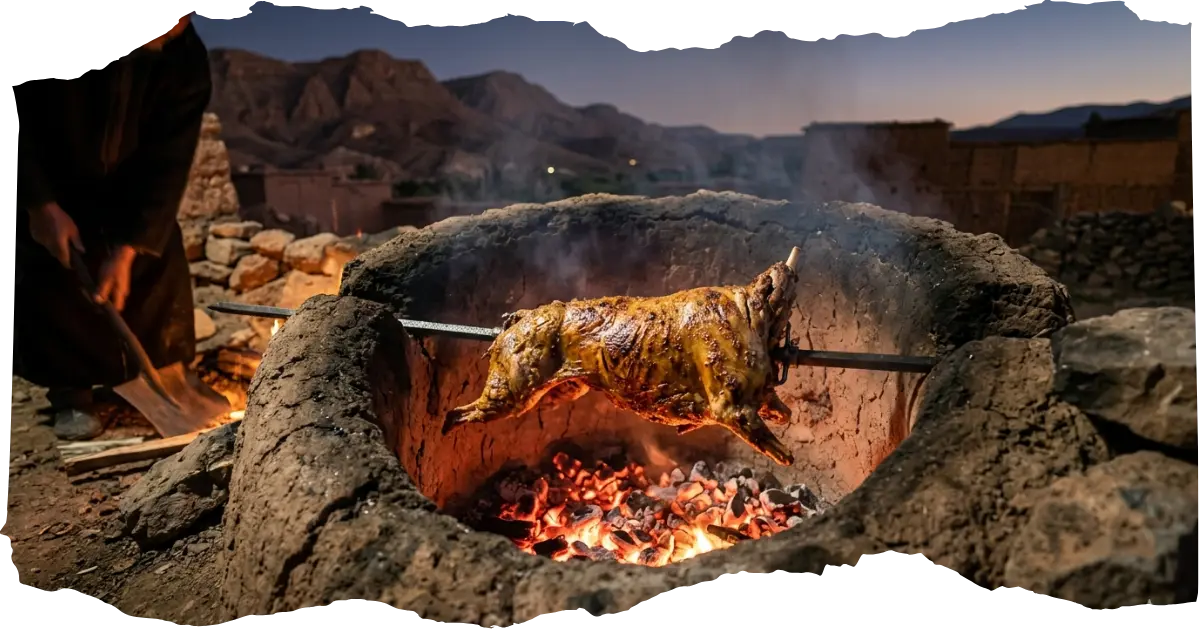
There is a moment — and every Moroccan knows it — when the whole neighborhood changes. The air shifts. Something ancient and irresistible travels street by street, over rooftops, through iron-grilled windows, past women hanging laundry and children kicking footballs in the alley. It is the smell of a whole lamb, rubbed with cumin and butter, roasting slowly over charcoal or inside a clay oven sealed with dough. It is the smell of mechoui. And it means only one thing: today, someone is celebrating.
What Mechoui Means
The word mechoui (مشوي) comes from the Arabic root meaning 'to grill' or 'to roast over fire.' But reducing mechoui to its technique is like describing the ocean as 'water.' Mechoui is the centerpiece of the most important tables in Moroccan life — weddings, circumcisions, Eid al-Adha, the arrival of honored guests, the completion of a new home, the return of a son from abroad. When a Moroccan family prepares mechoui, they are not simply cooking a meal. They are making a statement about how much they value the people sitting at that table.
In the royal courts of Morocco, mechoui has been served for centuries as the ultimate expression of karam — generosity. Historical records from the Alaoui dynasty describe entire lambs roasted on silver spits, brought before sultans and their guests on beds of flatbread, surrounded by towers of couscous and rivers of honey. When Hassan II hosted state banquets, mechoui was never absent. When Mohammed VI received foreign dignitaries, the whole-roasted lamb arrived first, before words, before wine, before any other gesture — because in Morocco, the table speaks before the host does.
In Morocco, we say 'the table does not lie.' What you serve a guest tells them exactly what place they hold in your heart.
What distinguishes Moroccan mechoui from any other roasted lamb in the world is threefold: the animal itself, the spice preparation called chermoula or smen rub, and — above all — the patience. There is no rushing mechoui. A proper mechoui for a whole lamb takes four to six hours of slow, attentive roasting. The Moroccan cook does not check their phone. They circle the fire. They baste. They listen to the meat. This meditative quality is part of the dish's meaning — the time invested is itself a form of love.
A Memory From Fes
I was nine years old when I first understood what mechoui truly was. My uncle — my father's elder brother, a man of few words and enormous hands — had returned to Fes after fifteen years working in France. My grandmother had not seen her son in four years. When we heard his taxi turn into the derb, the narrow alley outside our house in the medina, my grandmother did not run out to greet him. She was already in the courtyard, basting the lamb that had been roasting since before fajr prayer — the dawn. She had been awake since three in the morning. That lamb, rubbed the night before with preserved butter and spices, turning slowly over the coals she tended herself — that was her greeting. That was everything she wanted to say. When my uncle walked through the carved cedar doorway and smelled that lamb, he sat down on the tiled step and wept. I did not understand then. I understand now.
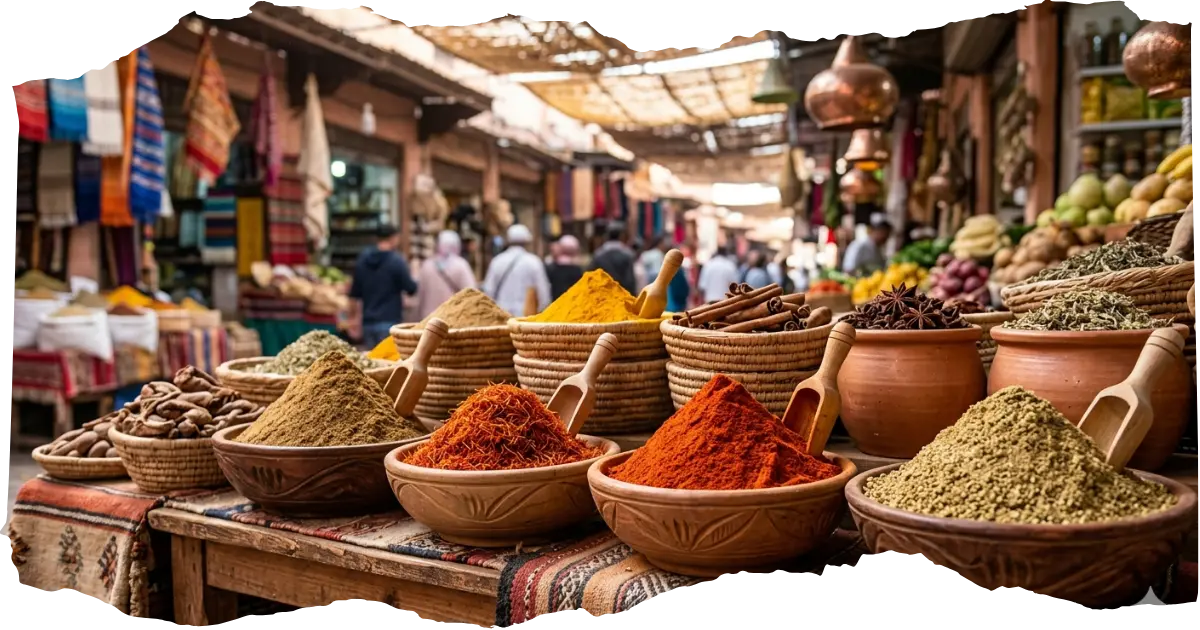
My grandmother's mechoui was Fassi-style — the tradition of Fes, which tends toward restraint and depth rather than heat. Her rub was built on smen (aged preserved butter), cumin, sweet paprika, and a whisper of saffron dissolved in warm water. No chili. No aggression. Just a slow, golden, impossibly fragrant crust that gave way to meat so tender it fell from the bone at the lightest touch. She served it the way Fes always serves it: no knife. No fork. You ate with your right hand, pulling threads of lamb and dipping them in a small plate of ground cumin mixed with coarse salt. That was all. Nothing more was needed.
The Regions Speak Differently
Morocco is not one country at the table — it is many, and mechoui reveals this beautifully. Travel from Fes to Marrakech to Tétouan to Essaouira and you will encounter four distinct interpretations of the same royal roast, each shaped by geography, climate, Berber and Arab and Andalusian history, and the particular character of the city's soul.
Fes — The Aristocratic Mechoui
As my grandmother taught me, the Fassi school prizes subtlety. The rub leans on smen — aged preserved butter with its complex, almost cheesy depth — combined with cumin, paprika, and salt. Saffron appears, always, because Fes has historically been the city of refinement and wealth. The cooking method is often a ferran — a communal wood-fired oven — where whole lambs are sealed inside on racks and left to roast with minimal intervention. The skin becomes lacquered and deep amber. The meat is white and yielding beneath it. Fes does not shout. Fes whispers, and you lean in to hear every word.
Marrakech — The Fire and the Rose
Marrakech's mechoui is bolder — there is more spice, more char, more drama. In the souks near Jemaa el-Fna, the famous mechoui stalls of the medina have been serving from underground clay pits called tanours since at least the 18th century. Whole lambs are lowered into these pits on hooks, the opening sealed with flat stones and wet clay, and left to cook in the trapped heat for up to six hours. The result has a smokier quality, a deeper crust, and Marrakchis use more cayenne in their rub — a nod to the city's proximity to the heat of the south. Rose water occasionally appears in the basting liquid, a haunting touch that perfumes the meat from within.
Tétouan — The Andalusian Touch
In Tétouan, the mountain city of the north where Moroccan-Andalusian culture runs deepest, mechoui takes on an herbal quality unfound elsewhere. The spice rub incorporates fresh cilantro paste and sometimes chermoula — the herb and lemon marinade more commonly used for fish — giving the lamb an almost Mediterranean brightness. The cooking here is often done on a spit over open wood fire rather than in a pit or oven. The fat runs and flames leap and are tamed and leap again. Tétouan's mechoui has a wildness to it that reflects the Rif mountains visible from its white terraces.
Essaouira — The Atlantic Wind
Essaouira, the blue-and-white port city where Atlantic winds never stop, produces a mechoui that carries the clean, salt-edged quality of the ocean in its character. Argan oil — liquid gold pressed from the nut of trees found only in this region of the world — replaces butter in the rub, giving the lamb a nutty, extraordinary crust. The spicing is lighter, almost delicate, allowing the quality of the animal and the argan to do the speaking. This is the mechoui of a city of artists and musicians, and it tastes like one: individual, irreplaceable, impossible to mistake for anything else.
The Complete Mechoui Recipe — Shoulder of Lamb, Fassi Style
The Table Around the Mechoui
In Morocco, mechoui is never a solitary centerpiece. It is the anchor of a table, and the dishes that surround it are as considered as the lamb itself. A traditional mechoui feast begins with a spread of salads — zaalouk (roasted eggplant with tomato and cumin), taktouka (roasted peppers and tomatoes), a carrot salad with harissa, a simple cucumber and preserved lemon plate. These are not appetizers in the Western sense — they do not precede the lamb. They are served simultaneously, creating the landscape across which the mechoui stands as a mountain.
After the lamb, if the gathering is truly a celebration, couscous arrives — a great mounded dish of semolina steamed three times with broth, topped with slow-cooked vegetables and a separate bowl of rich sauce. This is the completion of the meal, the carbohydrate that settles what the lamb has begun. At a full Moroccan feast, one does not reach for bread or couscous first. The lamb comes first, eaten with only the dipping salt, in its purity. Then the salads. Then the couscous. Then, finally, mint tea and sweets — but that story belongs to Part V.
The Mechanics of Moroccan Hospitality
When you serve mechoui at your own table — wherever in the world that table stands — you are inheriting this tradition. Bring the whole shoulder to the table on its platter. Do not pre-carve in the kitchen. Let the pulling apart happen in front of your guests, communally. Place the cumin salt in the center where everyone can reach it. Tear flatbread and pass it. Pour the pan juices. This is not just service — it is ceremony, and the ceremony is the point. The food and the ritual are inseparable.
The Art of the Whole Lamb — For When You Are Ready
The shoulder recipe above gives you mechoui within reach of any home kitchen. But let me speak briefly about the full experience — the whole lamb over fire — because to not speak of it in this chapter would be to describe the ocean from the shore and never mention the depths. A whole lamb of 12–15kg, prepared in the traditional manner, requires a mechoui pit or a tanour oven, 15 to 20 kilograms of charcoal, and a minimum of five hours. The preparation of the animal begins the evening before: the cavity is rubbed with smen and spices; the external skin is rubbed in the same manner; the legs are trussed together; the animal is sewn or pinned closed. In the morning, it is lowered into the pit or mounted on a horizontal spit and the work of tending the fire begins.
What you learn from a whole lamb that no shoulder can teach you is this: the different sections of the animal cook at different rates and develop different characters. The hindquarters, the legs, become almost crisp and intensely flavored. The loin section, across the back, yields the most elegant meat — fine-grained, perfumed with saffron and cumin. The shoulder and neck become falling-soft, collagen-rich, gelatinous in the best sense. The ribs crack away easily and are chewed to the bone. These are not simply parts of a meal. They are a landscape, and eating a whole mechoui is like traveling across that landscape with your hands.
If you are ready to attempt a whole lamb — and Part IV of this series is for those who are ready — the full instructions, including how to build a temporary mechoui pit in any outdoor space using standard materials, the charcoal-to-lamb ratios, the temperature management over five hours, and the Marrakchi tanour method using foil-sealed barrel drums as a modern approximation, are all included in the extended chapters of this volume. For now, the shoulder will take you to the same place in spirit, even if the scale differs.
What Comes Next — The Feast Continues
Mechoui is the sovereign of the Moroccan celebration table, but a sovereign without a court is only a person in a large room. The next chapter of The Royal Banquet takes you to the court — to the dish that, in many ways, is even more complex, more technically demanding, and more profoundly Moroccan than mechoui itself. It is the bastilla: the great sweet-and-savory pie of pigeon and almonds and cinnamon and eggs, wrapped in gossamer warka pastry so thin you can see your hand through it, dusted with powdered sugar and cinnamon in geometric patterns before it is served.
Bastilla is the dish that makes Moroccan cooks famous and makes visitors fall into stunned silence at the first bite. It is the dish that tells you, more than any other, that Morocco has always belonged to the highest tradition of world cuisine — that it was never a simple or rustic food culture, but one of the great sophisticated culinary civilizations. In the next chapter, I will take you through every layer of bastilla's history, from its Andalusian origins to its presence on the royal tables of Fes, and I will teach you to make warka pastry from scratch — a skill that will change what you believe you are capable of in the kitchen.
Mechoui feeds the body and gladdens the heart. Bastilla makes people ask: who taught you to cook like this? They are the two pillars of the Moroccan royal table, and between them, they hold everything up.
But before you turn the page — before the bastilla — sit with the mechoui a little longer. Make the shoulder recipe once. Eat it with your hands. Put the cumin salt in the center of the table and let whoever you have invited reach for it themselves. Notice how the act of eating this way — communally, without utensils, with the sound of flatbread tearing and the smell of saffron still in the air — changes the mood at the table. Notice how the conversation slows and deepens. Notice how people look at each other differently over a plate of lamb eaten this way. That is mechoui doing what it has always done, in every courtyard and royal hall and family kitchen across Morocco, for a thousand years. That is not a recipe. That is a form of love, written in fire and butter and time.