Foreword
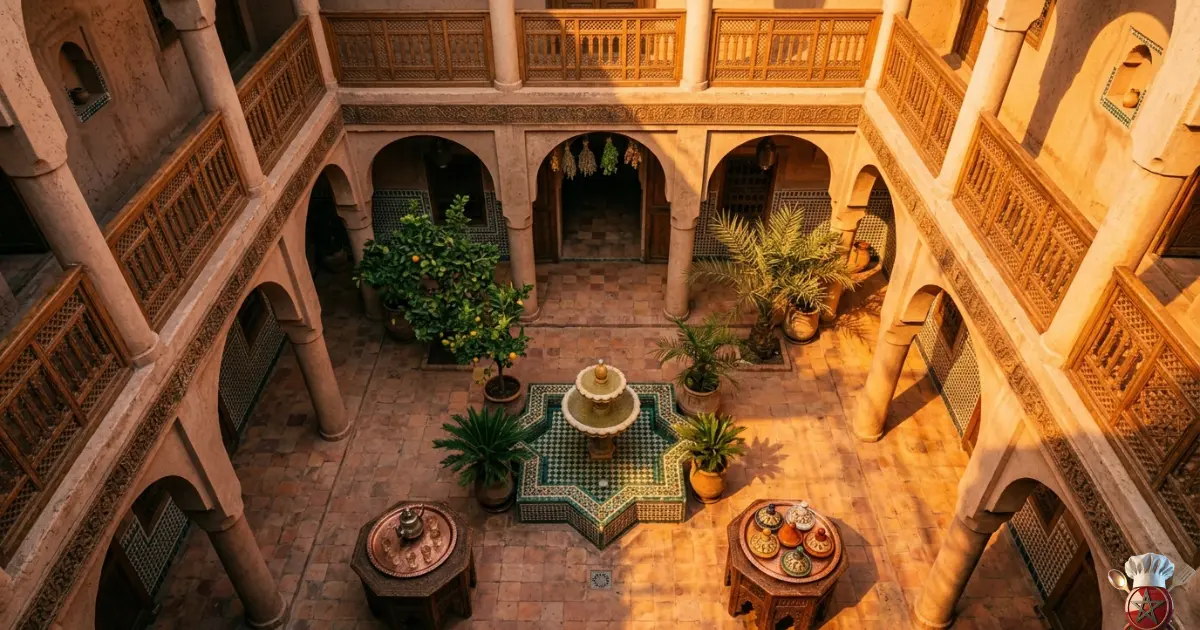
I was twenty-three years old when I first truly understood what food could be. Not in a restaurant, not in a cooking school — but sitting cross-legged on a hand-woven carpet in a riad in Fes, watching my grandmother's hands move through a cloud of steam rising from a couscoussier.
She was not following a recipe. She had no timer, no measuring cups, no written instructions of any kind. She was cooking from memory — from a knowledge passed down through her mother, and her mother's mother, stretching back centuries to a kitchen that no longer exists in a city that has changed beyond recognition.
And yet the dish she made that afternoon — a lamb tagine with preserved lemons and a handful of green olives — was the most perfectly balanced thing I have ever tasted. Sweet and salty. Tender and sharp. Ancient and immediate. I have eaten in fine restaurants across Europe and the Arab world since then, and nothing has come close.
What made it extraordinary was not the ingredients, which were simple. It was not the equipment, which was old and worn. It was not even the technique, which she performed without apparent effort or thought. What made it extraordinary was the knowledge behind it — an accumulated understanding of flavour, time, and proportion that no recipe has ever fully captured.
The cook who knows why a dish exists will always surpass the cook who only knows how.
This book series is my attempt to preserve that knowledge. Not just the recipes — there are thousands of Moroccan recipe books already, and many of them are excellent. What I want to preserve is the understanding behind the recipes: the philosophy, the history, the why. The things my grandmother never wrote down because she never needed to. The things that are disappearing, slowly but surely, as the generation that carries them ages.
Morocco sits at one of the great crossroads of human civilisation. Africa to the south. Europe barely fourteen kilometres across the Strait of Gibraltar. The Arab world at its cultural core. The ancient Amazigh people in its mountains and deserts, present for five thousand years before any empire arrived. Every one of these worlds has left something in the Moroccan pot — and the result is a cuisine of extraordinary complexity, depth, and beauty.
A Note on Authenticity
The word 'authentic' is complicated when applied to food. Moroccan cuisine has never been frozen in time — it has always evolved, absorbed, and adapted. The preserved lemon in the Fassi tagine arrived via Arab traders. The tomato in modern harira came from the Americas. The gas burner that most Moroccan cooks use today replaced the charcoal brazier only a generation ago.
When I use the word 'authentic' in this book, I mean something specific: true to the flavour principles, the technique logic, and the cultural spirit of Moroccan cooking — not necessarily true to any single historical moment or regional variation. Morocco has hundreds of regional variations for every dish. I have tried to teach the principle behind each dish, not just one version of it.
My grandmother is no longer alive. But every time I cook the dishes in these pages, I feel her hands in mine. I hope that by the time you finish this series, you will feel them too.