
Ras el Hanout
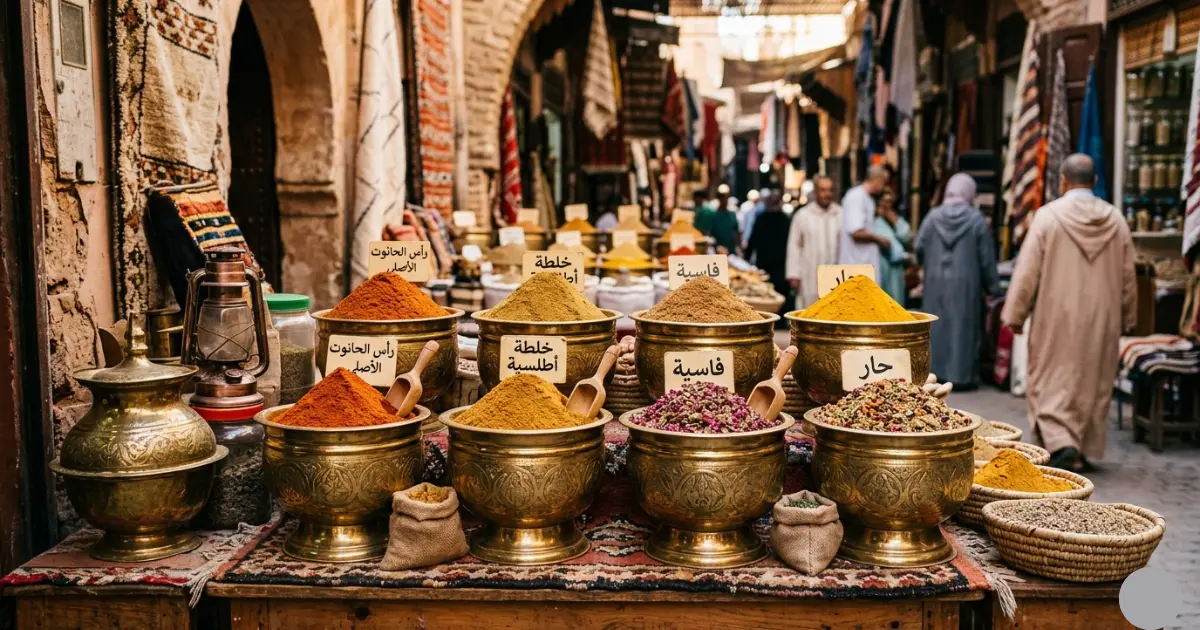
In the labyrinthine souks of Fes, when a merchant reaches for his most prized jar, he whispers ''ras el hanout''—head of the shop. This is not merely a spice blend; it is the merchant''s signature, his reputation ground into powder.
The name itself tells the story: رأس الحانوت (ras el hanout) translates literally as ''head of the shop,'' signifying the finest blend a spice merchant can offer. No two are identical. In Fes, I have tasted versions with thirty-seven spices, perfumed with Damascus rose petals and green cardamom. In the red-earth souks of Marrakech, the same name yields a darker, more muscular blend heavy with cinnamon bark and long pepper. The merchant is curator, the blend his masterpiece.
The Merchant''s Art
Walk through the Attarine souk in Fes at dawn, when the light slants golden through the wooden lattework, and you witness alchemy. Each merchant guards his ras el hanout formula like a family heirloom, passed down through generations of spice dynasties. Hajj Mohammed, whose stall I have visited for fifteen years, showed me his grandfather''s ledger—measurements recorded in archaic units, ingredients sourced from corners of the empire that no longer exist on maps.
A true ras el hanout must sing in three voices: the floral high notes, the warming middle, and the deep earthy bass. If any voice is missing, the symphony fails.
The complexity ranges from ten spices for a home cook''s version to thirty-five for a master merchant''s blend. Yet numbers tell only part of the story. The art lies in proportion and provenance: Taliouine saffron versus Spanish, Ceylon cinnamon against cassia, the difference between Meknes mint and wild spearmint from the Rif mountains. A master can identify the terroir of each component by scent alone.
Regional Expressions
Fes ras el hanout speaks with an aristocratic accent—refined, complex, perfumed with rose petals (ورد) and brightened with green cardamom from distant Kerala. The merchants of the imperial capital favor subtlety over power, creating blends that whisper rather than shout. In contrast, Marrakech versions carry the heat of the desert wind, built on warming spices like long pepper, grains of paradise, and the dark intensity of monk''s pepper.
Dried Damascus rose petals add floral perfume to northern blends. Harvest season peaks in May when entire valleys blush pink.
Peppery seeds with citrus notes, prized in southern blends for their warming bite and complex flavor layers.
Purple berries with resinous heat, traditionally added to ceremonial blends for their supposed mystical properties.
The Perfect Balance
A masterful ras el hanout must achieve what Moroccan spice merchants call التوازن الثلاثي (at-tawazun ath-thulathi)—the triple balance. Floral notes from rose and orange blossom provide the high register, warming spices like cinnamon and ginger form the middle, while earthy elements such as turmeric and cumin anchor the base. Remove any element and the blend collapses like a three-legged stool missing a leg.
Three Essential Formulas
After years of tasting and testing, I offer three approaches to this noble blend. The Classic Thirty represents the full traditional expression—what you might find in the stall of a master merchant in Fes. The Home Twelve makes ras el hanout achievable for the dedicated cook. The Restaurant Grade balances complexity with consistency, perfect for professional kitchens.
The Classic Thirty
This is ras el hanout in its full glory, requiring dedication to source and patience to balance. Begin with equal parts (1 teaspoon each) of the foundation spices: cumin, coriander, cinnamon, ginger, black pepper, and turmeric. Add half portions of cardamom pods, cloves, nutmeg, and allspice. Quarter portions bring the floral notes: dried rose petals, orange peel, and lavender. Exotic elements appear in pinch amounts: grains of paradise, long pepper, galangal, mace, monk''s pepper, and dried orris root.
The Home Twelve
For the home kitchen, simplicity serves flavor best. Combine 2 tablespoons each of cumin, coriander, and cinnamon with 1 tablespoon each of ginger, black pepper, cardamom, cloves, and nutmeg. Add 1 teaspoon each of allspice, turmeric, dried rose petals, and cayenne. Toast whole spices separately before grinding—cumin and coriander for 3 minutes until fragrant, harder spices like cinnamon and cloves for 2 minutes, delicate rose petals for just 30 seconds.
Storage and Shelf Life
Ras el hanout lives best in darkness and cool temperatures, stored in airtight glass containers away from light and heat. Whole spice blends maintain potency for eighteen months, while pre-ground versions peak at six months before the volatile oils begin their inevitable fade. I test my blends monthly—fresh ras el hanout should perfume the air when you open the container, hitting all three aromatic notes within seconds.
The merchant''s secret lies in understanding that ras el hanout is not a recipe but a philosophy—a commitment to excellence that transforms simple ingredients into aromatic poetry. In Morocco, we say that a cook who masters ras el hanout has learned to think like the spice itself: complex, balanced, and utterly essential.
Master this blend and you master the heart of Moroccan cooking. Every tagine, every mechoui, every celebration dish depends on the wisdom contained in these few spoonfuls of ground paradise. Ras el hanout is not just seasoning—it is Morocco itself, captured in a jar.