The Moroccan Spice Map
Morocco's spice map reads like an ancient manuscript, written across six distinct territories where altitude, rainfall, and centuries of cultivation have carved distinct flavor profiles into the landscape. From the saffron terraces of Taliouine at 1,800 meters to the chermoula-scented Atlantic ports, each region speaks its own aromatic dialect.
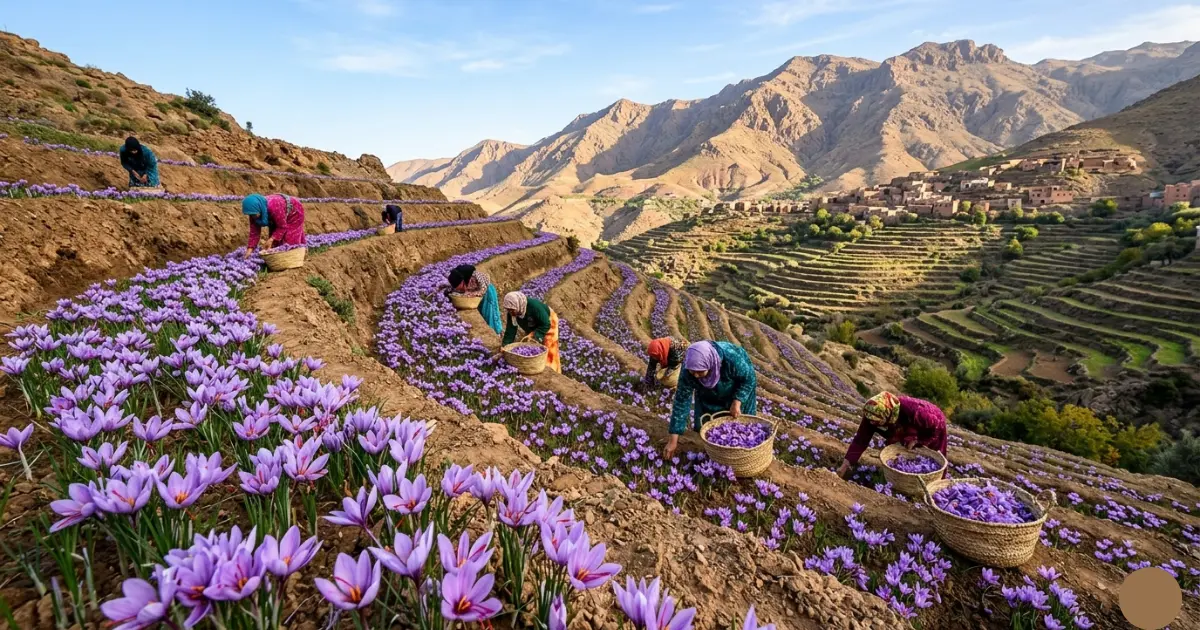
I've walked these spice territories for two decades, from negotiating with saffron farmers in Taliouine's dawn markets to watching rose petals cascade into copper stills in the Dadès Valley. Each territory evolved its spice culture around geography, climate, and the caravan routes that once connected Marrakech to Timbuktu. Understanding these six regions is understanding Morocco's culinary soul—because every dish carries the terroir of its spices.
The Six Spice Territories of Morocco
Each territory's spices carry the memory of its landscape—you taste the altitude in Taliouine saffron, the mountain wind in Rif za'atar, the ocean mist in Atlantic chermoula.
The genius of Moroccan cuisine lies in how these territorial spices dance together. A single tagine might unite Taliouine saffron with Souss cumin, Dadès rosewater with imperial ras el hanout. This is why understanding the spice map matters—every great Moroccan cook thinks territorially, combining the concentrated power of mountain spices with the delicate aromatics of the valleys.
The Twelve Foundational Spices
The backbone of Moroccan cooking, with a deep, earthy warmth that anchors tagines. Our cumin has a distinctive sweetness from the Atlantic coastal climate.
Always used dried and ground in Morocco, providing a sharp heat that cuts through rich stews. Essential in ras el hanout and kefta preparations.
The sweet spice that transforms tagines into aromatic symphonies. True Ceylon cinnamon, not cassia, for the complex sweetness Moroccan cuisine demands.
The fire that awakens all other spices. In Morocco, we use it generously, understanding its power to unlock the aromatic compounds in every blend.
The golden guardian of preservation and color. Beyond its vibrant hue, turmeric provides the subtle bitterness that balances Morocco's sweet-savory dishes.
Morocco's sweet paprika is sun-dried to develop deep, smoky sweetness without heat. This is what gives our tagines their characteristic burnt-orange color.
Navigating the Souk: A Spice Buyer's Guide
The souk spice quarter—the *'attar* (عطار)—operates by ancient codes that haven't changed since the Almoravid dynasty. In Fes, I still buy from the same stalls my grandmother visited, where spice merchants (*'attarine*) can trace their family trade back centuries. The art lies not just in knowing quality, but in understanding the seasonal rhythms that determine when each spice hits its peak.
Walk the souk in the morning when the light reveals true colors. Saffron should be deep red with orange tips—never yellow threads or powder. Cumin seeds must be uniform in color, free of the pale, flavorless seeds that mark inferior batches. The merchant who lets you smell before buying, who knows the harvest date of his saffron and the grinding date of his paprika—this is your *'attar*.
Quality reveals itself in details: fresh whole spices that crack when pressed, the oily residue good paprika leaves on your fingers, the way real ras el hanout changes color as you stir it. In the souk, trust your nose above all else. A master *'attar* will grind spices before your eyes, releasing aromatics that tell the story of their origin and age.
Seven-Territory Spice Tea
This tea represents Morocco's spice diversity in a single cup, combining aromatics from five different territories. It's what I serve visitors to demonstrate how our regional spices create harmony despite their distinct characters. The recipe follows traditional Berber tea protocols but incorporates territorial spices beyond the classic mint.
This tea tastes like Morocco itself—seven territories in conversation, each spice maintaining its identity while contributing to something greater than the sum of its parts.
The spice map of Morocco isn't just geography—it's a living system where altitude shapes aroma, where ancient trade routes still influence flavor profiles, where every territory contributes irreplaceable notes to our culinary symphony. Master these six regions, understand their seasonal rhythms, and you'll cook Moroccan food with the confidence of someone who truly knows the source of every flavor.